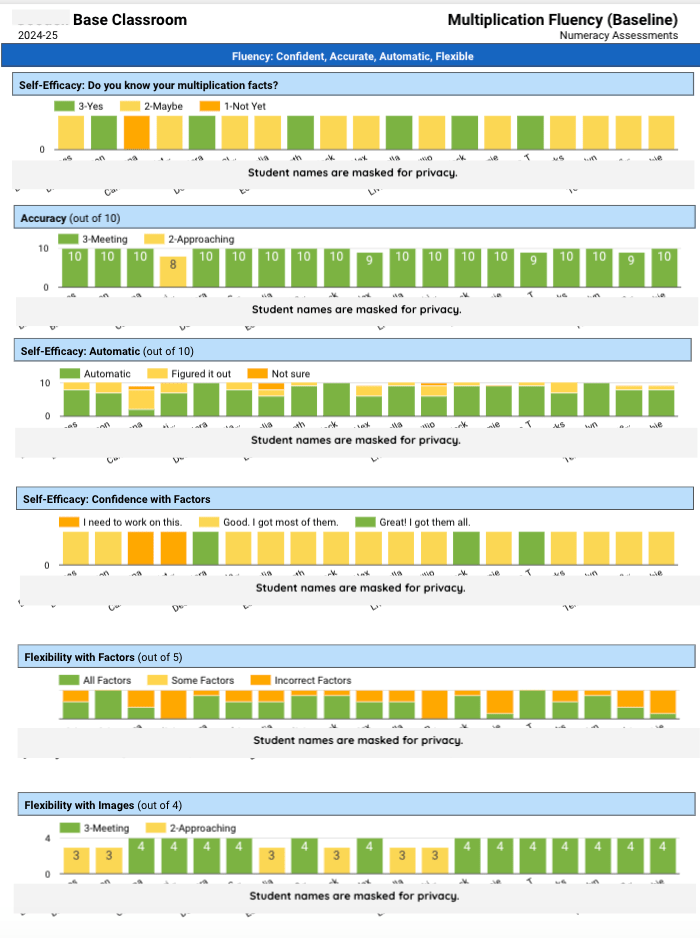
Our 4th, 5th, and 6th-grade mathematics teachers are committed to strengthening mathematical fluency in multiplication. At the beginning of the year, as a team, we work to assess our learners’ confidence and self-efficacy along with conceptual and procedural understanding of multiplication. We ask; they tell us. We spot-check to see if what they tell us matches their performance. Here’s what one class of students’ results looks like.
And, here is one student’s self-reported progress.
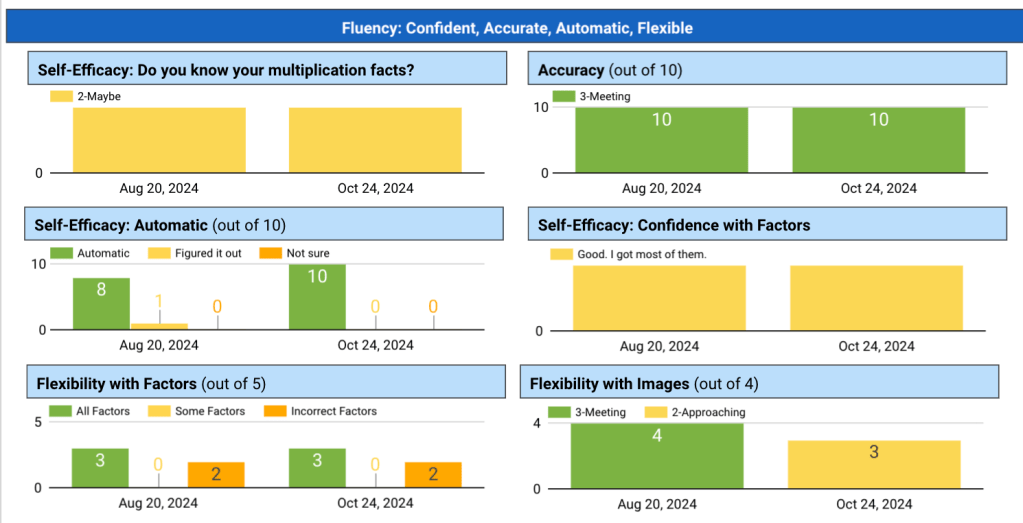
This learner reports a ‘maybe’ when asked if they know their multiplication facts even though they have 10/10 in the accuracy category with an increase in reported automaticity. Do you think this is a lack of confidence? There is evidence that this learner is accurate and automatic. It looks like factoring and divisibility rules need to be reinforced.
Here’s why this matters to us.
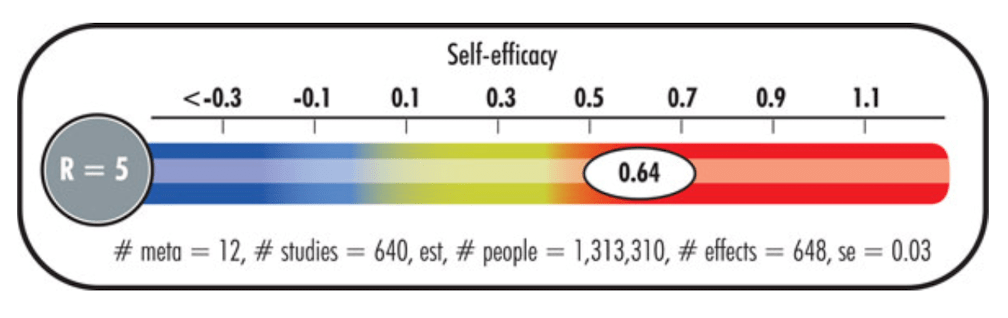
From John Hattie’s Visible Learning: The Sequel: A Synthesis of Over 2,100 Meta-Analyses Relating to Achievement:
Self-efficacy is having the confidence that one will triumph, one can do the task, one knows how to ask for help, or one knows what to do when one does not know what to do. Self-efficacy relates to judgments of our capabilities to organize and execute courses of action required to attain success criteria (Bandura, 1986). It leads to a willingness to exert effort and persist toward the goal, and is about whether a student believes they can accomplish the task. In many senses, it is the inverse of anxiety, which very much involves our belief that we cannot do the task, our fear of failure, and our questioning why we should invest effort and suffer negative consequences. Self-efficacy relates to our skills for performing the task and our confidence in the likelihood of completing the task to a sufficient level. (Hattie, 94 pg.)
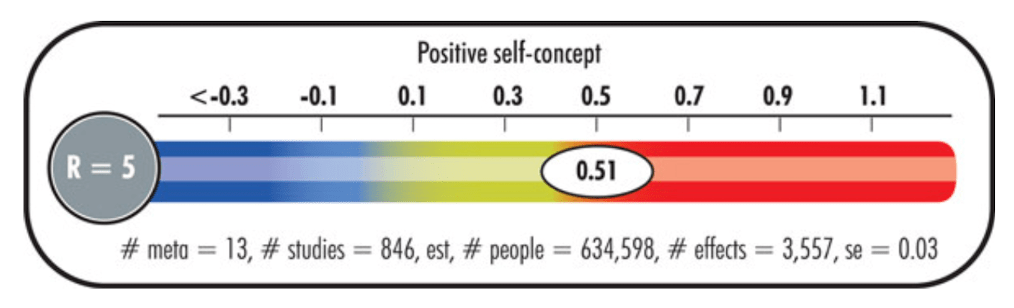
Self-efficacy relates more to confidence to engage, enact, and be successful in a task. In contrast, self-concept is broader and refers to cognitive appraisals, expressed in terms such as prescriptions, expectations, and/or descriptions that we attribute to ourselves (Hattie, 1992).
The argument here is that a sense of confidence to succeed in learning is a most powerful precursor and outcome of schooling. It is particularly powerful in the face of adversity – when things do not go right or errors are made. (Hattie, 95 pg.)
We want every learner in our care to have the efficacy to engage and be successful. It is important to remember that confidence is a most powerful precursor and outcome of schooling.
Hattie, John. Visible Learning: The Sequel: A Synthesis of Over 2,100 Meta-Analyses Relating to Achievement (p. 94-95). Taylor & Francis. Kindle Edition.
 Experiments in Learning by Doing
[…] amazed that we asked our students how they feel about what they are learning. (See earlier post: Multiplication: Student self-reported self-efficacy and confidence – here’s why it matters.) This, of course, led to more thinking, discussing, and learning about Hattie’s work around […]
LikeLike