February 12, 2025 | Damani Rec Center | EED Numeracy Team
Math Is a Playground: Sharing, Playing, Noticing
February 12, 2025 | Community Room | EED Numeracy Team
What if professional learning felt like a math classroom at its best?
This afternoon, it did. We gathered as learners—not to sit and get, but to mingle, play, experiment, and notice.
Beginning with Purpose: Share, Play, Connect
We opened with a quick game of concentration using the Tiny Dots cards, followed by a mingle and reflection to anchor ourselves in purpose and norms.
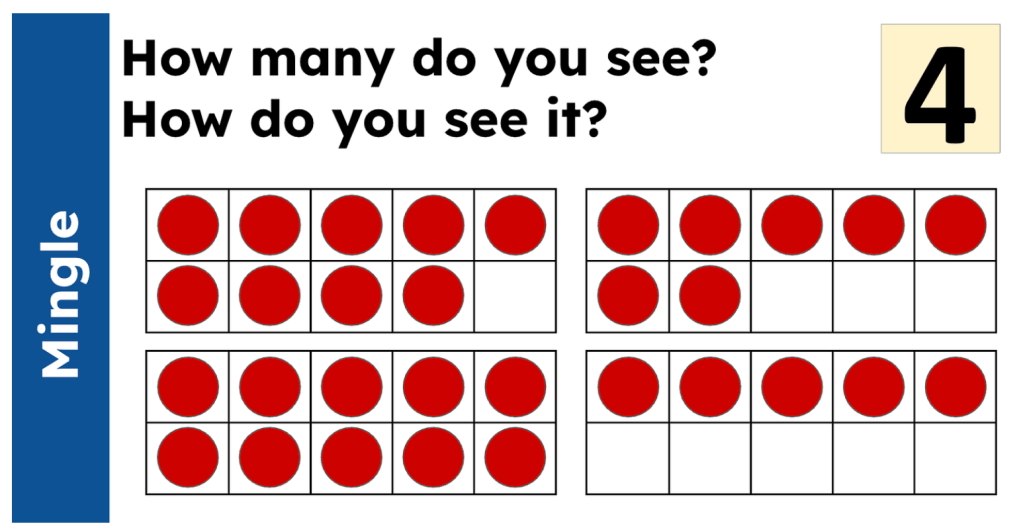
Then, a spark: Dan Finkel’s “Five Principles of Extraordinary Math Teaching”, a short video that challenges us to shift from delivery to discovery. Finkel’s message is simple and bold:
Share math with kids like it’s a story worth telling. A puzzle worth solving. A game worth playing.
We paused to consider: Where does that happen in our classrooms? Where could it happen more?
Let’s Play: Powerful, Purposeful Math
From there, we moved into more math games from Math for Love—playful on the surface, deeply mathematical underneath.
PowerDot (aka Tiny Polka Dot Challenges)
This low-floor, high-ceiling game makes number sense visible, tactile, and joyful. At one table, educators played “PowerDot War”—comparing card values and building fluency. At another, teams tackled suit-based counting challenges:
- Can you organize one suit from smallest to largest?
- What patterns emerge as you count the dots?
- What would a whole-deck representation look like?
So much math lives in those tiny dots: subitizing, counting strategies, comparing quantities, and early algebraic reasoning.
Why It Matters
These aren’t just “cute” games. They are powerful invitations to mathematical thinking. And today, we played them as students so we could teach them as professionals—more thoughtfully, more confidently, more joyfully.
Each of today’s tasks supports:
- Fluency through strategy, not speed
- Visual and concrete representations of abstract concepts
- Data collection and pattern recognition
- Mathematical conversations grounded in play and purpose
And when we make time to play together—when we pause to feel what it’s like to learn math with our hands and our voices—we walk back into classrooms with sharper tools, deeper empathy, and renewed excitement.
Let’s keep playing.
Let’s keep noticing.
Let’s keep sharing math in ways that invite wonder.
—Jill

