How do we learn and grow when we are apart? We make a commitment to read and learn every summer. We launched the following choices for summer professional learning: reading and watching.
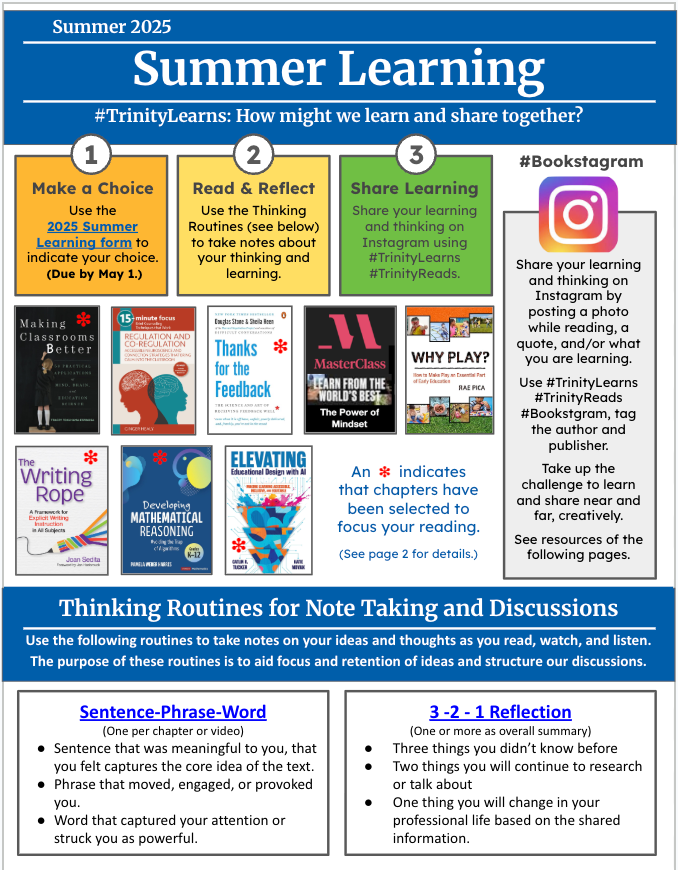
In an effort to continue our learning, but differentiate based on interest and time, we narrowed reading to selected chapters for some of the books this summer.
Here are the details of the choices:
- Why Play? How to Make Play an Essential Part of Early Education
by Rae Pica - Making Classrooms Better: 50 Practical Applications of Mind, Brain, and Education Science
by Tracey Tokuhama-Espinosa- Read: Chapter 1 and
- two of Chapters 2, 4, and 6
- 15-Minute Focus: Regulation and Co-Regulation: Accessible Neuroscience and Connection Strategies that Bring Calm into the Classroom
by Ginger Healy - MasterClass: The Power of Mindset
with Carol Dweck, Stephen Yeager - The Writing Rope: A Framework for Explicit Writing Instruction in All Subjects
by Joan Sedita M.Ed.- Read: Chapters 1- 6
- Developing Mathematical Reasoning: Avoiding the Trap of Algorithms
by Pamela Weber Harris- Read: Chapters 1, 2, 7, and
- one of Chapters 3, 4, or 5
- Elevating Educational Design with AI: Making Learning Accessible, Inclusive, and Equitable
by Catlin R. Tucker and Katie Novak- Read: Chapters 1-4 and
- one of Part II: Designing for Equity, Part III: Personalizing Learning, or Part IV: Building Resilience.
- Thanks for the Feedback: The Science and Art of Receiving Feedback Well
by Douglas Stone and Sheila Heen- Read Chapters 1-4,
- one of Chapters 5+6 or 7+8+9, and
- one of Chapters 11 or 12
We will continue to use the Visible Thinking Routine Sentence-Phrase-Word to notice and note important, thought-provoking ideas. This routine aims to illuminate what the reader finds important and worthwhile.
Sentence-Phrase-Word helps learners to engage with and make meaning from text with a particular focus on capturing the essence of the text or “what speaks to you.” It fosters enhanced discussion while drawing attention to the power of language. (Ritchhart, 207 pag.)
However, the power and promise of this routine lies in the discussion of why a particular word, a single phrase, and a sentence stood out for each individual in the group as the catalyst for rich discussion . It is in these discussions that learners must justify their choices and explain what it was that spoke to them in each of their choices. (Ritchhart, 208 pag.)
Ritchhart, Ron, Mark Church, and Karin Morrison. Making Thinking Visible: How to Promote Engagement, Understanding, and Independence for All Learners. San Francisco, CA: Jossey-Bass, 2011. Print
 Experiments in Learning by Doing