We have launched a new job-embedded professional learning course. Below is the course overview. It includes the goals for participants and the choice of resources and provides differentiated learning paths for our teachers to select a focus.
A lot has changed between 1997 and 2013 in Mind, Brain, and Education research. Over the past 16 years, technology has advanced significantly. This progress allows us to take a deeper look into working, healthy, learning human brains. Mind, Brain, and Education (MBE) principles are consistent for all brains. They remain the same regardless of cultural influence, age, race, or gender. Much of the core knowledge needed by people is embodied in MBE principles, tenets, and instructional guidelines. All teachers should know, consider, and apply these principles, tenets, and instructional guidelines when planning and facilitating learning episodes.
Course Goals for Participants
- I can deepen my understanding of current Mind, Brain, and Education research that all teachers should know and apply.
- I can implement classroom practices shown to improve learning, and I can document my practice.
- I can show and share MyLearning entries of student learning that capture growth over time based on the strategies I explored in this course.
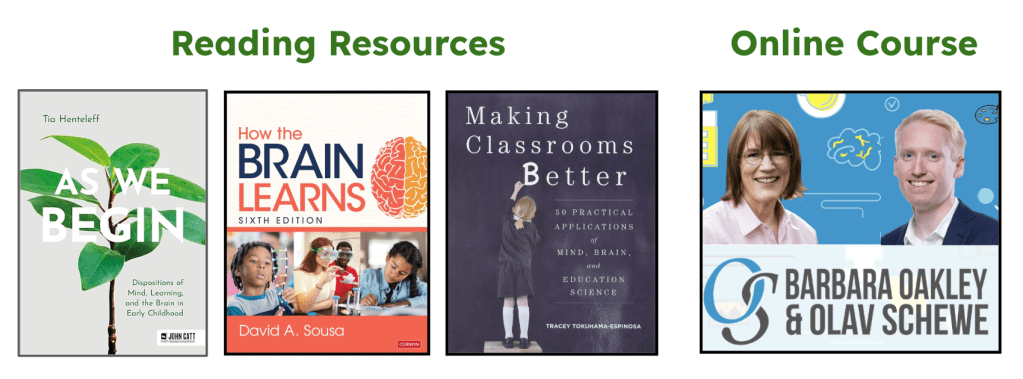
- As We Begin: Dispositions of Mind, Learning, and the Brain in Early Childhood by Tia Hentelef
- How the Brain Learns by David A. Sousa
- Making Classrooms Better: 50 Practical Applications of Mind, Brain, and Education Science by Tracey Tokuhama-Espinosa
- Learn Like a Pro: Science-Based Tools to Become Better at Anything with Barbara Oakley and Olav Schewe (edX course)
First Paths and Descriptions:
Early Childhood Path
- Combines a social-emotion path with an academic path: The early focus will be on dispositions toward learning. We know that memory and attention are essential for learning. Learning cannot happen in the brain without these two key ingredients. Feelings are the gateway to memory and attention.
- Resource: As We Begin: Dispositions of Mind, Learning, and the Brain in Early Childhood by Tia Hentelef
Social-Emotional Path
- Significant advances in MBE have been made over the past decade. These advances come from the field of emotions and affective neuroscience. We know that affect greatly affects how, why, and when a person can learn. Good learning environments are made, not found. Well-managed classes take advantage of natural human attention spans. Good classroom activities take advantage of the social nature of learning. Good teachers understand the mind-body connection (sleep, nutrition, exercise). Good teachers understand how to manage different students.
- Resources: Making Classrooms Better: 50 Practical Applications of Mind, Brain, and Education Science by Tracey Tokuhama-Espinosa, How the Brain Learns by David A. Sousa, and Learn Like a Pro: Science-Based Tools to Become Better at Anything with Barbara Oakley and Olav Schewe
Academic Path
- All new learning passes through the filter of what we already know. Making explicit connections to our knowledge base aids learning. The early focus will be planning activities using spaced practice, retrieval, and formative assessment.
- Resources: Making Classrooms Better: 50 Practical Applications of Mind, Brain, and Education Science by Tracey Tokuhama-Espinosa, How the Brain Learns by David A. Sousa, and Learn Like a Pro: Science-Based Tools to Become Better at Anything with Barbara Oakley and Olav Schewe
Sessions
- Session 0 (Pre-Planning): Neuro-myths, Neuro-facts, and Getting Started on a Path
- Session 1 (Sept. 11, Asynchronous): Working on the Selected Path
- Session 2 (Oct. 30, Face-to-Face): Show and Share Learning and Selecting a Next Path
- Session 3 (Nov. 13, Asynchronous): Working on the Selected Path
- Session 4 (Dec. 4, Face-to-Face): Show and Share Learning and Selecting a Next Path
- Session 5 (Feb. 12, Asynchronous): Working on the Selected Path
- Session 6 (Mar. 26, Face-to-Face): Show and Share Learning and Selecting a Next Path
- Session 7 (Apr. 16 Asynchronous): Working on the Selected Path
- Session 8 (Apr. 30, Face-to-Face): Show and Share Learning and Celebration of Learning
 Experiments in Learning by Doing
[…] the course, learn together, and pick initial resources. (If you’d like to know more, the plan, design, and proposed organization were shared in this previous post.) Here’s the shared […]
LikeLike
[…] tells us about learning in the intersection of neurology, psychology, and education. There’s a course plan, outline, differentiated resources, and the learning has begun. Session 1 was asynchronous and planned so that we had time to read, […]
LikeLike
[…] PD Planning for MBE […]
LikeLike