I love my school and our teachers! During New Faculty Academy, we looked at the data we are collecting and monitoring. Our new-to-Trinity teachers were amazed that we asked our students how they feel about what they are learning. (See earlier post: Multiplication: Student self-reported self-efficacy and confidence – here’s why it matters.) This, of course, led to more thinking, discussing, and learning about Hattie’s work around self-efficacy and positive self-concepts.
From John Hattie’s Visible Learning: The Sequel: A Synthesis of Over 2,100 Meta-Analyses Relating to Achievement:
The argument here is that a sense of confidence to succeed in learning is a most powerful precursor and outcome of schooling. It is particularly powerful in the face of adversity – when things do not go right or errors are made. Having high levels of confidence (the specific wow factor in growth and grit claims, i.e., can do, want to do) can assist in getting through many roadblocks. Such high concept leads to students invoking learning rather than performance strategies, accepting rather than discounting feedback, benchmarking to challenging rather than easy goals, comparing themselves to subject criteria rather than to other students, possessing high rather than low efficacy in learning, and invoking self-regulation and personal control rather than learned helplessness in the academic situation. The key dispositional factors that relate to achievement are the willingness to invest in learning, gain a reputation as a learner, and show openness to experiences. (Hattie, 95 pg.)
We decided to ask our young learners how they think they are performing in spelling and vocabulary, reading, and writing. After a little design work with Marsha Harris, Director of Curriculum, and Jayna Cook, Literacy Instructional Specialist, we met as a teaching team to discuss how to launch with our students. We agreed on a time and date, and I launched this idea with our students and their teachers. (There are no pictures because I was teaching. Rats!)
I selected one class’s data to share what we know now.
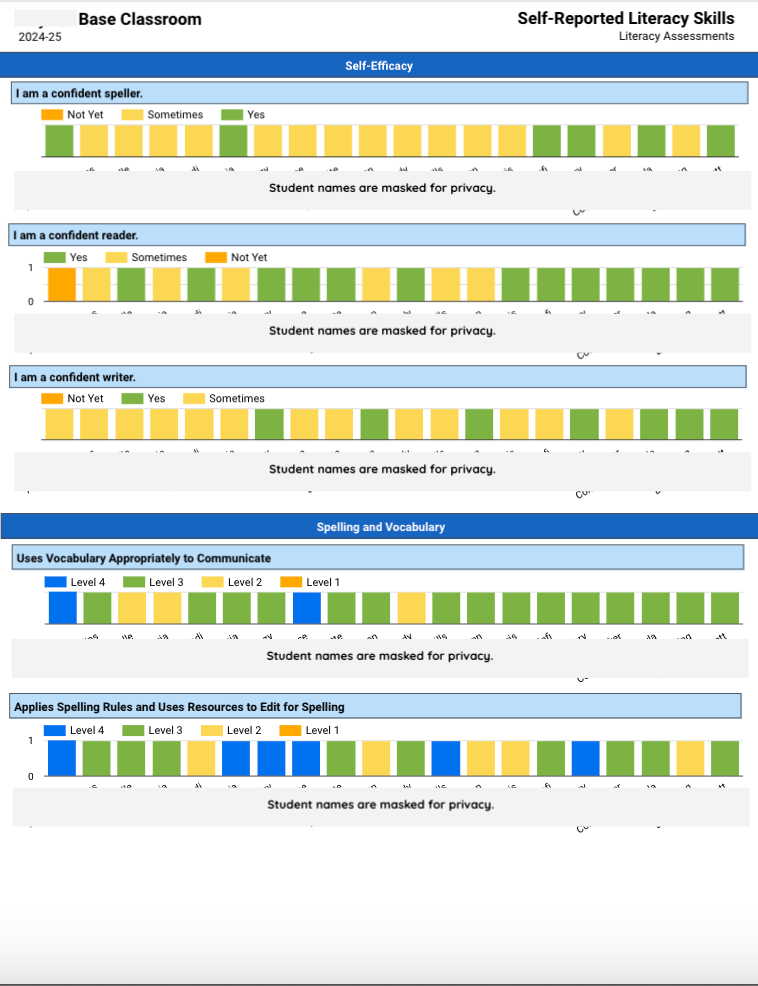
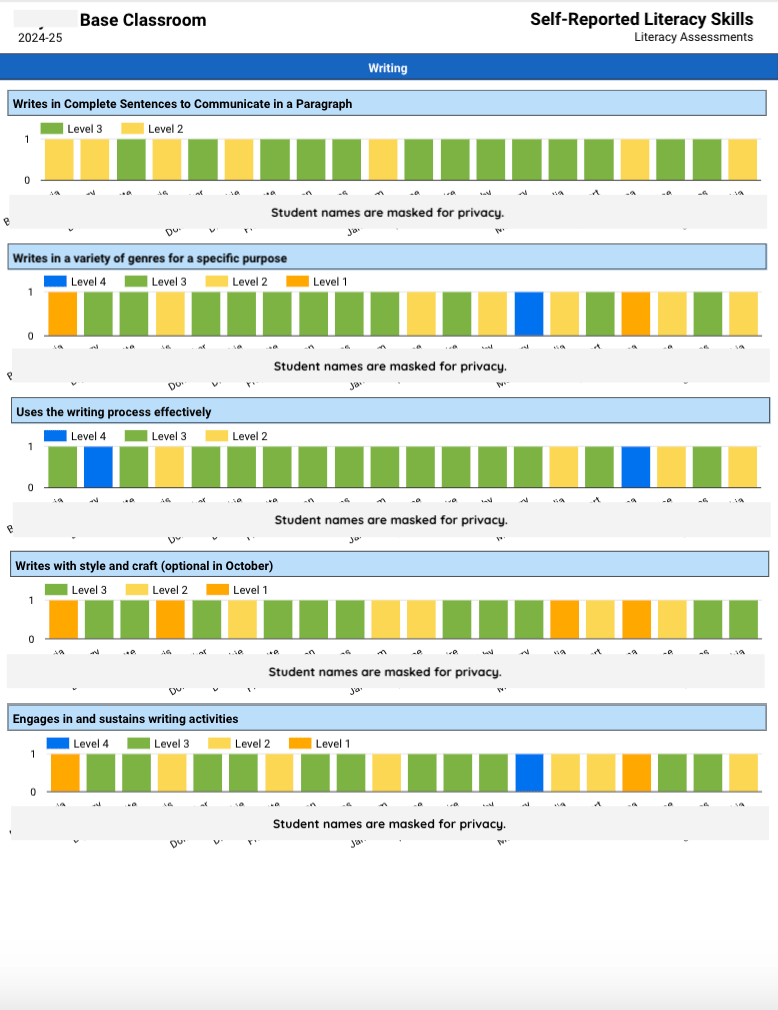
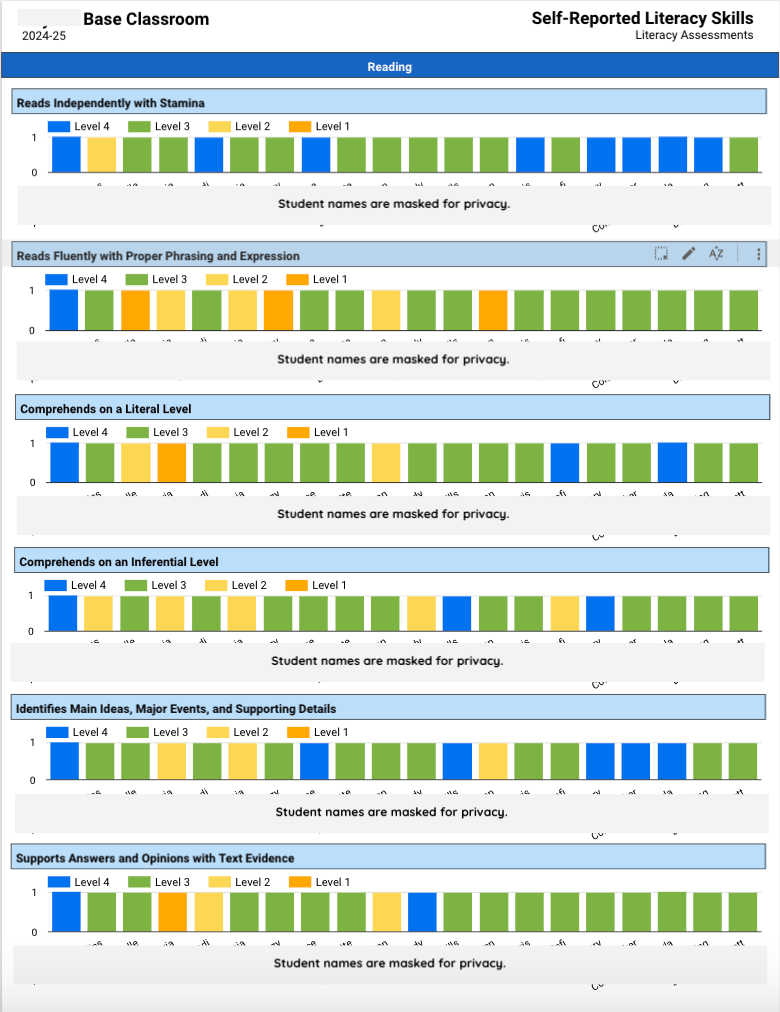
One of our pillars is to Empower Students in Their Learning: foster a growth mindset, cultivate voice, choice, and self-reflection, and promote leadership. The cobalt blue you see in the data above indicates the learners feel they are exceeding our expectations. Green indicates they feel they are meeting the current learning goals. Yellow tells us that they feel they are almost working at the current benchmark, while orange says they are not there yet.
Again, from John Hattie:
Such high concept leads to students invoking learning rather than performance strategies, accepting rather than discounting feedback, benchmarking to challenging rather than easy goals, comparing themselves to subject criteria rather than to other students, possessing high rather than low efficacy in learning, and invoking self-regulation and personal control rather than learned helplessness in the academic situation.
The data above gives our teachers a snapshot of their class as a whole. We also take the time to look at each learner’s data as an individual.
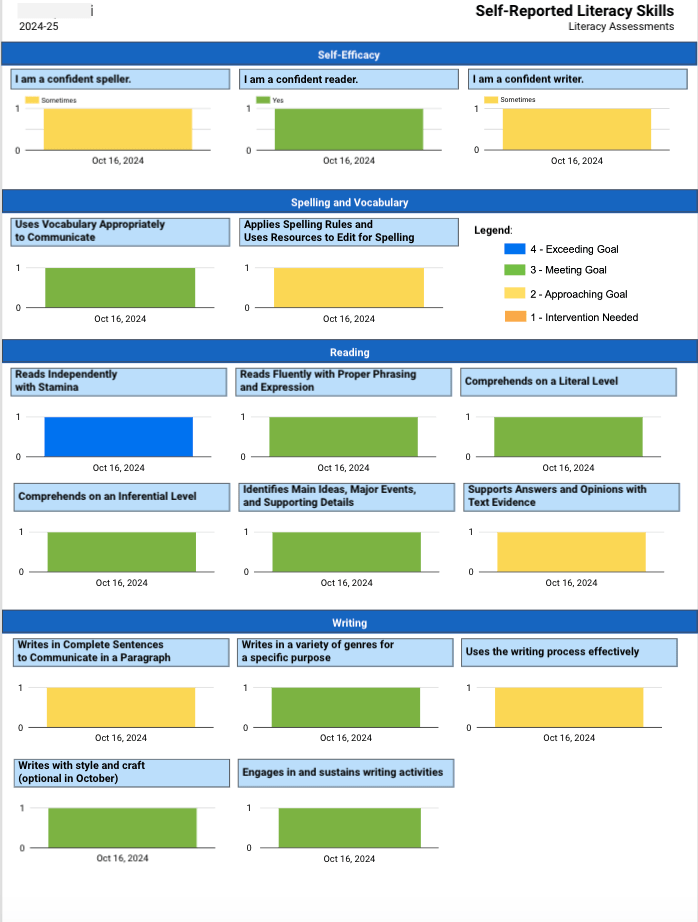
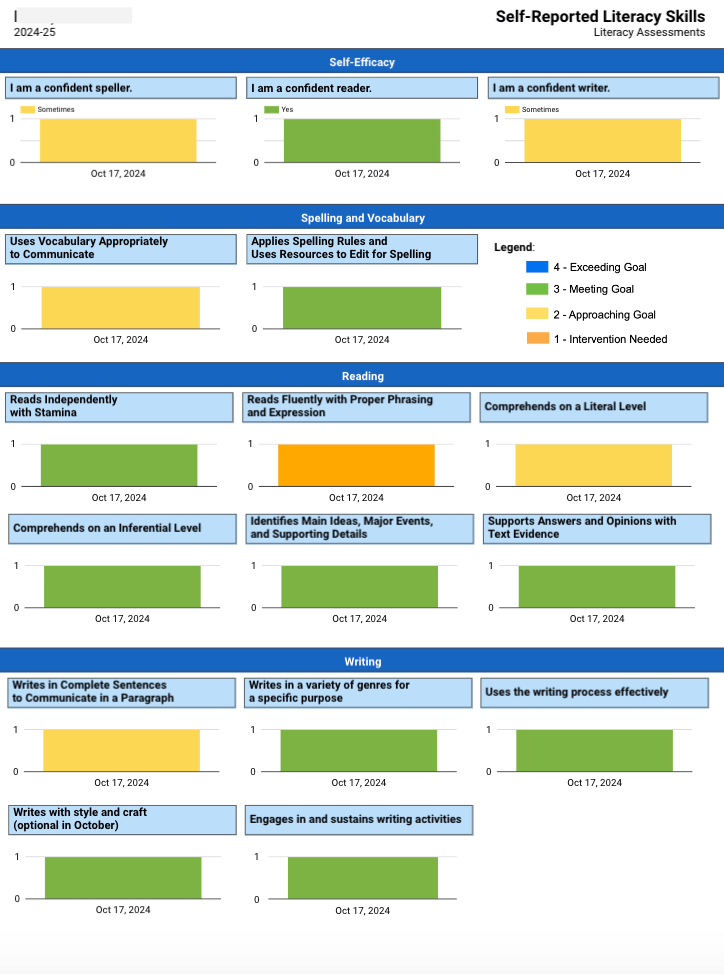
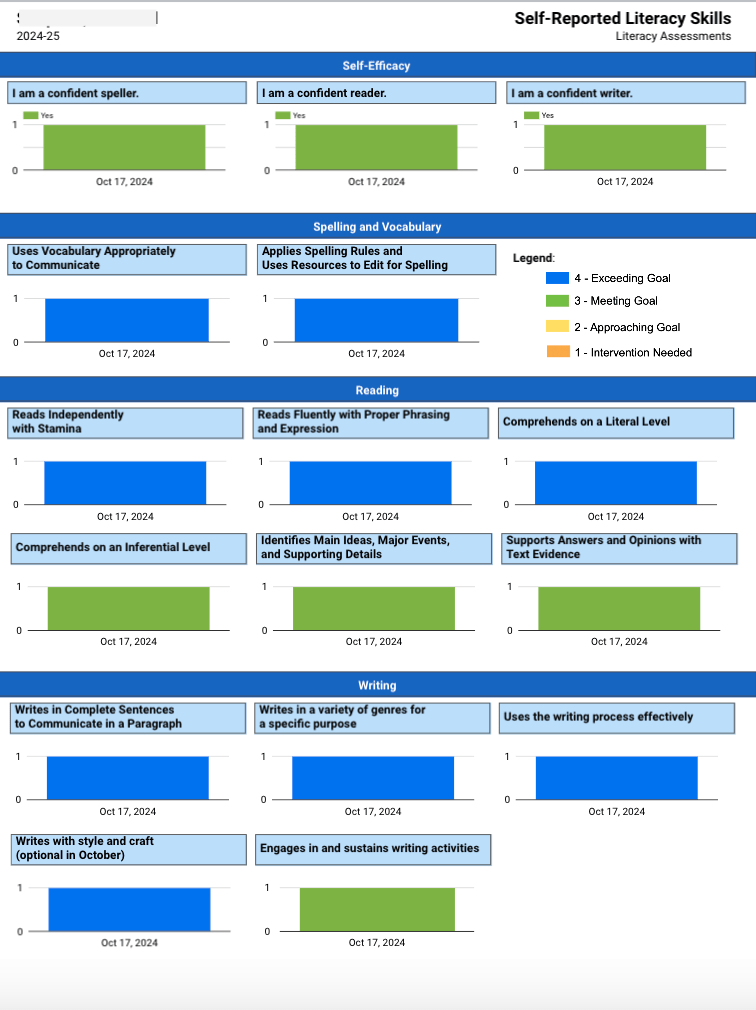
See what can be learned by viewing one learner’s data at the time? It is interesting to me to see the first young learner reports “Sometimes I’m a confident reader,” and “I can apply strategies to help me maintain my stamina and understanding of complex texts.” I do know that I am a confident reading most of the time – the genre matters. The second learner lets us know that they can read aloud, but they are not yet to a point where they can say “I can read aloud to match the text’s mood, tone, and characters.” In our third example, we see a learner that feels confident and successful. Every learner is different. Our goal is to foster a growth mindset as well as cultivate voice, choice, and self-reflection in each student.
No one knows if these data are accurate. We know they represent each student’s perception of how they are performing and feeling. We know more about our students, and we have talking points when we conference with them.
And, they know we value what they think and feel.
Hattie, John. Visible Learning: The Sequel: A Synthesis of Over 2,100 Meta-Analyses Relating to Achievement (p. 95). Taylor & Francis. Kindle Edition.
 Experiments in Learning by Doing