As a community, we continue to learn. At Pre-Planning, we pitched a system of teacher-choice levels of observation opportunities. Marsha Harris and I were invited to observe 4th-grade math at the same time. I have the privilege of observing Marcia Twiggs, Monique Glafcke, and their students.
Visited Teachers: Marcia Twiggs and Monique Glafcke
Date Visited: 11/18/2024
Class or Grade: 4th Grade Numeracy: An Assortment of Fractions
Observer: Jill Gough
9:15
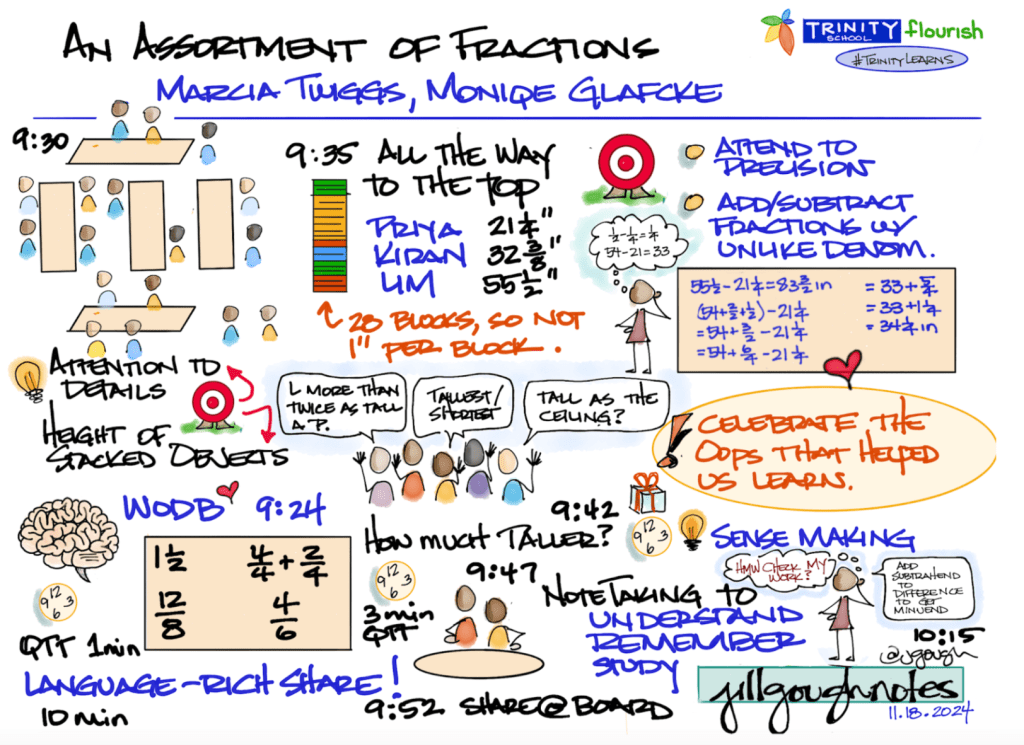
Students returned from Specials classes at 9:15. Quickly, they organized themselves and their materials with very little prompting from the teachers, indicating strong routines in place in the classroom. Marcia’s opening remarks briefly indicated that based on the results of Friday’s check-point, more attention to detail would be emphasized as they began today’s lesson on the height of stacked objects in IM’s An Assortment of Fractions lesson.
9:24
Students were already engaged, warming up their brains, with a WODB task asking them why one of the following is not like the others: 1 1/2, 4/4 + 2/4, 12/8, and 4/6. Quiet think time (QTT) was offered to students for approximately 1 minute. Students were encouraged to write about their thinking and to come up with more than one way these fractions could be classified as alike and different. For approximately 10 minutes, Marcia probed and questioned students about their mathematical thinking on this task. Answers varied, and some were repeated. All answers were given using appropriate, precise mathematical language. Some answers were:
- 1 1/2 is the only mixed number.
- 1 1/2 is the only one that has a whole number.
- 12/8 is the only improper fraction.
- 12/8 is the only fraction with a numerator greater than 10.
- 4/4 + 2/4 is the only choice written as an expression.
- 4/6 is the only fraction less than one.
- 4/6 is the only fraction not equal to 1 1/2,
- A, B, and C are equivalent fractions. D is the only fraction not equivalent to 3/2.
As students shared their thinking, Marcia positively reinforced the language-rich discussion the students were having. Their precise use of mathematical vocabulary was correct and consistent.
9:35
Students transitioned to the task for the period. Students were shown Priya’s Lego tower, which is 21 1/4 inches in height. Additionally, students were provided with more data: Kiran’s tower of Legos was 32 3/8″, and Lim was 55 1/2″ in height. They were asked to notice and wonder about the different towers based on the image and the information given. Students noticed Lim’s tower was over twice as tall as Priya’s. Students ordered the towers from tallest to shortest. In cherishing childhood and offering the gift of time to connect with the context, Marcia and Monique playfully let the students wonder if Lim’s tower was as tall as the classroom ceiling.
9:42
Students were tasked with determining how taller Kiran’s and Lim’s towers were than Priya’s. Students were given 3 minutes of quiet think-time to work independently and show their work in the workbook. Marcia and Monique floated around the room, observing students thinking and encouraging/reminding students to work independently – to see what they know and can do by themselves.
9:47
Students partnered up to discuss their work, answers, and how they approached solving the problems.
9:52
A pair of students were asked to show their thinking to the class. Marcia kindly and firmly asked one student to let the other student have the floor. The student at the board decomposed 55 1/2 into 54 + 2/2 + 1/2. Marcia’s facilitation was excellent, coaching this student to share their thinking. When done, Marcia noticed and shared with the class that she sensed some confusion since this method – a correct method – was not how most of the class solved the task. Marcia encouraged students to think, “What is 1/2 – 1/4?” And, “What is 55 – 21?” Marcia confirmed that there are many ways to solve this problem correctly. Marcia reinforced that we “celebrate the Oops! that causes us to or helps us to learn.” I appreciated the slow pace of the sharing so that students had time to make sense of an approach different from theirs.
10:05
Marcia reminded the class about the importance and the purpose of note-taking. We take notes to understand, to remember, and to study. You should take notes if a strategy is unfamiliar to you. Monique reinforced note-taking as Marcia quickly debriefed the difference between Kiran’s and Priya’s towers, modeling finding common denominators with 1/2 and 3/8.
10:10
Marcia reminded students to check their work using inverse operations and reinforced additional mathematical language. “To check your subtraction, add the subtrahend to the difference to get the minuend.”
10:15
The observation ended as students worked on the next task: would the combined towers touch the ceiling?
Strengths observed:
- Clear, established classroom routines and norms. Students were prepared and ready initially and throughout the class, working at tables or the rug, moving to work with this month’s assigned partner, and going back into note-taking form.
- Clear learning goals were highlighted at the beginning of class and reinforced throughout the learning episode.
- Off-task, distracting, and inappropriate behaviors were kindly and firmly corrected quietly and in the moment. As students were working on note-taking, Marcia quietly counseled a student on what to do instead of doing nothing when finished early.
- Both teachers were engaged – differently – with our students. Strong, patient facilitation, attention to individual students, and positive reinforcement of student strengths were evident again and again.
- Well-planned lesson and coordinated teamwork.
- Strong leveraging of social learning.
- Emphasis on both content and mathematical practices. It was clear that students were learning/practicing
- Adding/subtracting fractions with unlike denominators
- Making sense and persevering
- Attending to precision in both English and Math
Photos from the lesson:
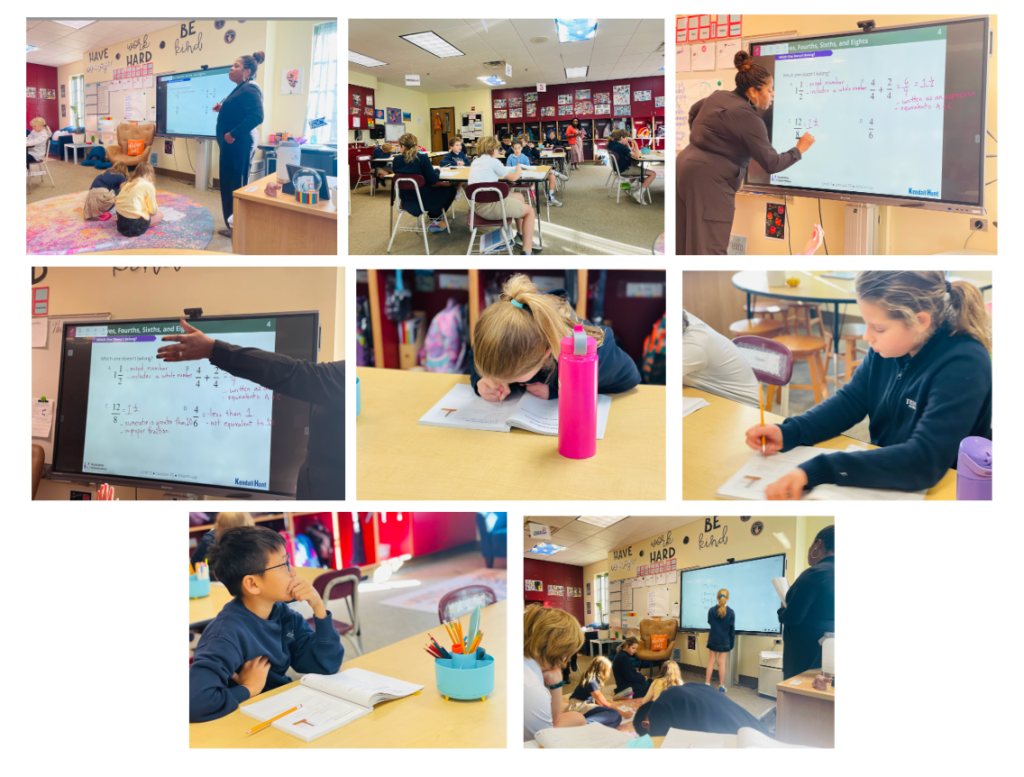
As is our practice, we met for a face-to-face debrief and Q&A session over lunch.
 Experiments in Learning by Doing