We are working on strength-based teaching and learning, multiplication, language-rich math classrooms, and structure. How often do we – and our students – just start computing to solve, guessing and checking at will. What if we teach our students to slow down and think, to contemplate before calculating, and to look before leaping? What if we set classroom conditions to identify good work and strengths of all students?
I know that there is not enough time, but in the case of Open Middle Multiply and Divide within 100 #1, anticipating student responses is a must. The original task gives mathematicians these directions:

I wondered (and learned) why 1 was not included and why digits could be reused. As we grappled with finding solutions, I wondered if we might combine ideas to classify solutions. Could we find more solutions? The point is to get our students to work on multiplication. Here’s what I pitched to our 4th, 5th, and 6th Grade math teachers at our Wednesday Workshop.

<Flash Forward> Here’s what our students posted early in the week.
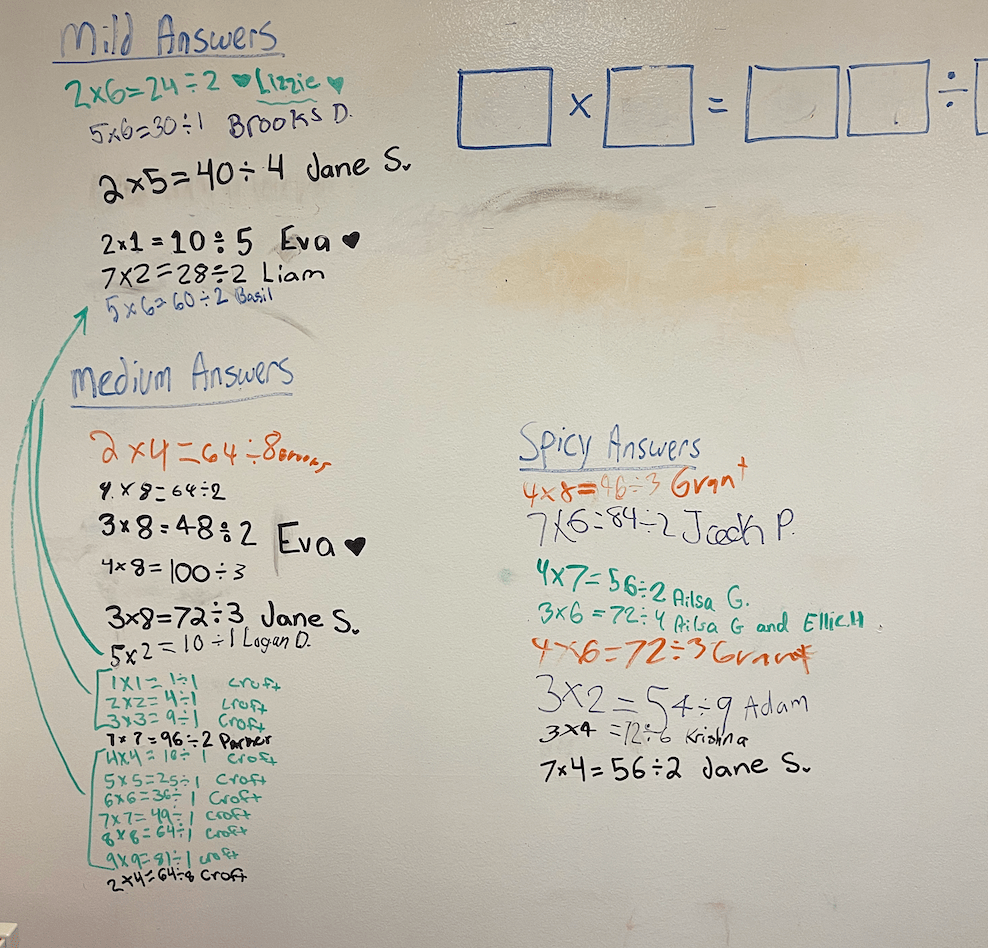
At first glance, it seems that Croft’s contributions have been reclassified from medium to mild by classmates. The solution 1 ✕ 1=1 ➗ 1 reused 1 more than once. 2 ✕ 2=4 ➗ 1 and 3 ✕ 3=9 ➗ 1 don’t have 2-digits for the quotient. But what about the rest of Croft’s list? Doesn’t Croft show an understanding of perfect squares and the multiplicative identity? (Also, Parker picked up on the regularity in Croft’s repeated reasoning but needs to check their work.)
Early in the week, Vicki Eyles popped in to let us know an unanticipated benefit of the reframe with mild-medium-spicy is that many more students are contributing to the collective list of solutions. Let’s repeat that! Many more students – different students – are engaged in the task, in the public posting of good mathematics.
When you experience success, you try again. In strength-based teaching and learning, we look for Notice that their answers are classified as mild, medium, and spicy. We are looking for conceptual understanding, procedural fluency, strategic competence, adaptive reasoning and productive disposition as described in Adding It Up: Helping Children Learn Mathematics.
</Flash Forward>
Now, my teaching point was to slow down to look for and make use of structure. in PD, we found solutions such as 4 ✕ 9=72 ➗ 2. As a teaching team, will we accept the following as two unique solutions or not?
4 ✕ 9=72 ➗ 2 and 9 ✕ 4=72 ➗ 2
We teach and expect them to apply the Commutative Property of Multiplication. Shouldn’t we be pleased that they are using it?
Will our students realize that they have more solutions if they think about inverse operations?
4 ✕ 9 = 72 ➗ 2 and 9 ✕ 4=72 ➗ 2
2 ✕ 4 = 72 ➗ 9 and 4 ✕ 2=72 ➗ 9
4 ✕ 2 = 72 ➗ 8 and 2 ✕ 4=72 ➗ 8
What if we let this beautiful task linger for a little while longer? What will our students learn? How many of our students will feel included in the solution finding?
What will we learn? Let’s repeat Vicki’s finding.
Many more students – different students – are engaged in the task, in the public posting of good mathematics.
Inclusion and belonging.
Two tough culture points in math classrooms.
What if we reframe how strengths are identified, displayed, and highlighted? What if we linger longer?
National Research Council, Karen S. Adding It Up: Helping Children Learn Mathematics. National Academy Press.
 Experiments in Learning by Doing