STLinATL 2025 | Workshop 1 | Monday, March 10, 2025 | 75 Minutes
In our work with Building Thinking Classrooms, we continue to explore practices that shift agency and ownership of learning into our students’ hands. One powerful distinction that has surfaced again and again is the difference between note-taking and note-making.
Note-taking is often passive. Students copy what we say, what’s written on the board, or what’s handed out in a slide deck. But note-making? That’s different. Note-making invites students to think, connect, and make meaning — it’s an active construction of learning, not a record of what happened.
In this hands-on session at STLinATL, we offered a math-rich experience that modeled what this looks and feels like. Together, we did math, moved, talked, recorded, and reflected. And we considered how designing for note-making might deepen student understanding and support the development of independent, flexible thinkers.
Workshop at a Glance
Getting Started with Purpose (5 minutes)
We began by naming our shared goals:
Student Goals:
- Thinking
- Flexibility
- Regularity in repeated reasoning
Teaching Goals:
- Strength-based feedback
- Confidence
- Consolidation
Naming these intentions at the start of the session helped center our shared purpose—and reminded us that how we teach is just as important as what we teach.
Math Task: Carnival Conundrum (25 minutes)
Using visible random grouping and vertical non-permanent surfaces, we launched into a differentiated math task: mild, medium, spicy. The problem was rich with opportunities for students to make sense of structure, attend to precision, and engage in repeated reasoning.

As groups worked, we highlighted the math practices in action. We watched ideas unfold, mistakes lead to insights, and patterns emerge. It’s powerful to see what students (and teachers!) can do when given time and space to think.
Note-Making: Metacognition in Action (20 minutes)
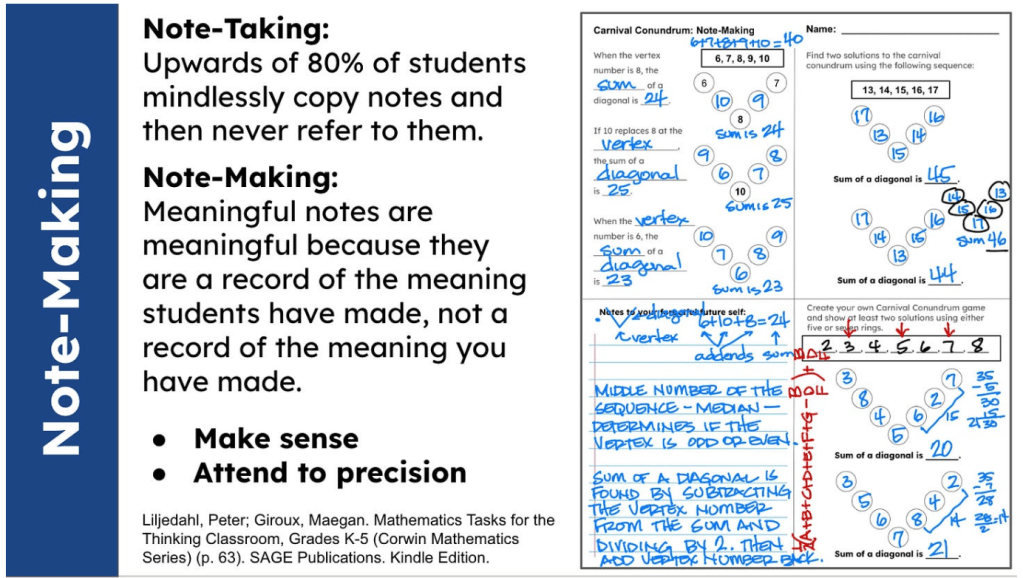
After the math, we paused. What did we notice? What strategies worked? What representations helped?
Each participant created their own notes, not from a handout or slideshow, but from experience.
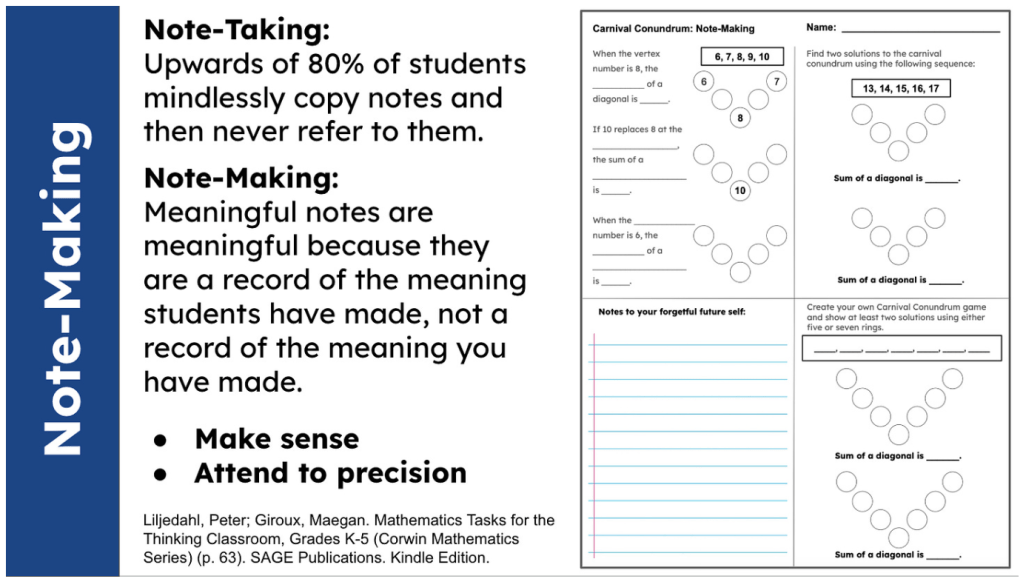
We considered:
- What do I want to remember?
- How will I record it in a way that makes sense to me?
- How might my students learn to do this, too?
Teaching note-making means teaching metacognition. We’re not just documenting work; we’re making sense of it.
More Math: Growing Patterns or Gauss Addition (10 minutes)
Back to thinking and doing, with a short burst of another math task. Vertical boards again, new partners, new ideas.
More Note-Making (10 minutes)
This second cycle helped reinforce the rhythm: experience → reflect → record. This is a habit we can build with students.
Closure (5 minutes)
We closed by reflecting on where we saw our goals in action. How did our math experiences support student thinking? When did confidence show up? Where was consolidation evident?
What We’re Learning
Note-making is a habit we can model, scaffold, and nurture. It builds metacognitive strength, strengthens independence, and makes thinking visible—not just to teachers, but to students themselves.
We’re learning to ask:
- How might students record what they found important?
- What opportunities are we offering students to meaningfully consolidate their learning?
- How can note-making support retention, transfer, and self-confidence?
If you’re designing learning experiences for your students, consider starting not with what you’ll say, but what you hope they’ll think about and record for themselves.
Let’s keep building classrooms that invite and honor thinking.
Let’s keep experimenting in learning by doing.
Jill
_____
Liljedahl, Peter; Giroux, Maegan. Mathematics Tasks for the Thinking Classroom, Grades K-5 (Corwin Mathematics Series) (p. 63). SAGE Publications. Kindle Edition.

