First things first: a heartfelt thank you. Connie White, your vision and leadership make AATE a community worth showing up for. The care you pour into gathering people, curating speakers, and holding space for big thinking is a gift. Thank you for continuing to build something that matters. And to the entire AATE crew, thank you for making today feel both purposeful and joyful.
To Sean Maxwell and Jennifer Womble: thank you for your generosity, your honesty, and your willingness to push our thinking. You didn’t just present at us. You invited us into the questions. That’s the difference between a talk and a learning experience.
Today was that kind of day.
Sharing my notes:
Fireside Chat: Classroom of the Future — Ethical AI: When Innovation Outpaces Intention, from Sean Maxwell, Google Customer Engineer, SLED Moonshot Architect | GenAI, HPC & Digital Transformation.
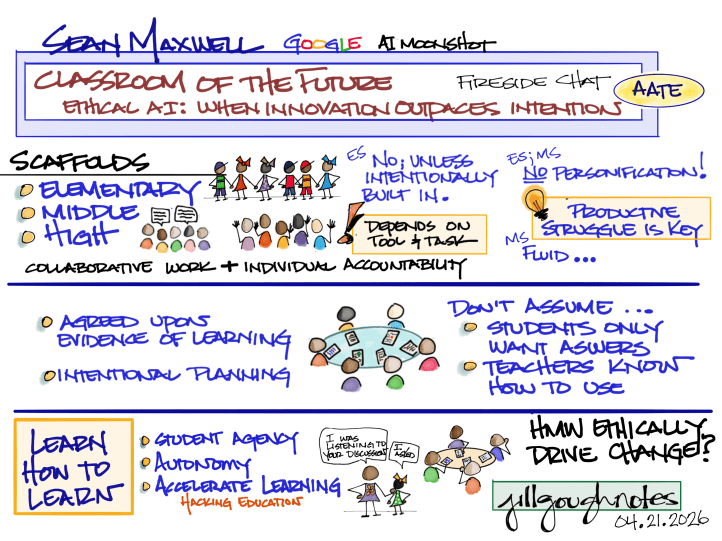
Sean opened the morning with a question that’s been sitting with me all day: How might we ethically drive change?
What struck me most was how grounded and practical the conversation felt. Just honest exploration of what it actually looks like to bring AI into schools in ways that are intentional, ethical, and student-centered.
A few things I’m still turning over:
Scaffolds matter, and they look different at each level. For elementary students, the answer to “should AI personify?” is loudly NO. Yes, the use of AI is understandable if it’s intentionally built into apps and software designed for young children. For middle school, things get more fluid. The key question is always: what does this tool do for this task? Depends on the tool. Depends on the task. Not a cop-out… It is wisdom.
Collaborative work and individual accountability aren’t opposites. We tend to frame them that way, but they can and should coexist. Students need both. The presence of AI doesn’t change that — if anything, it makes designing for both more urgent.
Don’t assume. Don’t assume students only want answers. Don’t assume teachers know how to use these tools. Both groups are learning. Both groups deserve support, patience, and productive struggle, which, yes, is just as key for educators as it is for learners.
Agreed-upon evidence of learning + intentional planning: this pairing is doing a lot of work. If we don’t define what learning looks like before we introduce AI into the mix, we won’t know what we’re measuring or missing. Intentionality has to come first.
And this: learn how to learn. Student agency. Autonomy. Accelerating learning, not outsourcing it. Sean’s frame around “hacking education” isn’t about gaming the system. It’s about students understanding their own learning well enough to take the wheel.
Sharing my notes:
AI-Powered Leadership — Leveraging Modern Tools for Strategic and Impactful School Transformation, Jennifer Womble, Founder of Scaling Success & FETC Conference Chair
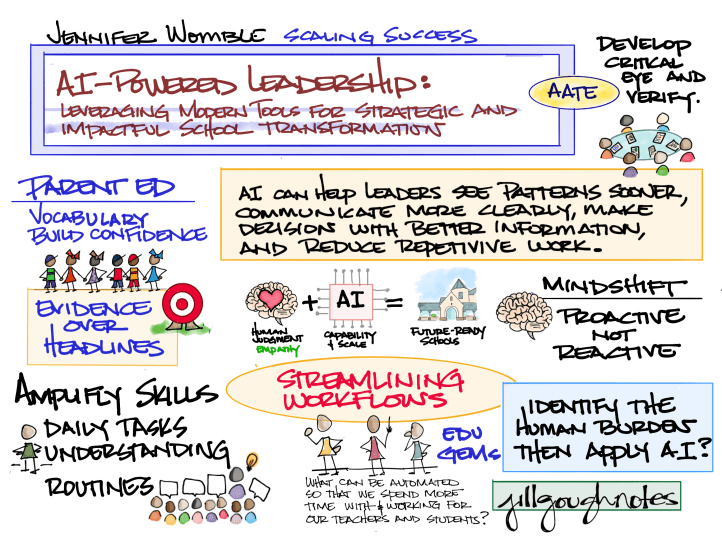
Jennifer brought the same energy to leadership that Sean brought to classrooms, and the through-line was integrity.
The framing that anchored her keynote:
Human Judgment + Empathy + AI Capability & Scale = Future-Ready Schools
Not AI instead of us. AI with us. That equation matters.
She challenged leaders to stop being reactive and start being proactive: a mindset shift she clearly named. AI can help us see patterns sooner, communicate more clearly, make better-informed decisions, and reduce repetitive work. But only if we go in with intention.
Two things I wrote down and underlined:
Evidence over headlines. In a world where every week brings a new breathless announcement about what AI can or can’t do, Jennifer’s reminder to build confidence through vocabulary and evidence, especially in parent education, felt necessary and grounding.
Identify the human burdens, then apply AI. This is the right order of operations. Not: here’s a cool tool, now what can we do with it? But: where are our people exhausted, overwhelmed, bogged down, and then ask if AI can help. What can be automated so that we spend more time with our teachers and students?
She named something I’ve been sensing but couldn’t quite articulate: amplify skills, not just tasks. When AI handles the daily administrative routines, it creates space for the deeply human work of understanding of relationships, mentorship, and real teaching.
Sharing my notes:
Designing the Future of Learning: AI, Leadership & the Next Era of Educational Technology, again from Jennifer Womble.
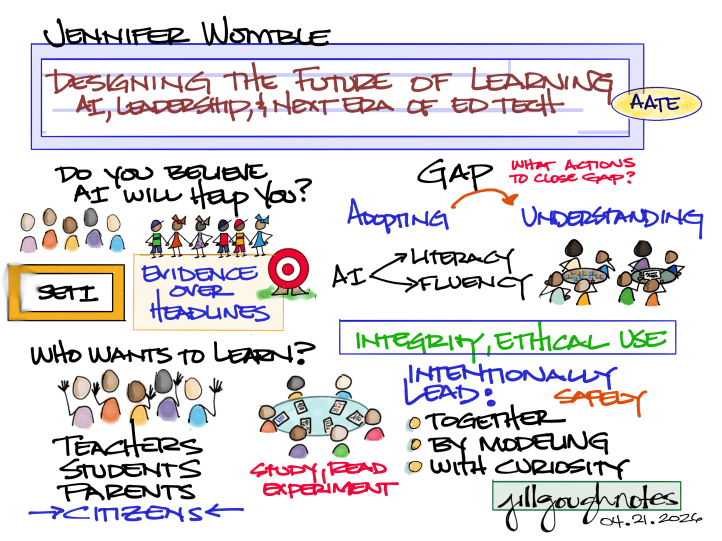
The afternoon session deepened the morning’s themes and added a question I’ll be sitting with for a while:
Do you believe AI will help you?
Jennifer put that question to the room, not rhetorically, but really. Because belief shapes behavior. And if leaders, teachers, students, or parents don’t believe AI has anything to offer them (or believe it’s something to fear), adoption will stall at the surface.
She named a gap I see in my own community: the distance between adopting AI and understanding it. Closing that gap requires moving from AI literacy to AI fluency, and that’s a different kind of learning. It’s slower, messier, and more important.
Who wants to learn? Teachers. Students. Parents. All citizens. That’s the scope. And that’s why the work matters, not just for schools, but for the communities those schools serve.
The call to action was clear:
Intentionally Lead:
Safely. Together. By modeling. With curiosity.
Not: deploy and hope. Not: wait and see. Lead through study, reading, and experimentation. Lead through integrity and ethical use. Lead through showing up as a learner alongside your colleagues and students.
A Question to Carry
How might we ethically drive change?
Sean asked it this morning. Jennifer kept answering it all day. And I left Indie Studios still holding it.
The gap between adoption and understanding is real. It’s not a reason to slow down; it’s a reason to be more deliberate, more curious, and more courageous about the questions we ask before we act.
Today was a good reminder that the best professional learning doesn’t hand you answers. It hands you better questions.
#AATE #EthicalAI #AIinEducation #ClassroomOfTheFuture #AILeadership #EdTech #LearnHowToLearn #FutureReadySchools #jillgoughnotes

