Trinity Teachers have questions about our craft. Determined to hone and enhance teaching, assessment, and relationship-building skills, we turn to each other for advice. From the work of Harvard Graduate School of Education professors Elizabeth City, Director of the Doctor of Education Leadership Program, and Richard Elmore, the Gregory R. Anrig Professor of Educational Leadership, we know some of the highest-quality professional development we can offer to each other is observation and feedback.
We know that confident learners push themselves to reach the next level. As teachers, we constantly offer feedback to our students so that they learn, grow, and become stronger. So, how do we seek feedback to learn, grow, and become stronger?
Kudos! As a faculty, we are seeking more observations and feedback. This embodies our mission at Trinity School: to create a community of learners.
When you are ready, please choose a level of observation and let ALT know.
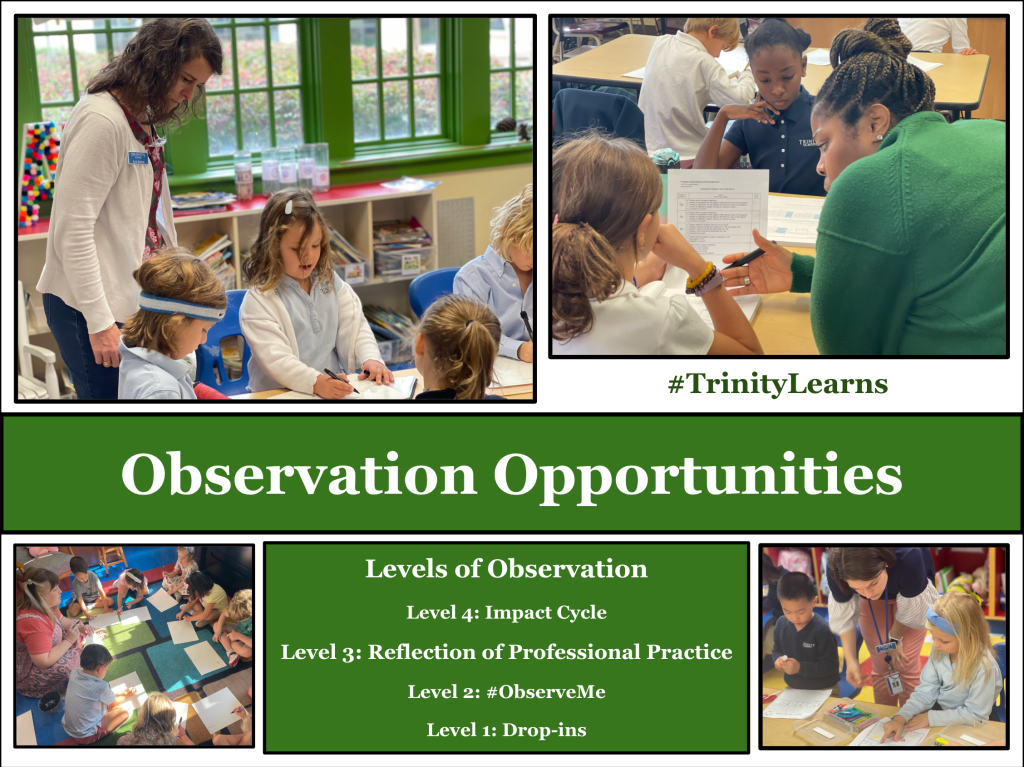
- Level 4: The impact cycle is a reflective process in which a teacher and an administrator work collaboratively to complete three rounds of pre-meeting, observation, reflection to focus on professional practice.
- Level 3: Considered a “traditional” observation, faculty would connect with a member of ALT for a formal observation with written feedback. This observation will be one round of Jim Knight’s Impact Cycle, our Level 4.
- Level 2: #ObserveMe is a movement designed by mathematics teaching specialist and educational consultant Robert Kaplinsky to encourage feedback among educators.
- Level 1: Currently in place, ALT drops in for quick micro-observations. Often, feedback is shared verbally, on a Post-it note, or in an Instagram post.
Additional details if you are curious:
Level 4: The Partnership
- Conversations: We will partner in productive and reciprocal conversations by listening with empathy.
- Autonomy: We will honor the expertise of the teacher and the power of individual decision-making.
- Professionalism: Our work will reflect a commitment to quality, professionalism, and the individual and collective talents in the partnership.
- Trust: Our partnership will be grounded in trust and confidentiality during vulnerable moments without judgment.
- Goals: The identified goals must be centered around student improvement and professional growth and must mean something to the teacher so there is motivation for success
What to Expect
- Meeting 1: Ask questions about what the teacher wants from the cycle and any information about the classroom environment.
- Meeting 2: Classroom observation with video used only by the teacher for reflection and observation.
- Meeting 3: Reflect on the video and lesson and see the situation’s current reality. Ask and answer questions toward a meaningful student-centered goal. PEERS Goals Setting and Strategies will be agreed upon.
- Meeting 4: Centered around the strategy and progress toward the goal, a second cycle is developed, planned, and executed.
Level 3: Reflection of Professional Practice
Observation of Practice takes on the task of helping educators seek and gain perspective.
Observers will spend a “period” observing and recording what takes place in the classroom. If there are specific questions or goals, they will be used to focus the observation.
- How might we help teachers focus on what is happening in classrooms in a systematic, purposeful, and focused way?
- How might we model and embrace formative assessment of our practice?
- How might we identify, highlight, and celebrate teaching strengths?
The Process
- Action 1: Invite a member of ALT to observe a lesson. This should be scheduled with a calendar invitation once a time is planned
- Action 2: Quick discussion with ALT member about your professional practice goal or question. This can be a face-to-face conversation over lunch if time permits.
- Meeting 3: Classroom observation from an ALT member. Notes will be shared with the observed teacher within 24 hours of observation.
- Meeting 4: Follow-up conversation to debrief observation and notes with a Q&A session.
Level 2 #ObserveMe invites others to observe!
#ObserveMe sign says a few things. It says that we’re a community of risk-takers who are brave enough to say, “Here’s what I want to know about my own practice.” It also says, “We’re trying to do the best job we can on a daily basis, and at any moment, you’re welcome to drop in because this is what we’re striving for.” It says that we believe we can help each other become better by leaning in and discussing our practice.
Getting Started
- Step 1: Open your copy of the #ObserveMe sign template for your door.
- Step 2: Add 1-3 points to your #ObserveMe sign, print it, and post it on the outside of your door.
- Step 3: Invite a member of ALT (and your colleagues) to come in for an #ObserveMe session.
- Step 4: Have a conversation to discuss what was observed.
Level 1: Drop-in Visits
Usually unscheduled and informal, members of ALT will drop by for a quick visit. Feedback is shared verbally, on a Post-it note, or in an Instagram post
 Experiments in Learning by Doing
[…] more about our teaching and our students’ learning, and we seek more feedback. We implemented a system of teacher-choice levels of observation opportunities. On September 12, I received the following […]
LikeLike
[…] a community, we continue to learn. At Pre-Planning, we pitched a system of teacher-choice levels of observation opportunities. On September 4, I received the following […]
LikeLike
[…] a community, we continue to learn. At Pre-Planning, we pitched a system of teacher-choice levels of observation opportunities. Marsha Harris and I were invited to observe 4th-grade math at the same time. I have the privilege […]
LikeLike