Our mission calls for us to continue as a community of learners in a diverse and distinctly elementary-only environment. How are we, as administrators and strategic planners, modeling the differentiation that we want to see in our classrooms? Participants in these planned sessions differ in content expertise, knowledge base, experience, and age of students in their care. Designing for a team that varies from art and music, to science and world languages, to PE, and to media-science/makers requires intentional goal setting and differentiation. It also requires systematic and thoughtful planning.
During Pre-Planning, we gathered to launch the course, learn together, and pick initial resources. (If you’d like to know more, the plan, design, and proposed organization were shared in this previous post.) Here’s the shared plan:
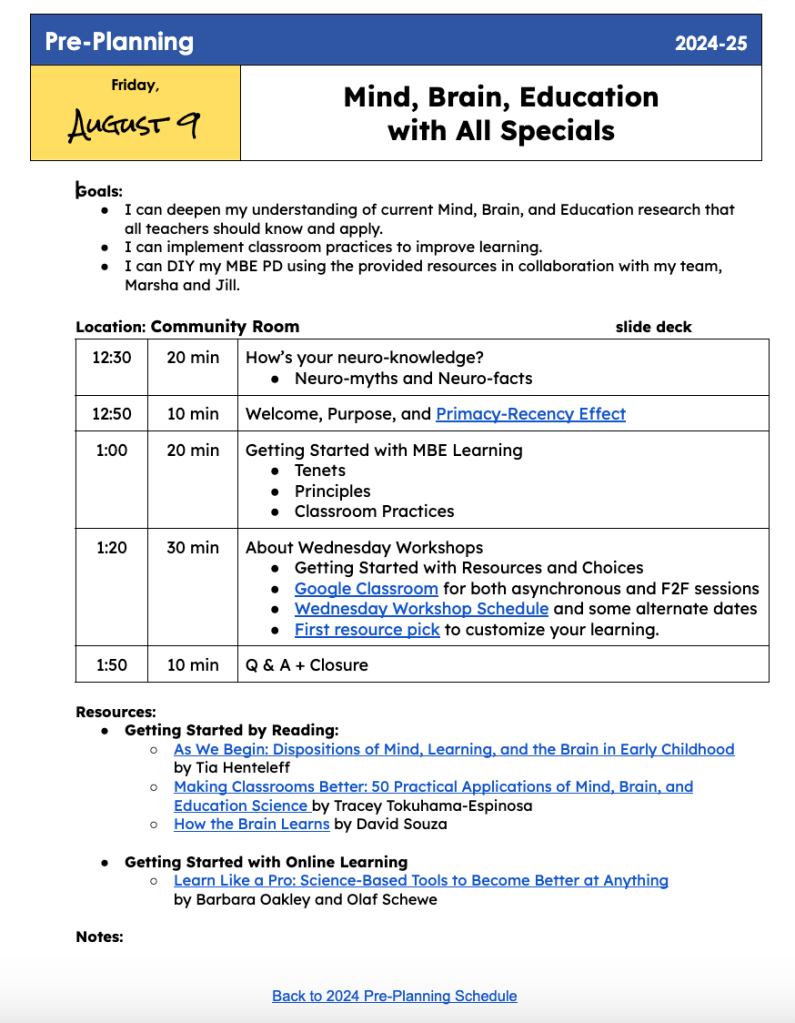
Now, at Trinity, we play-to-learn. Yes, on Friday afternoon, after lunch, we met. If you pay attention to social media, you can imagine the collegial conversation on the way to the Community Room. But, I have faith in my community and our teachers, and I know that social media does not represent everyone.
Have you played Face the MBE Facts: A Neuromyth Busting Activity from The Center for Transformational Teaching and Learning at St. Andrew’s Episcopal School? If not, you should check it out.
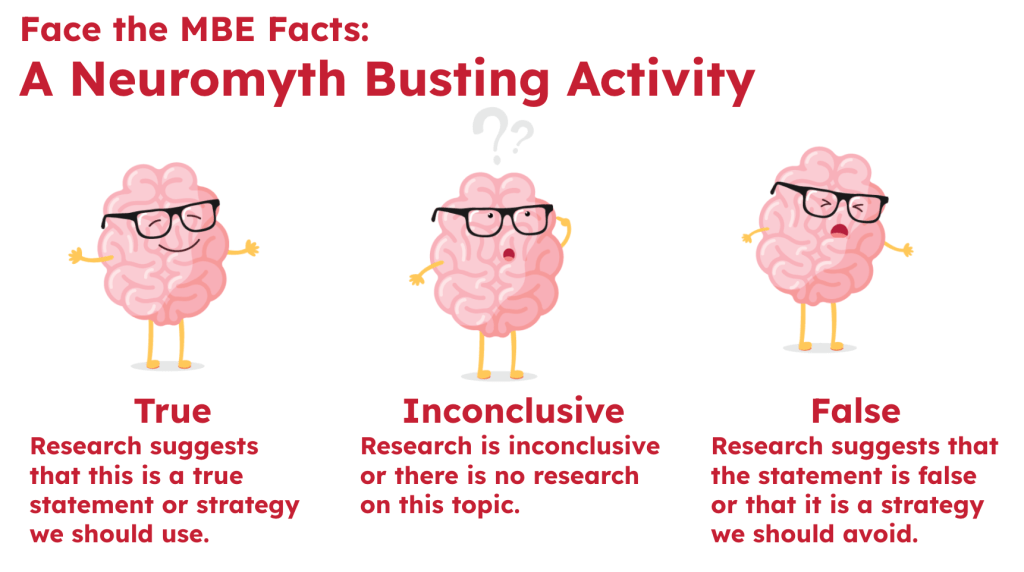
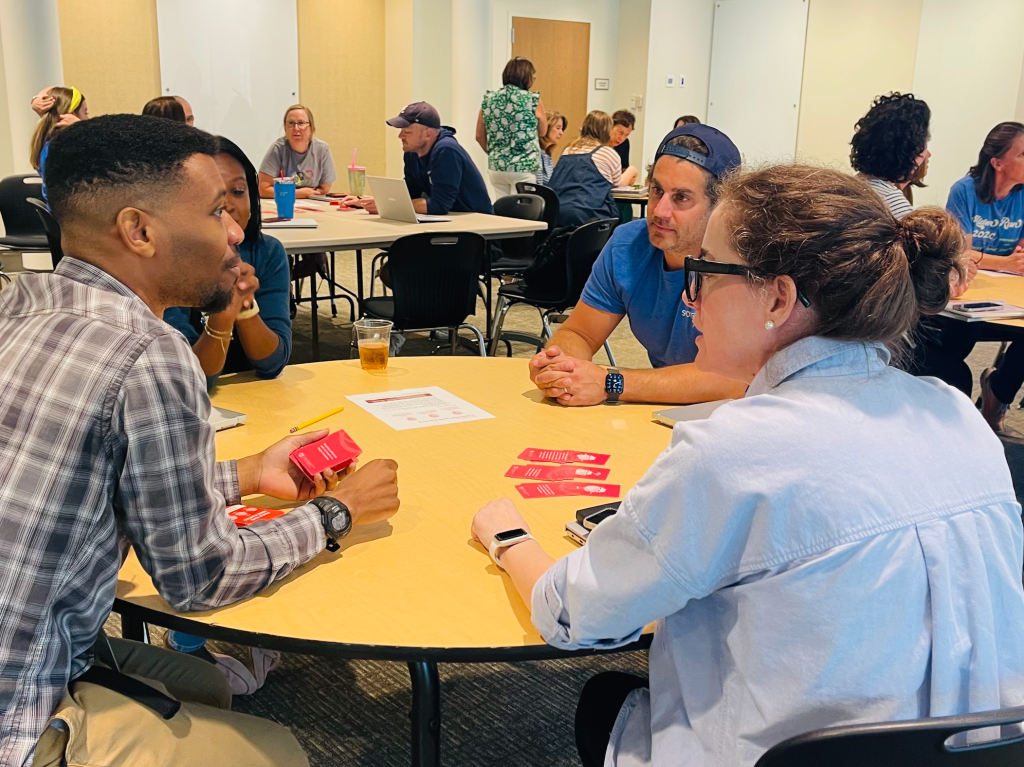
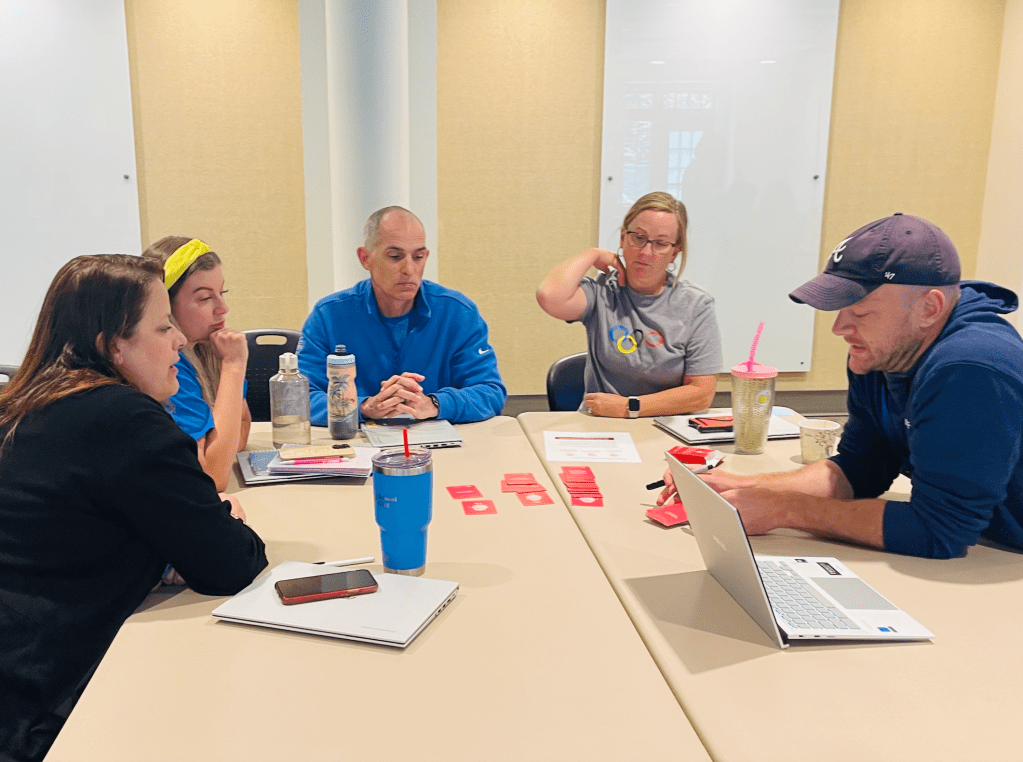
As teachers arrived, the cards and how to play were out on the table. No waiting for a formal start. Just build a team and play. Many of the cards are worded to be provocative. Some challenged long and deeply held beliefs, which helped us debate and discuss. And we want to learn more.
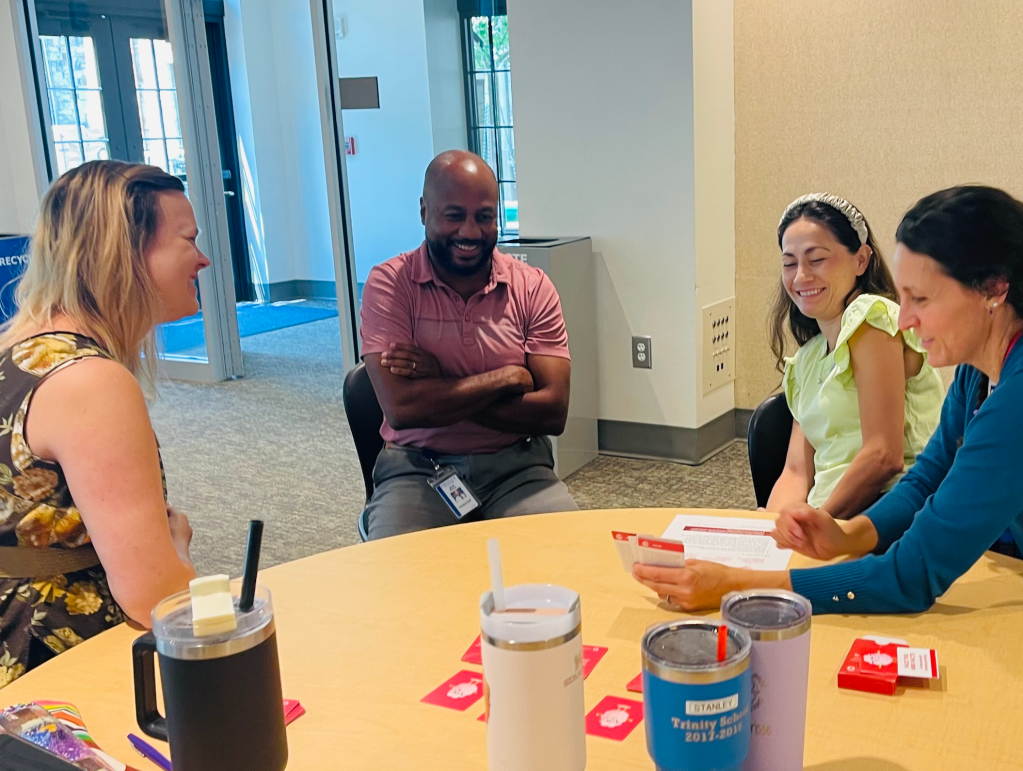
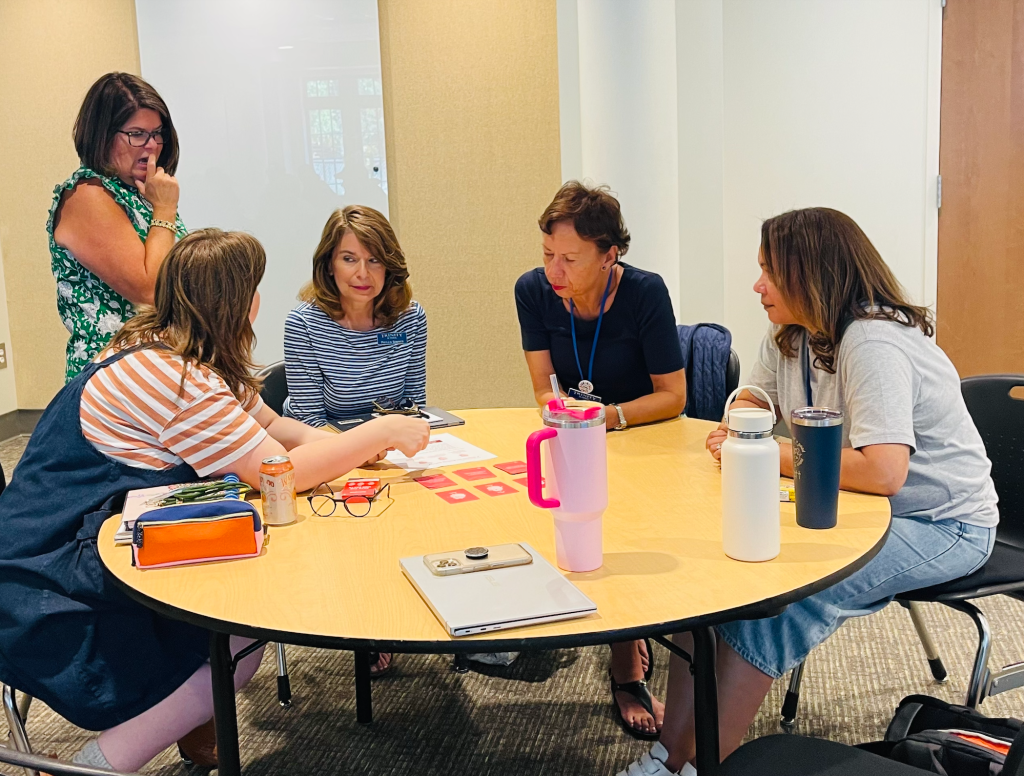
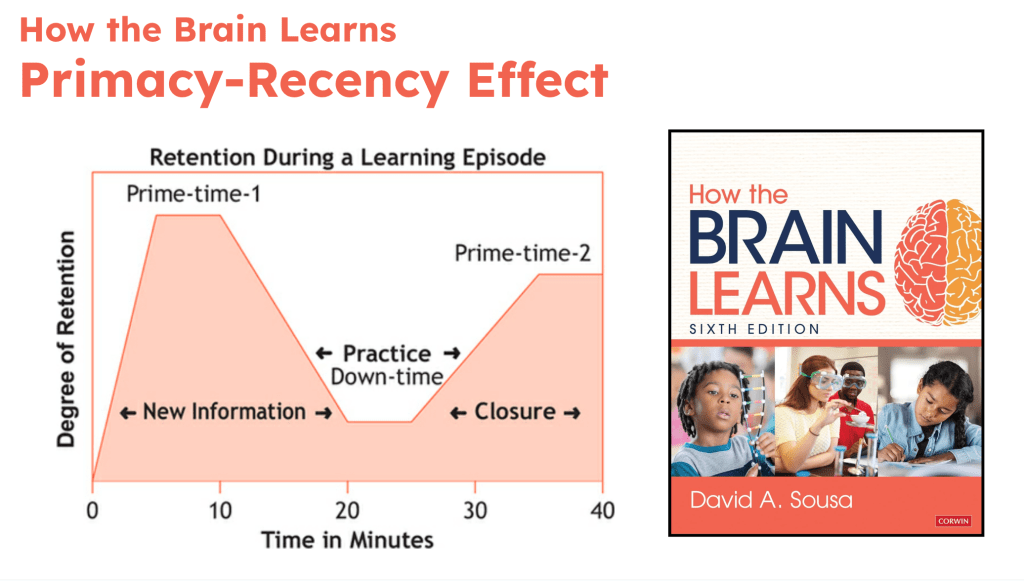
Then, a quick lesson on the primacy-recency effect from Sousa’s How the Brain Learns to prime our teachers to learn more.
In the round, as a community, we read the MBE Tenets from Tokuhama-Espinosa’s Making Classrooms Better:
Principles That Great Teachers Follow
- Great teachers know that each brain is unique and uniquely organized.
- Great teachers know that all brains are not equally good at everything.
- Great teachers know that the brain is a complex, dynamic system and is changed daily by experiences.
- Great teachers know that learning is a constructivist process and that the ability to learn continues through developmental stages as an individual matures.
- Great teachers know that the search for meaning is innate in human nature.
- Great teachers know that brains have a high degree of plasticity and develop throughout the lifespan.
- Great teachers know that MBE science principles apply to all ages.
- Great teachers know that learning is based, in part, on the brain’s ability to self-correct.
- Great teachers know that the search for meaning occurs through pattern recognition.
- Great teachers know that brains seek novelty.
- Great teachers know that emotions are critical to detecting patterns, to decision-making, and to learning.
- Great teachers know that learning is enhanced by challenge and inhibited by threat.
- Great teachers know that human learning involves both focused attention and peripheral perception.
- Great teachers know that the brain conceptually processes parts and wholes simultaneously.
- Great teachers know that the brain depends on interactions with other people to make sense of social situations.
- Great teachers know that feedback is important to learning.
- Great teachers know that learning relies on memory and attention.
- Great teachers know that memory systems differ in input and recall.
- Great teachers know that the brain remembers best when facts and skills are embedded in natural contexts.
- Great teachers know that learning involves conscious and unconscious processes.
- Great teachers know that learning engages the entire physiology (the body influences the brain, and the brain controls the body).
The rest of the session was dedicated to an overview of the choices and initial goals. Is everyone connected to our Google Classroom? What would you like to know before selecting a resource for learning?
Resources:
- Getting Started by Reading:
- As We Begin: Dispositions of Mind, Learning, and the Brain in Early Childhood
by Tia Henteleff - Making Classrooms Better: 50 Practical Applications of Mind, Brain, and Education Science by Tracey Tokuhama-Espinosa
- How the Brain Learns by David Souza
- As We Begin: Dispositions of Mind, Learning, and the Brain in Early Childhood
- Getting Started with Online Learning
- Learn Like a Pro: Science-Based Tools to Become Better at Anything by Barbara Oakley and Olaf Schewe
Teachers were invited to peruse the resources and make a decision over the next week so that the resources would be ready and available well ahead of our first asynchronous session in September.
Tokuhama-Espinosa, Tracey. Making Classrooms Better: 50 Practical Applications of Mind, Brain, and Education Science . W. W. Norton & Company. Kindle Edition.
 Experiments in Learning by Doing
[…] our Pre-Planning session, teachers took time to explore the resource choices. The plan is to differentiate based on […]
LikeLike
[…] Pre-Planning Launch […]
LikeLike
[…] Pre-Planning Launch […]
LikeLike