If you have always been able to code and “do” math, would you more readily overcome stereotypes concerning who is capable? At Trinity, our teachers are teaching algebraic reasoning and coding at an early age. Our maker-teachers invited me to observe coding-in-action with our 4th Graders.
With their permission, my observation notes and comments are shared below.
Visited Teachers: Paul Pileggi, Steven Valentine
Observer: Jill Gough
Date Visited: September 9, 2024, 8:30 Class (4th Grade, Parker-Webster)
My notes:
Focus of the observation (if any) and class context:
- Coding, Making to Learn
- Annual ‘Running of the Spheros’
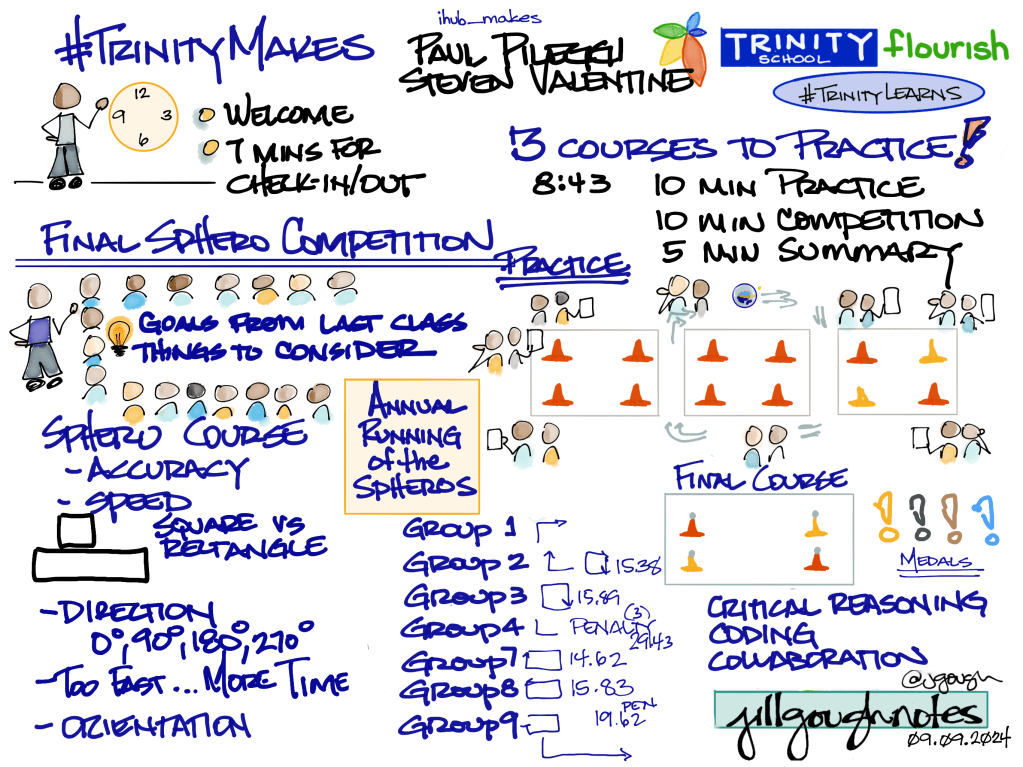
Steven was waiting for our 4th graders to arrive. He greeted them warmly and gave them 7 minutes to check in and check out books. As students completed this task, they joined Paul in the iHub.
Once Paul had most students, he began instruction with a review. Students explained the goals of the last class were and what they were working on. Students actively answered all review questions.
“Today is the final Sphero Competition,” remarked Paul as the final few students arrived in the iHub. Paul described the course roadway and reminded students that the keys to success are speed and accuracy. Speed impacts the turning radius of the Sphero; too fast or too slow makes a difference.
Students had three courses on which to practice. The practice courses were outside the Learning Commons/Multi-Purpose Room/elevator. Each course was marked with cones.
“It is 8:43. You will have 10 minutes to practice, 10 minutes of competition, and then 5 minutes to summarize back in the iHub.” Students found their partner, the iPad, and matching Sphero, and enthusiastically went to work.
Students needed and were given more time to practice. During the practice session, Paul coached teams kindly and directly. His immediate feedback focused on what they needed to consider regarding time, angles of turning, and speed.
Steven set up the final course for the competition. Students lined the walls to watch and learn from others. Each team had two chances. A penalty of 5 seconds was given if a cone was hit. It also applied if the ping pong ball was knocked off of the top. The penalty was enforced if the Sphero went askew.
All teams competed. There was a winner. Students then returned to the iHub where Paul summed up the learning. Everyone had the same challenge. Everyone was required to work collaboratively. Everyone reasoned and problem-solved. And they are coders/programmers!
Jill’s comments:
Wow! There was a lot of mathematics and physics in that lesson. Squares and rectangles, direction and magnitude, speed when turning. An experiential understanding of these topics will help them when learning about vectors.
To the outside observer, it could look like chaos and off-task behavior. I saw none. Students were engaged in problem-solving and reasoning. Critical thinking and collaboration were paramount to success.
Oh, and I loved the carabiner medals for the winners and participants. What a great idea!
Strengths Observed:
- Routines are critically important to success. Steven’s warm greeting and consistent expectations showed. The students knew what to do quickly!
- Paul reviewed the process, procedures, and tasks of the last class by questioning the students. He leveraged what could have been “down” or wasted time by beginning this discussion early.
- Organization, routines, and high expectations were evident. Students knew who to work with, where the materials were located, and how to position themselves to practice and find success.
- Questions are clearly invited and expected. Clear, direct, and kind feedback was sought and delivered.
- When mistakes were made, both Steven and Paul were kind, clear, and direct in their coaching, correction, and feedback.
I am grateful. I know it is hard work.
Thank you to both of you.
Jill
Photos from class:
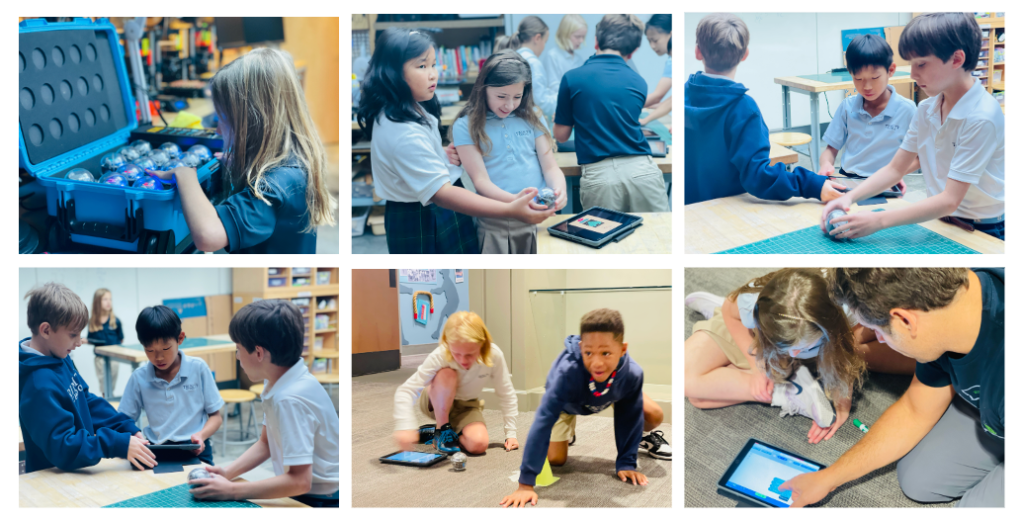
See more photos and video on Instagram.
My sketchnote from today’s class: