We are working to learn more about our teaching and our students’ learning, and we seek more feedback. We implemented a system of teacher-choice levels of observation opportunities. On October 1, I received the following email.
Hello!
We are grateful you are able to come to observe in our classroom as we launch a new writing piece on special places on Wednesday, October 9 at 9:30ish (Kindergarten very much runs on analog time!).
We can debrief on Friday, October 11, 11:30 to 12:25, if that time is available on your schedule.
Thank you!
Abbey and Kate
I try to find a quiet spot where I can sketch-note the observed lesson. When the observation concluded, I immediately sent my sketch to the observed teacher(s) and posted the following on Instagram.
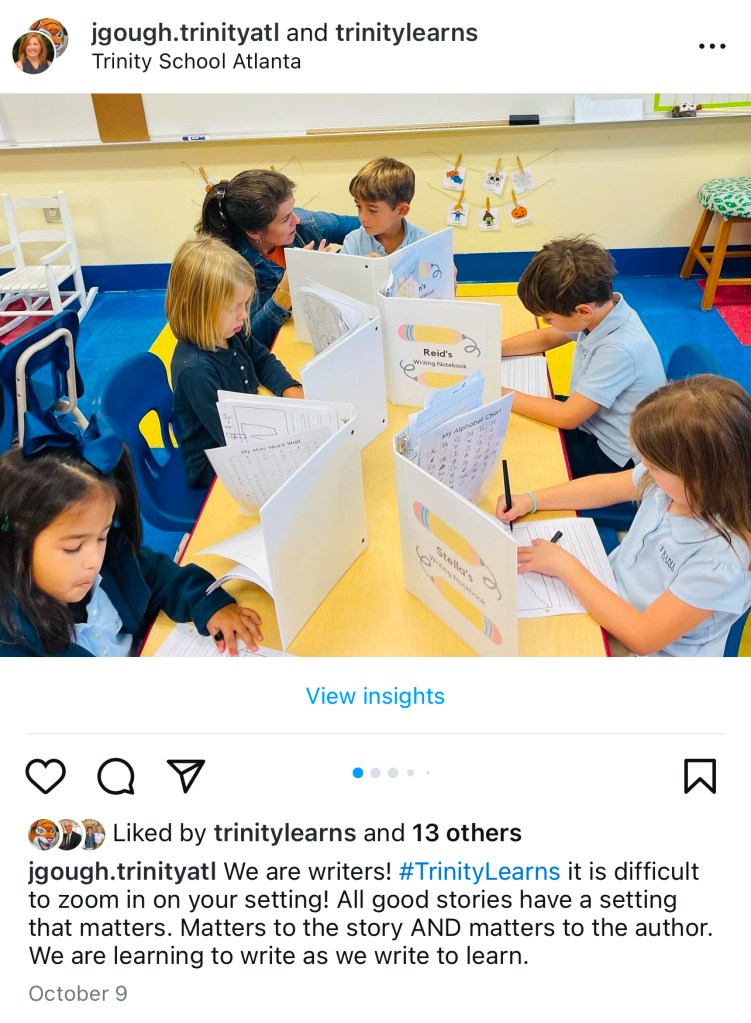
Within 24 hours, I also shared a detailed written observation with the observed teachers and asked for a time to debrief after they had a chance to review my notes.
With their permission, I am sharing my sketch, notes, and photos from their observation.
Visited Teachers: Kate Burton+Abbey Moore
Date Visited: 09/12/2024
Class or Grade: Kindergarten Writer’s Special Place Launch
Observer: Jill Gough
My notes:
Kate and Abbey invited me to observe the launch of a new writing unit.
Tentatively, we’re planning on launching a new piece of writing on Wednesday, 10/9, around 9:30ish. Can you observe us during that time?
I planned to arrive at 9:15 to find an unobtrusive spot. Kate asked if I would also observe the transition from snack to writing.
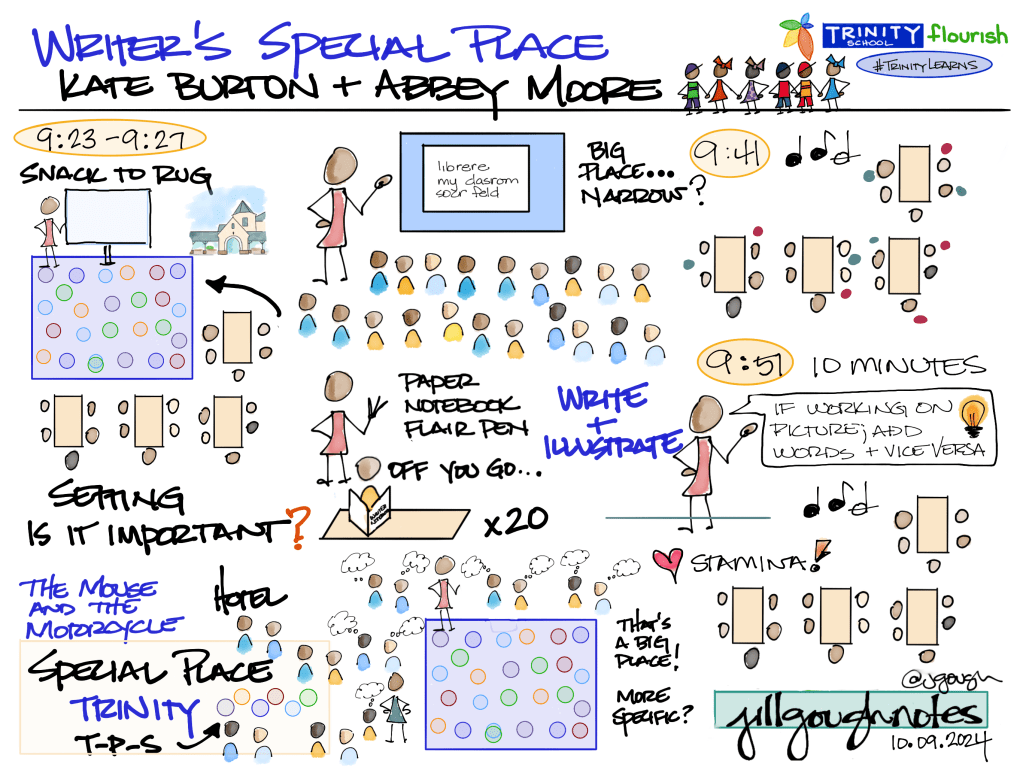
Kate rang the gong at 9:23 and explained students should clean up and join her on the rug. At 9:27, all students were in place – in their individual spots – on the rug and ready for the lesson.
Kate launched with a question about the setting of the story The Mouse and the Motorcycle. “Is it important to the story that it was set in a hotel? Why?” Students offered lots of reasons. Kate asked what would happen if the mouse was at their house. Nice connect-to-self opportunity.
Kate added a story about a previous Kindergarten student with a story about her special place. Kate called eight students by name and noted a special-to-them place they might have. Abbey was managing students with needs to the side so that the lesson continued. Abbey was so quiet and smooth that I had to look for her in the room to notice her work. Nice!
Kate used the features of the rug to have the students get on their feet for a quick Think-Pair-Share about a special-to-me place with a partner.
Kate used the document camera with the Clear Touch to model the writing experience with our students. “What’s a place that EVERYONE here LOVES? A place that EVERYONE loves and understands?” To which the student replied, “Trinity!” Kate congratulated them on their unanimous choice and explained that Trinity was a BIG place, “Can we be more specific? What part of Trinity?” Students replied, “library,” “soccer field,” “classroom,” etc. Kate asked again, took the answer “library” and modeled how to note that in their new writer’s book. Kate asked how to spell library and followed our learners using their inventive spelling while coaching them to sound library out. You can see in my notes that page 1 had “librere.” Kate turned the page and asked for another location. “My classroom” was the next place offered by the students. Kate asked how to spell “my” and enthusiastically congratulated the students who used the classroom resources to find the high-frequency word on the wall. They then proceeded to sound out “classroom.” “What does it start with?” Students offered both “c” and “K.” Kate got them to “c” and again used their inventive spelling to note “clasrom” on page two of their book. “Soccer field” was offered for page three. Kate attempted to get the students to “playground” (I think) but no. Soccer field was the choice. Again, inventive spelling.
Kate used a clearly established routine for their classroom to give next steps. There are three things to get:
- Your new book paper from me or Miss Abbey.
- Your writer’s notebook, and.
- Your special flair pen from your cubby.
Kate repeated, “Say it with me.” And in chorus, the students repeated: “1. New paper; 2. Writer’s notebook; and 3. Special flair pen.”
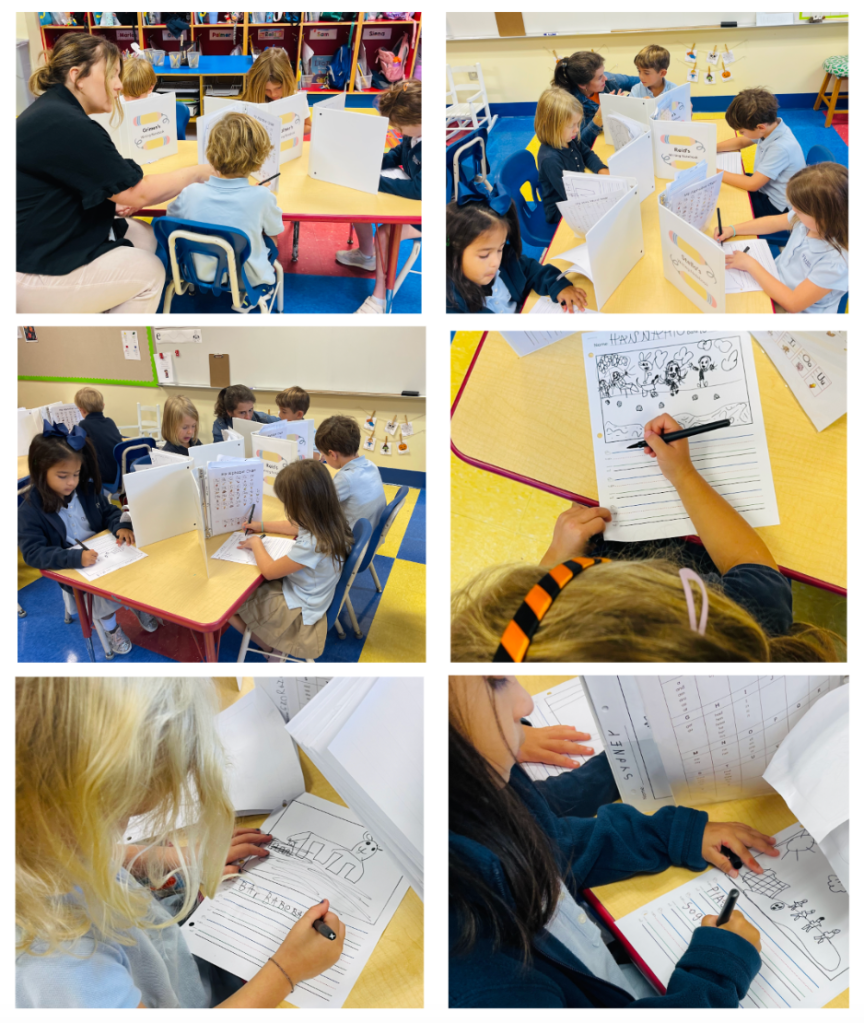
Kate asked students to pick their three places and, when ready, use the thumbs-up over your heart to let them know. Kate and Abbey then called students up to hear their ideas and help them narrow when needed. When ready, students were sent off to retrieve their three things and get to work writing. Students whispered to both Kate and Abbey, who responded with enthusiasm, joy, and gentle coaching to narrow to smaller settings. Students independently retrieved their three things, set their notebooks up like privacy shields, and went to work illustrating and writing.
At 9:41, all students were back at their tables, writing and illustrating. Kate turned on instrumental music as part of the clear routine. Kate and Abbey moved from student to student, offering encouragement, affirmation, and coaching. It was so quiet. Students worked intently. I noted two struggling students, one with tears and the other frustrated because of a mistake. Both were handled quietly and effectively so students could return to work with positive comments and coaching.
At 9:51, TEN minutes later, Kate explained that now would be the time to write if you had only been illustrating and to illustrate if you had only been writing. Nice stamina for such young writers.
My pre-set alarm called for me to leave at 9:55, so I missed the lesson’s close. Kate did point several students out to me so that I could see their work as I was leaving.
Strengths observed:
- Strong sound-symbol recognition (the alphabet principle) uses teacher-to-student, student-to-student, and in the examples
- Classroom routines and norms are evident and practiced
- Student’s voice was cultivated and invited
- Teacher clarity again and again
- Student ability to sustain the writing process
- Individualized feedback that was so quiet creating a sense of safety for students who had or might have made a mistake – perceived or actual.
Photos from the lesson:
We met later in the week for a face-to-face debrief over lunch with Q&A.
 Experiments in Learning by Doing