What if the strategy a 1st grader uses for 9 + 3 is the same one a 3rd grader uses for 247 + 326, and the same one a 4th grader uses for 0.9 + 0.3?
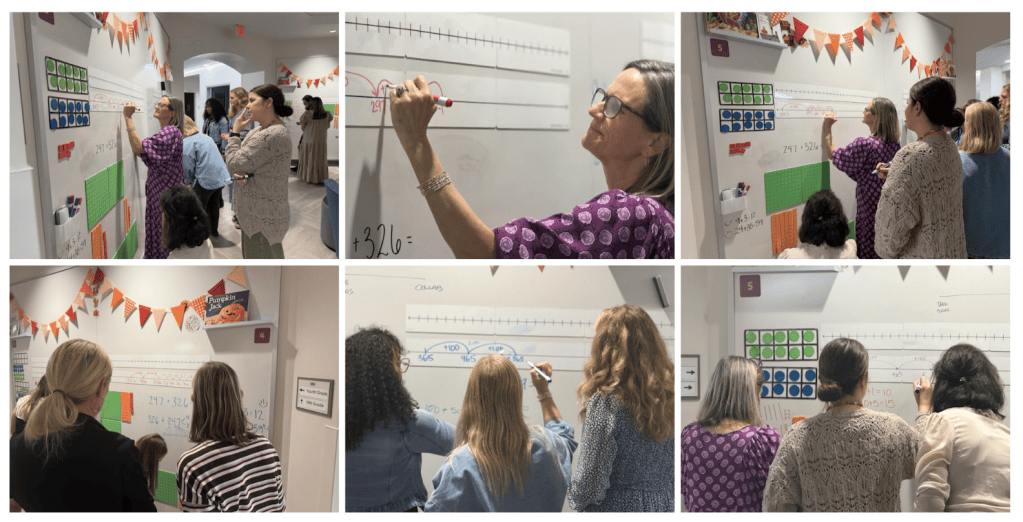
That was the question behind this week’s Wednesday Workshop. Twenty-four of our 1st-, 2nd-, and 3rd-grade teachers gathered in the UED Hub. We reviewed the Building Thinking Classrooms norms and practices, then spent most of our time doing mathematics: the Banner Method with thin slicing, anchored in Pam Harris’s number strings.
Four strings, one progression
We worked with four strategies. Each string climbs from single digits to two digits to three digits, then on to decimals.
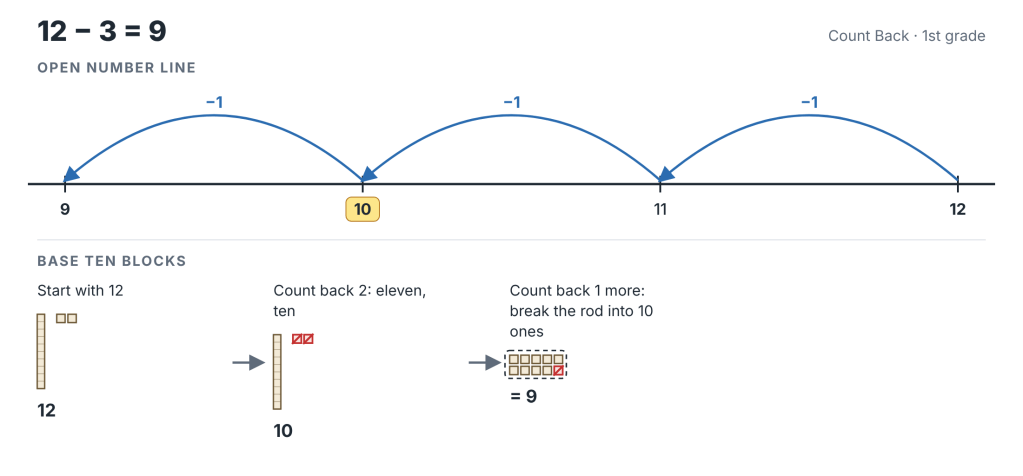
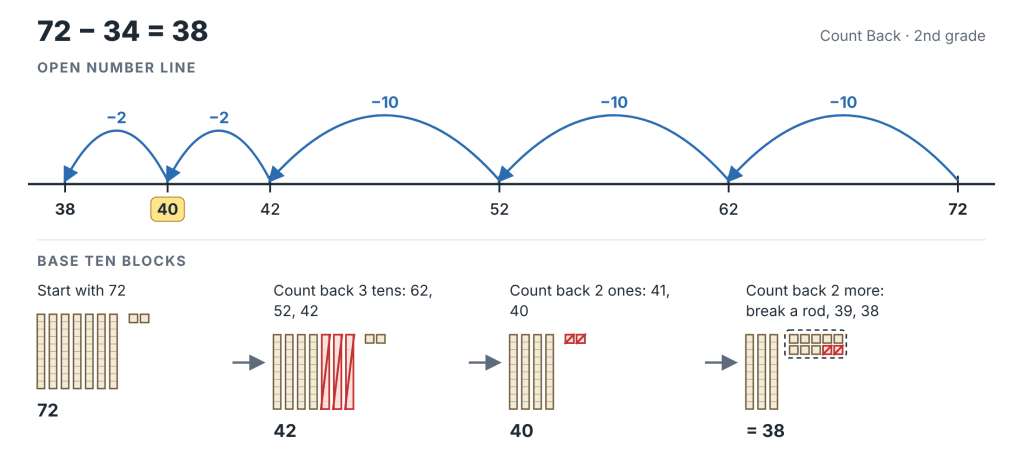
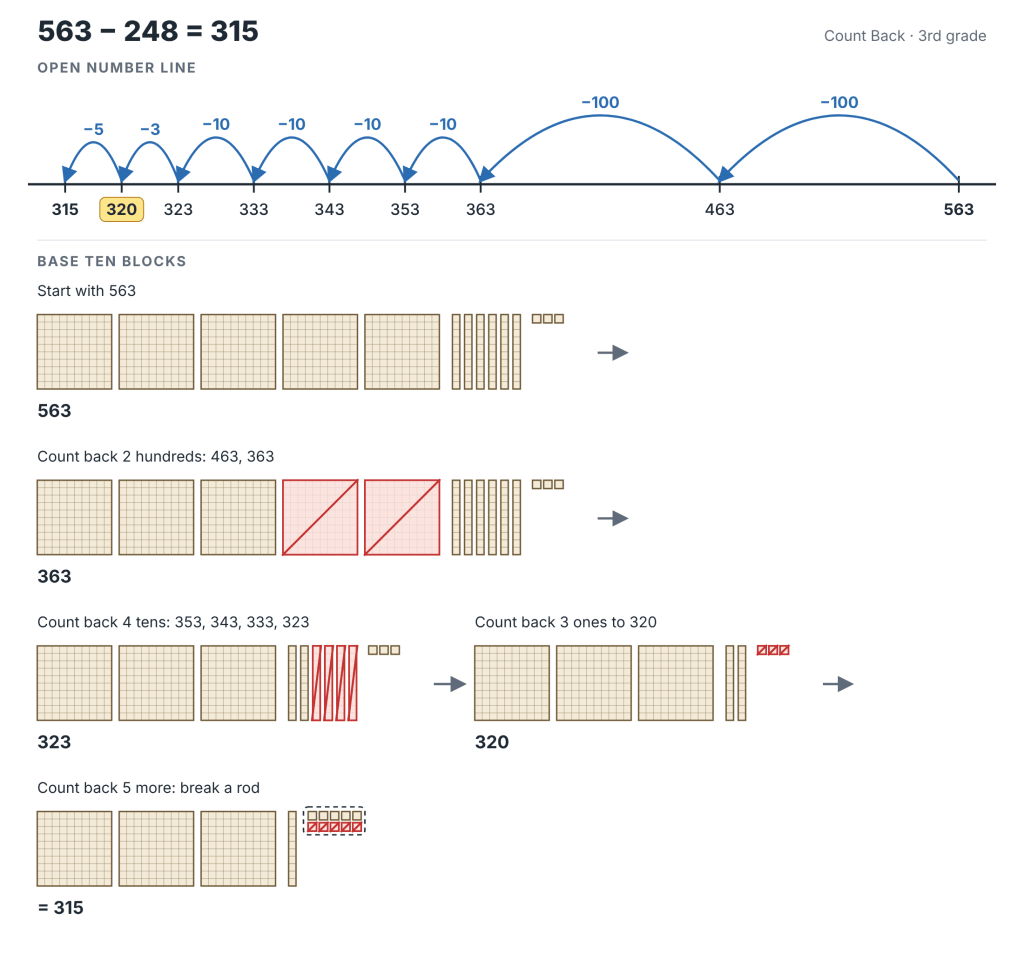
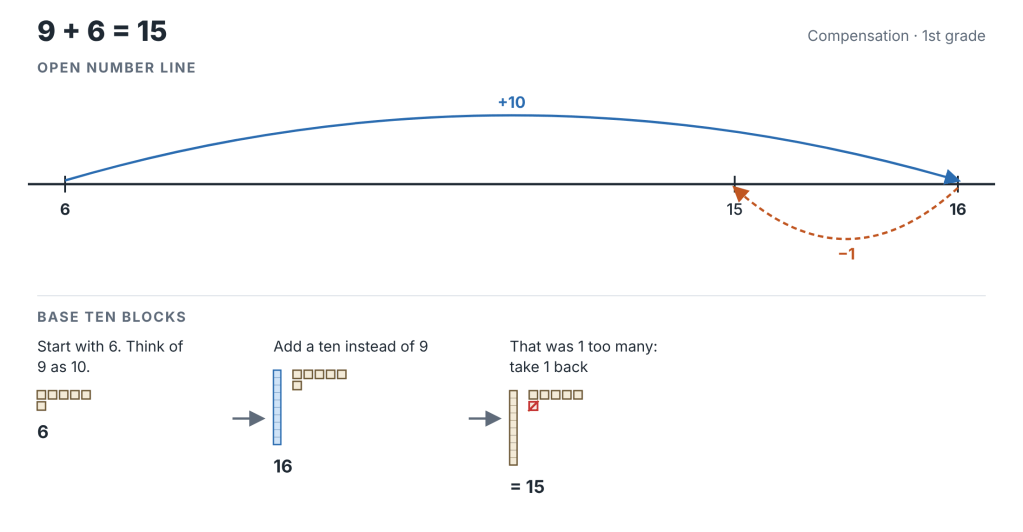
| Count On | Count Back | Compensation | Decomposing |
|---|---|---|---|
| 9 + 3 | 12 − 3 | 9 + 6 | 8 + 5 |
| 24 + 35 | 72 − 34 | 46 + 19 | 47 + 36 |
| 247 + 326 | 563 − 248 | 63 − 19 | 73 − 25 |
| 0.9 + 0.3 | 1.2 − 0.3 | 365 + 199 | 568 + 274 |
| 2.4 + 3.5 | 7.2 − 3.4 | 4.6 + 1.9 | 4.7 + 3.6 |
| 6.3 − 1.9 | 7.3 − 2.5 |
Read any column from top to bottom, and you can see a progression. The first problem lives in 1st grade. The next lives in 2nd grade, then 3rd grade. The decimal problems show where the same thinking goes next.
Look closely at the decimals. 0.9 + 0.3 uses the same digits as 9 + 3. 2.4 + 3.5 uses the same digits as 24 + 35. 4.6 + 1.9 echoes 46 + 19. The strategy doesn’t change when the numbers get smaller or larger. Place value carries it along.
Three jobs, three ways to see the math
Our goal was to build conceptual understanding of these strategies through a multisensory approach. So every member of a team had a job:
- Scribe: records the thinking on the board.
- Number line visualizer: shows the strategy as jumps on an open number line.
- Base-ten block visualizer: builds the strategy using base-ten blocks.
When each new string was launched, the jobs rotated. Everyone had a turn with the manipulatives and a turn as the scribe.
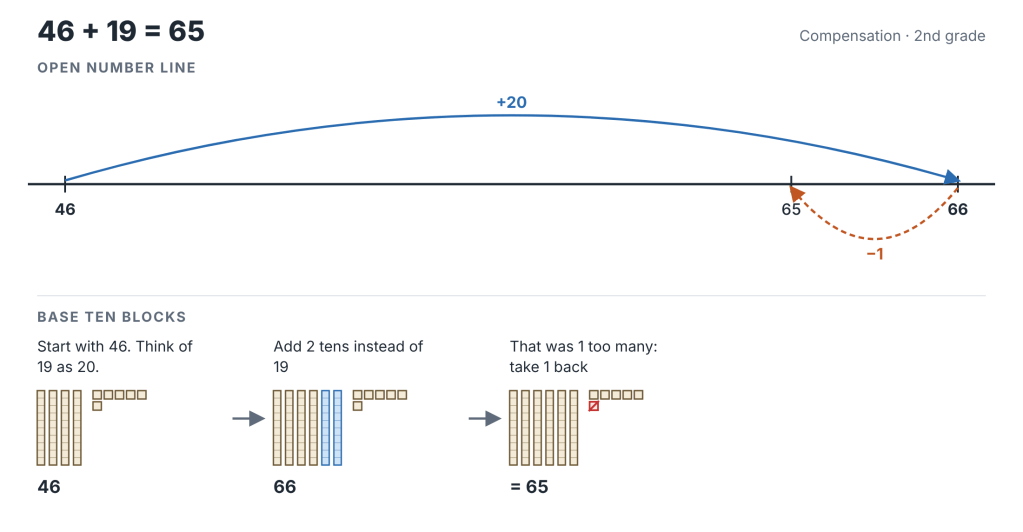
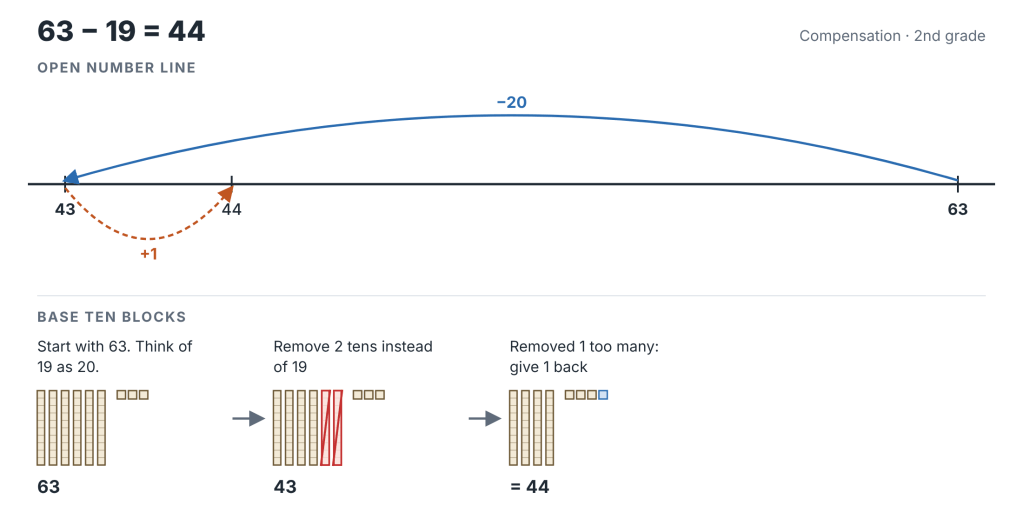
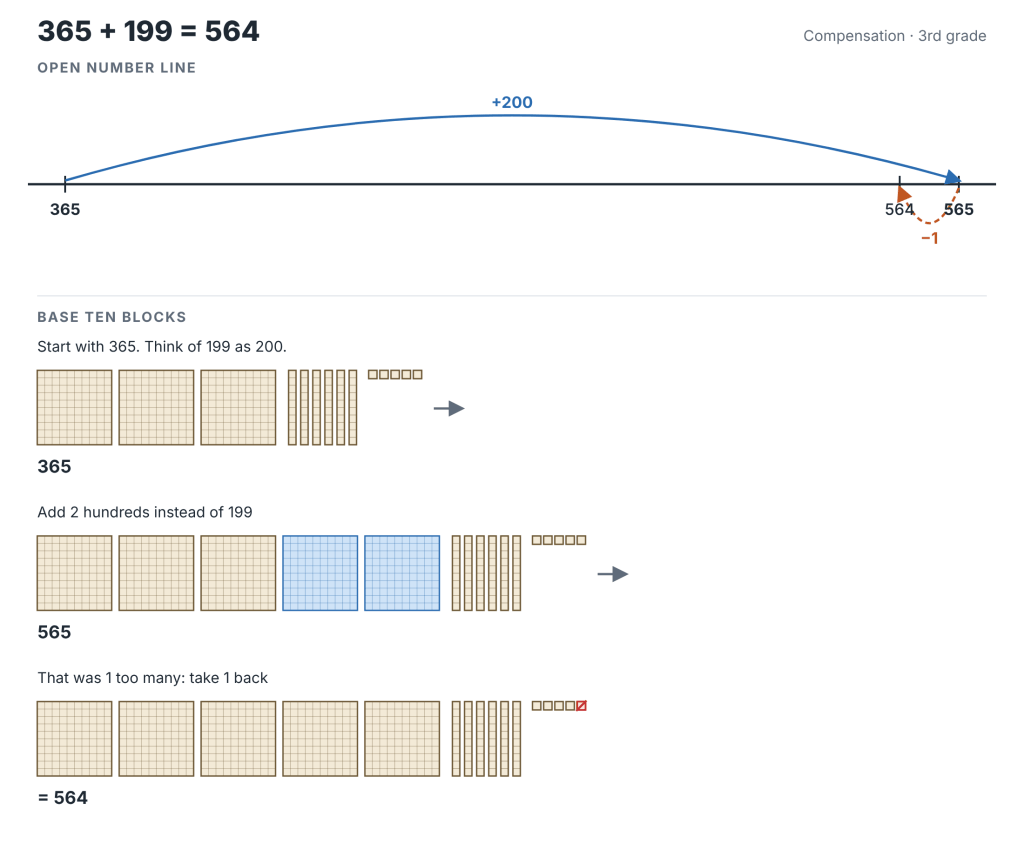
Seeing the same problem in three ways at once gives us more to talk about. The number line shows the jumps and the distance. The blocks show us when we compose a ten or break one apart. The scribe’s record connects both to the symbols.
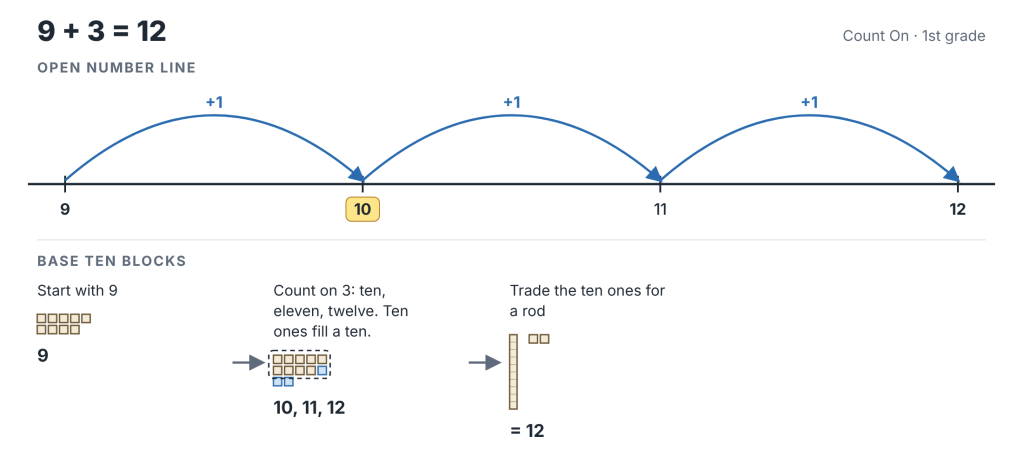
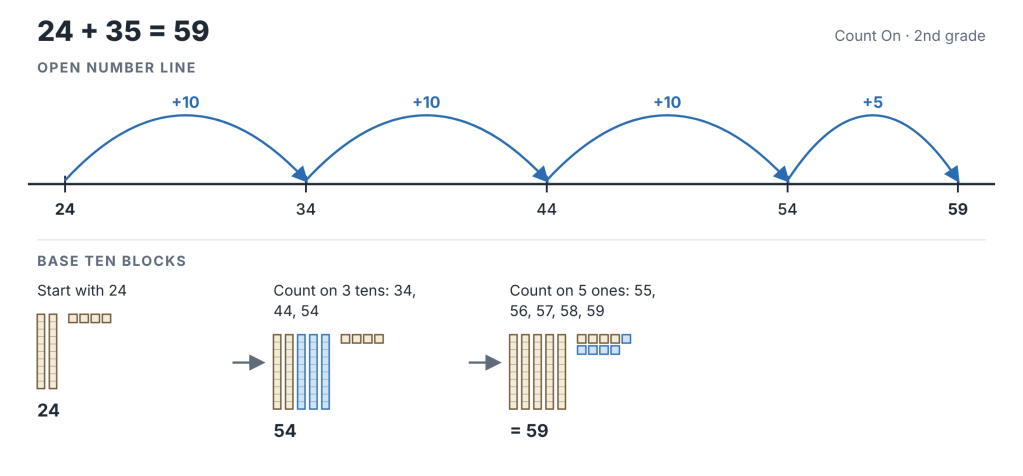
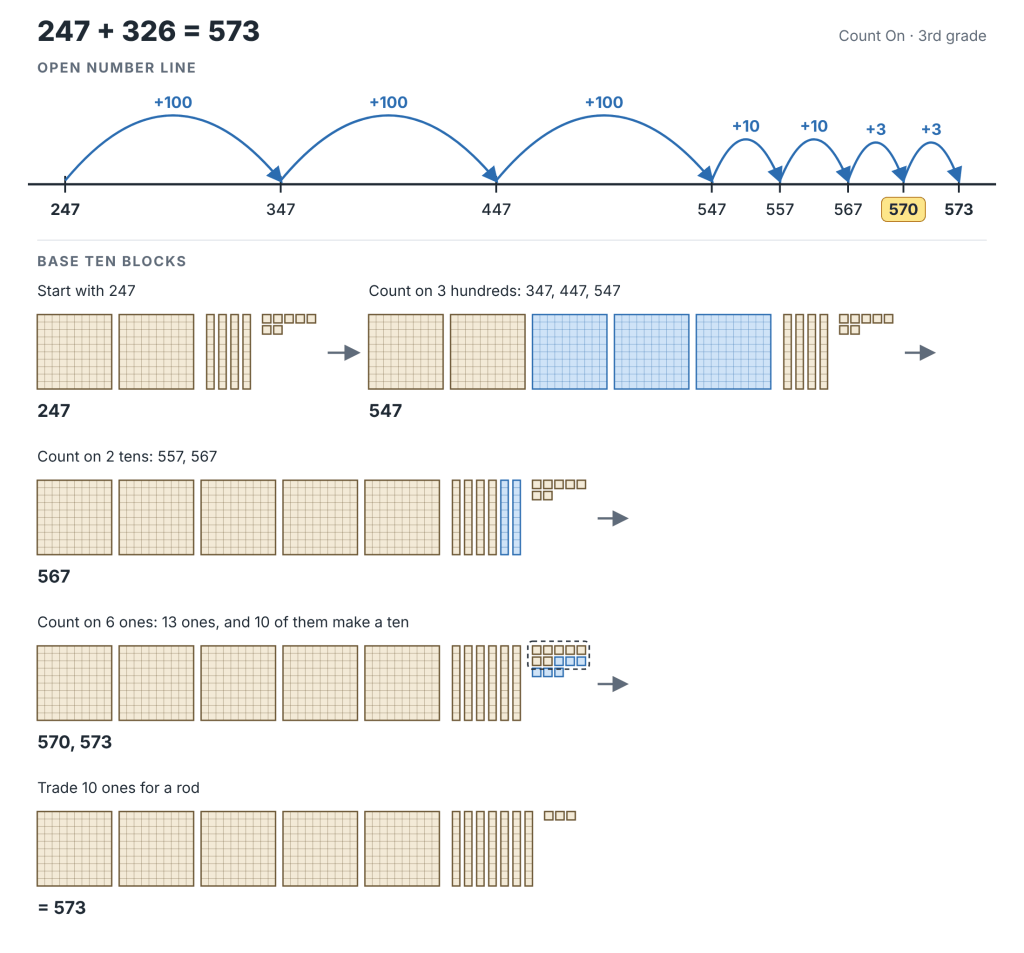
Thin slicing kept everyone moving. Each new problem in a string raised the challenge a bit, so teams could keep building on what they had just figured out.
Compensation holds a lovely twist. When you add 20 instead of 19, you added one too many, so you take one away. When you subtract 20 instead of 19, you took away one too many, so you give one back. Having 46 + 19 and 63 − 19 in the same string brings that flip to the surface.
Making the movie in your mind
In reading, we talk about making the movie in your mind. A reader can decode every word on the page and still not understand the story. Comprehension happens when the reader builds a picture of what the words describe.
Conceptual understanding in mathematics works the same way. A student who understands 63 − 19 can see the action: a jump back 20 that goes a little too far, then a step forward 1. A student who writes 0.12 for 0.9 + 0.3 has processed the digits but hasn’t yet pictured the quantities. That is the math version of decoding without comprehending.
Our three jobs are frames of that movie. The blocks put the quantity in our hands. The number line draws the action. The scribe connects both to the symbols. The goal is for students to carry the movie with them, so that one day they can close their eyes and narrate it with no tools at all.
What might change if we asked students to tell us the movie before we asked them for the answer?
Growing together as a vertical team
Our teams intentionally mixed 1st-, 2nd-, and 3rd-grade teachers. When a 1st-grade teacher builds 247 + 326 with blocks and a 3rd-grade teacher draws 9 + 3 on a number line, we each see where our students are coming from and where they are headed next.
That shared view is how a vertical team builds capacity together. We share four strategy names: count on, count back, compensation, and decomposing. We share two models: base-ten blocks and the open number line. And we share one big idea: the strategy stays the same when the unit changes.
One question I hope we keep asking each other: What does my grade promise the teacher who will have my students next year?
- 1st grade builds ten as a landmark students can see and use.
- 2nd grade makes place value something students can act on, composing and breaking tens with confidence.
- 3rd grade stretches landmarks to the hundreds and opens the door to decimals.
As a next step, imagine each of us bringing back one student number line and one sketch of base ten blocks. If we lay them side by side from 1st grade through 3rd, where does the movie get clearer from grade to grade? Where does it get blurry?
Questions to carry back to our classrooms
The ones doing the talking are the ones learning, and today our teachers did a lot of talking. As we head back to our classrooms:
- Where in each string do your students live right now?
- How might you use jobs like scribe, number line visualizer, and base ten block visualizer with your students?
- What would it take for your students to choose a strategy for themselves, rather than wait to be told which one to use?

