In Part 1, Multiplication: Knew It Right Away, or Figured It Out? A team approach to fluency, I shared how we assess multiplication fluency in 4th, 5th, and 6th grade: accuracy in chunks: flexibility, confidence, and a leveled retrieval-practice assessment.
But data that lives only in a teacher’s gradebook can’t help a student learn. So every student has access to their own data: what they know and what they need to learn.
What happens when students can see it for themselves?
What students see
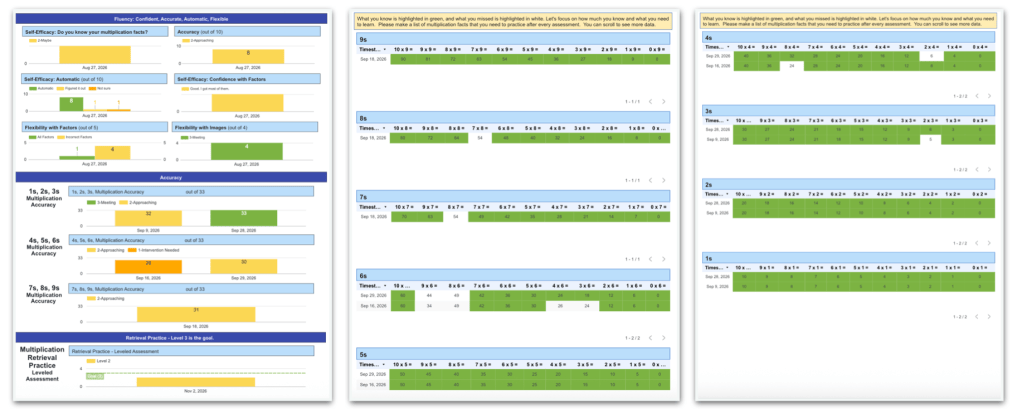
Each student’s view has two parts.
- A dashboard. Their self-efficacy, accuracy, automaticity, flexibility, accuracy chunks, and leveled assessment results, all on one page.
- Fact tables. One table for each set of facts, from the 1s through the 9s, with a row for every assessment. What they know is highlighted in green. What they missed is highlighted in white.
At the top of every fact table, students read the same invitation: Let’s focus on how much you know and what you need to learn. Then they make a list of the multiplication facts they need to practice, after every assessment.
Notice what this does. Students start with a sea of green; they know lots of facts. The white cells are not failures. They convert into a short, specific practice list.
Same level, different paths
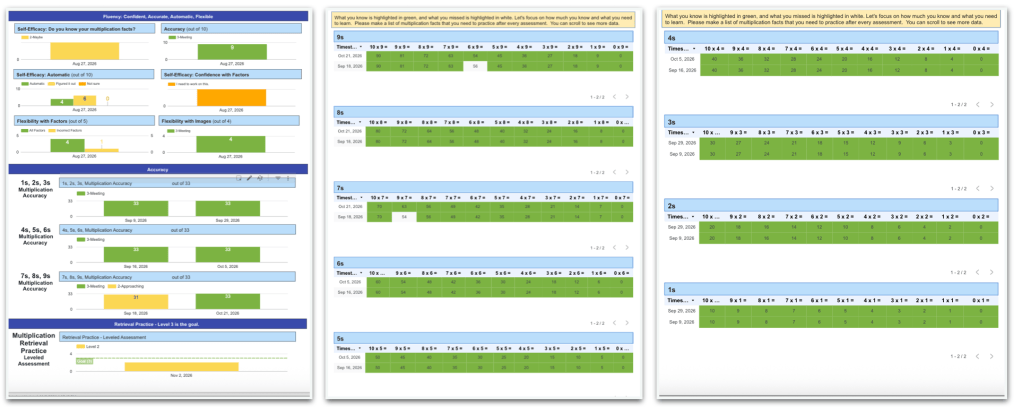
Here are two more students. Both answered “Maybe” when asked if they know their multiplication facts. Both are at Level 2 on the leveled assessment. Do they need the same next step?
| Student C | Student D | |
|---|---|---|
| Do you know your multiplication facts? | Maybe | Maybe |
| Automatic (out of 10) | 8 | 4, with 6 figured out |
| Flexibility with factors (out of 5) | 1 | 4 |
| Confidence with factors | “Good. I got most of them.” | “I need to work on this.” |
| 4s, 5s, 6s accuracy (out of 33) | 28, then 30 | 33, then 33 |
| 7s, 8s, 9s accuracy (out of 33) | 31 | 31, then 33 |
| Leveled assessment (goal: Level 3) | Level 2 | Level 2 |
Student C needs specific facts and factor work. The fact tables point to a short list: the 6s, plus 7 × 8 and 8 × 7. The 4s, 5s, 6s chunk is climbing, from 28 to 30. Finding all factors, 1 of 5, is the bigger gap, and C believes it is going well.
Student D needs efficiency. Every fact on D’s most recent tables is green. D is accurate. But 6 of 10 facts are still figured out rather than automatic, and D honestly reports, “I need to work on this” with factors.
Same level. Same “Maybe.” Different next steps. That is why we look at more than one measure, and why students look too.
54 or 56?
Look closely at the white cells, and a pattern appears.
- Student C wrote 54 for 7 × 8 and for 8 × 7.
- Student D wrote 56 for 6 × 9 and 54 for 9 × 7.
Two different students mixed up the same two neighbors: 6 × 9 = 54 and 7 × 8 = 56. These are not random errors. They are close-but-not-quite memories of facts that sit side by side.
More drill on the answer is not the fix. A strategy that rebuilds the fact is.
- 7 × 8: I know 7 × 7 = 49. One more 7 makes 56.
- 6 × 9: I know 6 × 10 = 60. Take away one 6, and I have 54.
And spaced practice works. Student D missed 6 × 9 and 9 × 7 in September. By the October assessment, both were green.
From student data to teacher learning
If students are making practice lists, teachers need a rich set of practice options that are not worksheets. So this round of data shaped our next faculty learning: an asynchronous session on Wednesday, November 4.
Our goals
- I can focus on retrieval practice for multiplication fluency.
- I can plan activities that help students become fluent mathematicians.
Our resource: Each teacher received a copy of Figuring Out Fluency: Multiplication and Division With Whole Numbers by Jennifer Bay-Williams and John SanGiovanni.
The plan
- Read the first two pages of Part 3, Putting It All Together (pp. 166-167).
- Sign up for one activity from Part 3 and learn how to use it.
- Practice with your team.
Each teacher becomes the expert on one routine, game, or center, then teaches it to their team. Together, a team leaves with a toolkit.
| Activity | Name | Type |
|---|---|---|
| F.1 | Strategize First Steps | Routine |
| F.2 | M-A-K-E a Decision | Routine |
| F.3 | Share-Share-Compare | Routine |
| F.4 | Strategy Spin | Game |
| F.5 | Just Right | Game |
| F.6 | Strategories | Game |
| F.7 | Make a Product | Game |
| F.8 | A-MAZE-ing Race | Game |
| F.9 | Strategy Problem Sort | Center |
The game boards and resources are on the book’s companion website. Three grade levels learn together. They share the load. They find time to learn together and develop more resources for students.
Questions I’m sitting with
- What changes when students, not only teachers, can see what they know and what they need to learn?
- Which errors in your classroom are close-but-not-quite memories, like 54 and 56?
- How do you help students turn a practice list into practice that builds strategies, not just repetition?
I’d love to learn from you. How do your students use their own data?

