On Friday, November 13, I joined Atlanta Area Technology Educators (AATE) at The Westminster Schools. It is always a little bit of a homecoming for me to walk that campus; I spent years there teaching Algebra I and Calculus. This time I came as a learner with three questions in my pocket:
- What is worth learning now, when AI can write the essay and solve the problem?
- How do we make sure students (and teachers) are still doing the thinking?
- What does it take to build a culture where innovation is the norm, not the exception?
The day did not hand me tidy answers. It gave me better questions, and that is exactly what good professional learning should do.
Starting in a 6th grade math classroom
The morning opened with tours of Westminster’s innovation labs. I chose a different path and asked to observe a 6th grade math class instead. I will always choose the chance to watch students think.
What I saw in that classroom set the tone for the rest of my day. The ones doing the talking are the ones learning.
Keynote: Dr. Leah Carmichael, “What Is Worth Learning Now”
Dr. Leah Carmichael, Executive Director of Active Learning at the University of Georgia, framed her keynote as a hero’s journey through five stops: Lecture, Pandemic, Active Learning, AI, and What’s Next. I loved that she began where many of us began, in an elementary classroom. Before UGA, she taught third grade at The Children’s School, where her students ran a class congress and learned through immersive role-play. She described it as active learning before she had a name for it.
Then came graduate school and the message that, as a PhD, you must lecture (but charismatically). Her story turned in 2018, when UGA’s Active Learning Summer Institute changed everything for her. The research is detailed and has been for a long time: lecture alone fails students. The pandemic made it impossible to ignore. When lectures became videos on Zoom and YouTube, one question remained. If a lecture is just a video, what is the room for?
UGA’s Active Learning initiative, launched in 2022, has grown into something impressive:
- 200+ instructors have redesigned full courses
- 82,000+ students have taken redesigned courses
- 81% of central classrooms have been upgraded for active learning
- GPAs are up, and DFW rates are down in redesigned courses and courses with Peer Learning Assistants
What caught my attention as a professional learning leader was how they support faculty. It is a path, not a one-time workshop. Active learning is built into hiring, introduced in short workshops, deepened through a summer institute where faculty rebuild a course through backward design, and sustained by Active Learning Mentors who bring the approach back to their departments. The phrase on the slide said it all: a culture, not a workshop.
They also invest in students teaching students. Peer Learning Assistants, undergraduates who did well in the course, guide group work as peers, never graders. Courses with Peer Learning Assistants see gains even when the course itself has not been redesigned. That is a powerful reminder of the role of student voice and peer explanation.
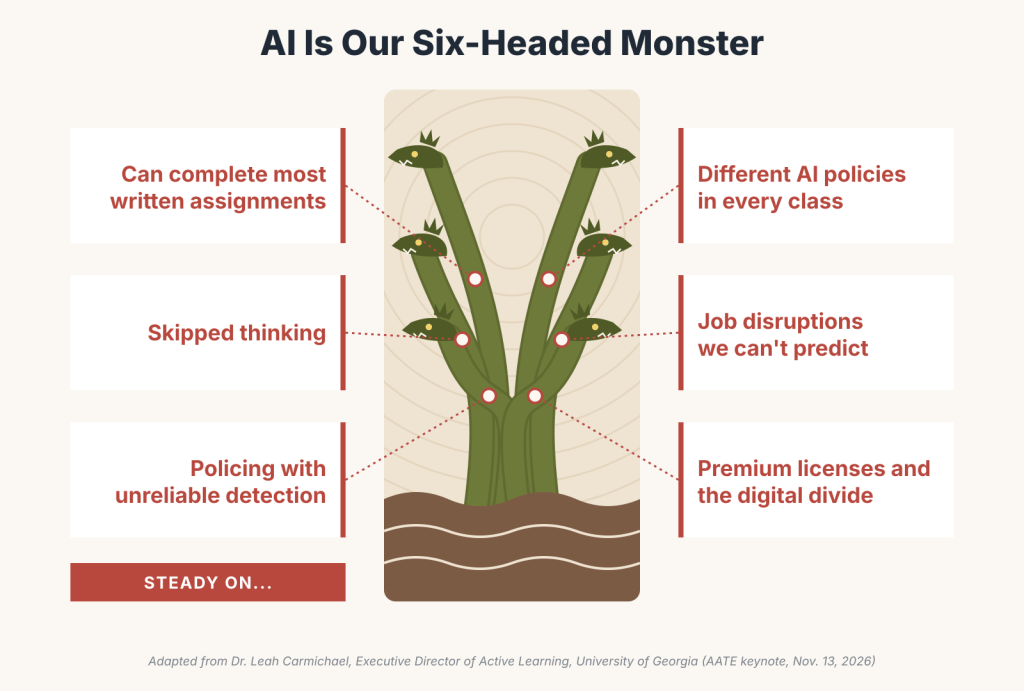
Dr. Carmichael named what many of us are feeling. AI can complete most written assignments. Thinking gets skipped. We find ourselves policing with unreliable detection. Students face different AI policies in every class. Job disruptions are hard to predict, and premium licenses widen the digital divide.
Her response was not to abandon active learning but to sharpen it. Active learning still means focusing on skills (students apply, analyze, evaluate, and create), co-creating knowledge together, and reflecting so students learn how they learn, for life. She walks through backward design: start with the skills for mastery, decide what evidence of mastery will look like, then choose active learning approaches that both practice and reveal that mastery. In her own course, a policy brief became a live press conference where students build their positions on their own and then defend them in the room.
My favorite idea of the morning was what she calls the Bloom’s Round Trip. Students climb every level of Bloom’s without AI, from remembering to creating. Then, on the way back down, they use AI and evaluate it. Students earn the expertise first, and then they have the knowledge they need to judge what AI produces.
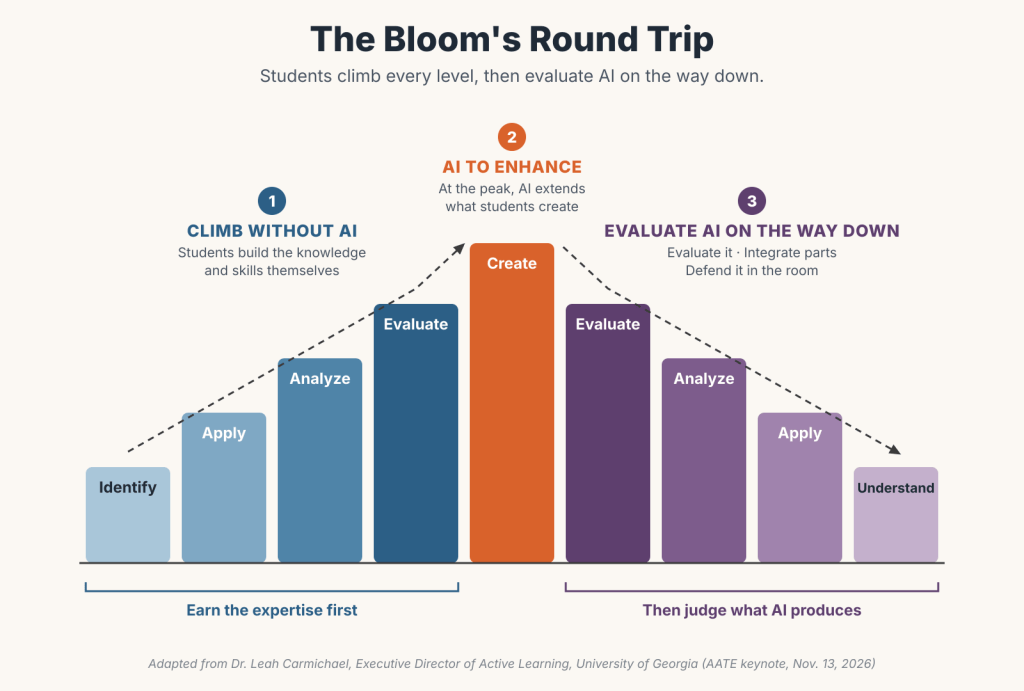
This connects so directly to what we know from Mind, Brain, and Education science. Students cannot evaluate what they do not yet know. Retrieval, practice, and metacognition are not old-fashioned in an AI world; they are the foundation that makes thoughtful use of AI possible.
She closed with questions for those of us in K-12:
- Are your students already performing what they know?
- How can we align K-16 around world-readiness skills that build on one another year after year?
I am still sitting with both. I think the answer to the first is “yes, and we can do more.” The second one feels like an invitation.
Apps Script: Vibe Coding with AI
After lunch, I joined Daniel Forrester (HIES) and Mark Labouchere for a session on vibe coding with Google Apps Script. The premise: you can build a working tool for your own classroom without knowing how to code. You describe what you want in plain English, the AI writes the code, you paste it into Apps Script, and you tell the AI what happened. That back-and-forth is vibe coding.
The presenters shared a starter guide with two paths in:
- The guided build. A set of six prompts that builds a course planning app, one layer at a time: a day-by-day list, a calendar builder, a minute-by-minute view of a single class period, and (my favorite) cognitive load coaching that charts the load across a lesson and flags things like two high-load blocks back to back or no break in a long period.
- The blank chat. A fill-in-the-blank starter prompt for building the tool you have always wanted: “I am not a coder, but I want to vibe code an app using Google Apps Script and a Google Sheet. I teach… Right now I… and it’s frustrating because…”
What struck me most is that the habits of good vibe coding are the habits of good learning:
- Small steps you can test. Ask for one change at a time and test it before asking for the next.
- Report what happened. The step most people skip is telling the AI what you actually saw. It is feedback, and feedback drives learning.
- Let it ask questions. The starter prompt asks the AI to pose up to three questions before writing any code. Those questions often show you what you had not decided yet.
- Protect student privacy. Never paste student names, grades, or personal details into the chat. Describe the data instead, and keep the real data in your own Sheet.
- Expect things to break. The guide includes a “when you get stuck” table of exactly what to say. Productive struggle, with sentence frames!
The guide also includes a progression from plain-language prompts to direct prompts, and you pick up the vocabulary just from reading what the AI sends back. I could not help thinking about our learning progressions and “I can” statements. Novice builders start with full scaffolds and, over time, need fewer words to say the same thing.
Creating Community: How Investing in Culture Became a Catalyst for Innovation
My last session was with Mark Labouchere and Ben Steele, who shared the story of Westminster’s Innovation PLC and Innovation Cohort. Fifteen years in, these programs are two of Westminster’s most impactful efforts for sparking faculty creativity. The headline of their story: invest in people and culture, not tools alone.
It started in 2013 as a voluntary group of teachers with a shared curiosity: bottom-up and faculty-driven. Teachers from all divisions formed a monthly STEAM PLC. A STEAM exhibit put student work in front of the whole school, and Maker Faire Atlanta took the energy off campus. By 2018, running three divisions on one calendar was hard on faculty, so each division built its own version. In 2020-21, the Innovation PLC and Cohort took shape in the Upper School.
Today the Innovation PLC is in its 14th year, with 20-30 faculty at a typical session and faculty presentations twice a month. I loved how simple and intentional the structure is:
- 7:45 Arrive. Food, coffee, and the presenter’s walk-up song.
- 7:50 Present. Twenty minutes from a colleague, with pictures over polish.
- 8:10 Discuss. Fifteen minutes of questions and shared ideas.
- 8:25 Adjourn. On time, before the school day.
Recent sessions have come from every disciplinary corner, from a Chemistry Casino to making vocal phonation visible in performing arts to inclusive projectile motion for students who are blind or have low vision.
The formal model offers multiple entry points: come and listen at the Innovation PLC, try a tool with support in a workshop, redesign a lesson or course with a curriculum grant, or spend a year building a project with coaching and peers in the Cohort. Cohort members receive paid time, a design sequence, 20-30 hours of one-on-one coaching, connections across campus, and a public stage for their work. Eight principles they keep returning to:
- Unite around a common purpose
- Focus on people, not technology (coaching was the most-cited benefit)
- Focus on individual creativity (start from each teacher’s wonder)
- Be inclusive and non-oppositional (open to all, and “bring a friend”)
- Meet people where they are (many entry points, no pressure to climb)
- Address real curriculum needs
- Make learning visible (a gallery of work drove adoption)
- Make it fun and exciting
They left us with two questions that I want to keep asking at Trinity:
- Where do communities organically form at your school?
- Is student or faculty work highly visible at your school? Where or how is that work celebrated or displayed publicly?
Teachers are most inspired by what their colleagues are doing. That line has me thinking about how we make our own Wednesday Workshops and classroom practice more visible to one another.
The common thread
Looking back over my notes, the same idea surfaced in every room. At UGA, it is a culture, not a workshop. At Westminster, it is people, not technology. In vibe coding, it is small steps, feedback, and a willingness to say “I am not a coder” and learn anyway. And in that 6th-grade math class, it was the students doing the thinking.
AI is changing what students can produce. It does not change how people learn. Learning still requires effort, practice, feedback, reflection, and community. Our job is to design for that, for our students and for ourselves.
So I will leave you with the question that framed the day:
What is worth learning now, and how will we ensure our students (and our faculty) are the ones doing the learning?
I would love to hear how you are wrestling with it.
Thank you to AATE and to The Westminster Schools for hosting a thoughtful, energizing day.

