In my last post, I shared Marsha Harris’s guest write-up of a Building Thinking Classrooms lesson I taught with our third graders and their teachers. Marsha captured the morning beautifully from the outside. This post is my view from the inside: what I planned, what I let go of, and one surprise I can’t stop thinking about.
Planning I didn’t use (and why that was fine)
I built a slide deck for The Carnival Conundrum, a task from Mathematics Tasks for the Thinking Classroom, Grades K-5 by Peter Liljedahl and Maegan Giroux. It held my launch script, my anticipation work, and a note-making page for the end of the lesson.
Then we met in the hub, and the deck stayed closed.
That turned out to be a gift. One of the Building Thinking Classrooms norms is that tasks are given verbally, with students gathered close and standing, not reading off a screen. Without a projector to lean on, I told the story. Mr. Gough loves carnival games and never wins. At the end of a long day, he finds one last game: five circles, five numbers, and a promise that he wins if both diagonal arms add to the same sum. He tries once and loses. He has one more chance. How can he arrange the numbers to win?
The story did the work the slides would have done, and the students leaned in.
Anticipating the mathematics
The deck was never really for the students anyway. It was for me. Before I teach a task, I want to do the mathematics myself so I can anticipate what students might try, where they might get stuck, and what patterns might surface.
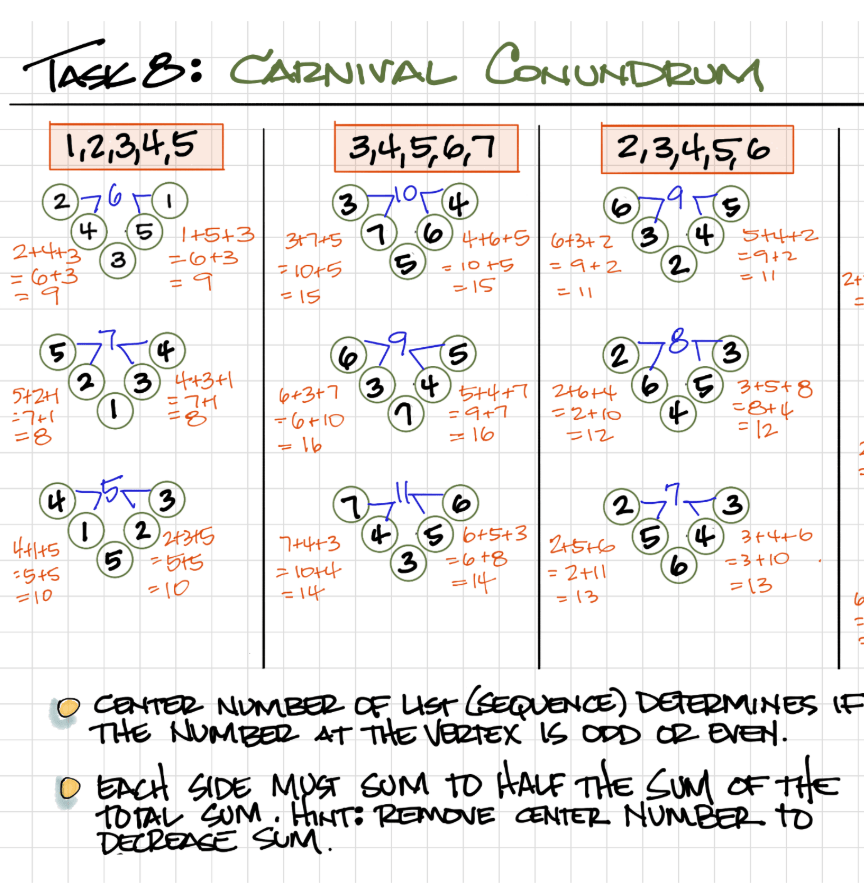
I worked three sets of consecutive numbers: 1 through 5, 3 through 7, and 2 through 6. For each set, I found three winning arrangements and checked every diagonal. Two noticings went to the bottom of my page:
- The center number of the list determines whether the number at the vertex is odd or even.
- Each diagonal has to sum to half of the total sum, which means the vertex matters more than any other position.
Looking back at my own work, I notice how I checked each diagonal. I didn’t line the numbers up and carry. I grouped first: 2 + 4 + 3 became 6 + 3, then 9. I looked for a friendly pair and added the third number on. Keep that in mind.
Morning meeting: What students told us
As it happened, I was in the room for morning meeting. After the greeting, each student shared their favorite addition strategy.
Of the 19 students in the room, 15 named the standard algorithm. Several of them said they had two favorites: the standard algorithm and decomposing. The other 4 students said they preferred partial sums and decomposition.
I tucked that away and went to teach.
At the boards: What students did
As the teachers and I circulated, students tested arrangement after arrangement. They wrote equations. They crossed out attempts that didn’t work. When we moved to 13, 14, 15, 16, and 17, they kept adding three-digit numbers to check each diagonal.
And here is the surprise. We never, and I mean never, saw the standard algorithm.
What we saw instead was decomposing, regrouping, and looking for friendly combinations. 13 and 17 add up to 30. 14 and 16 make 30. Students found those pairs and built from them, much like I had in my anticipation work.
What I’m wondering
I don’t read this as a gap. I read it as good news. These students chose strategies that fit the numbers in front of them. With three small addends and lots of checking to do, mental strategies were faster and more flexible than stacking numbers and carrying. That is exactly the kind of number sense we hope for.
But there is a real difference between what students said and what they did, and that makes me curious.
- Why do so many students name the standard algorithm as their favorite? Is it the strategy with the most official-sounding name? The one that feels most grown-up? The one they believe teachers want to hear?
- Do students recognize when they are decomposing? If they can’t name the strategy they just used, how do we help them notice their own thinking?
- What would happen if we asked, “Which strategy did you use?” right after the task instead of “What is your favorite strategy?” at morning meeting?
- How might note-making help? My planned note-making page asked students to record what they needed to remember in their own words. What if one of those things were the strategy they actually used, and why it worked for these numbers?
The standard algorithm is a powerful tool, and students will need it. It just isn’t the only tool, and it isn’t always the best one for the job. I want our students to choose strategies intentionally and know they are making that choice.
Looking ahead
This is metacognition in action, or maybe metacognition waiting to happen. Our students are already flexible thinkers. The next step is helping them see themselves that way.
The ones doing the talking are the ones learning. I want our students talking about how they added, not just what they got.
How might we help learners notice, name, and own the strategies they are already using?

