In an effort to be transparent and focused on learning, with Sarah’s permission, I am sharing the write-up from her strength-based observation: “Observation by Invitation: Observation, not Evaluation.”
Date Visited: April 8, 2026
Grade: 5th Grade Social Studies with Kate Burton
Observer: Jill Gough
Here’s what I think happened prior to today:
This was Day 3 of a jigsaw activity focused on the Great Depression. On Day 1, students read and studied articles about the Great Depression, each group becoming “experts” on their assigned aspect of the topic. On Day 2, students “took notes” on their reading in their “expert” groups and discussed the six factors that led to the Great Depression.
As we are preparing for 5th Grade Olympics, three IOC (International Olympic Committee) groups anchored the collaborative structure:
- Montreal
- Los Angeles
- Berlin
On Day 3, groups returned to their IOC teams to synthesize their expertise into a collaborative summary document, working toward a collective answer to the anchor question:
“What made the Great Depression a terrible time?”
Students were tasked with recalling what they read, identifying what was important, and working together to create the “ultimate study guide.”
2:05 PM — Students Arrive
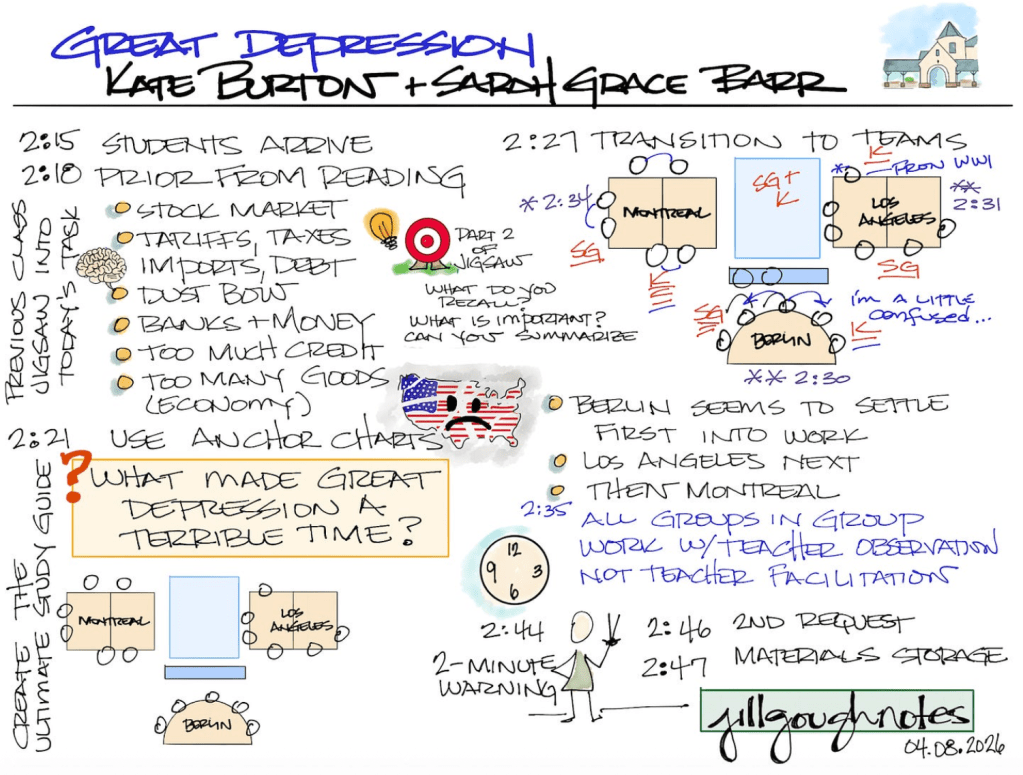
Students entered and transitioned to their IOC groups. The physical space was arranged with group tables already set up, supporting immediate collaborative engagement. No time was lost to logistics.
2:10 PM — Prior Knowledge Activation
Teachers opened by connecting to the previous session’s jigsaw work. Students recalled the topics they had studied: Stock Market, Tariffs and Taxes, Imports and Debt, Dust Bowl, Banks and Money, Too Much Credit, and Too Many Goods. Kate scribed as students recalled.
This activation move aligns with retrieval practice research, which consistently shows that asking students to recall what they know before instruction strengthens long-term retention significantly more than re-reading or reviewing. The “What do you recall? What is important? Can you summarize?” trio of prompts is a textbook example of a retrieval-and-elaboration sequence.
“What made the Great Depression a terrible time?” This question reflects the NCSS C3 Framework’s emphasis on disciplinary inquiry, which frames learning around questions that require students to construct evidence-based arguments rather than simply receive facts. This question also reflects Trinity’s commitment to deep learning.
The question also directly aligns with Georgia Standard: “Explain how the Great Depression and New Deal affected the lives of millions of Americans,” connecting the lesson’s group task to the required historical understanding of causes and human impact.
2:27 PM — Transition to IOC Teams
At 2:27, students transitioned to their groups (Montreal, Berlin, Los Angeles) with the following structure visible:
- Kate explicitly named the task: create the “ultimate study guide” together
- Groups were given agency over how to organize their thinking
Teacher Circulation Pattern (2:27–2:44)
My observation notes tracked group interactions with both Kate and Sarah Grace. Each underlined pair of initials represents a distinct interaction. The pattern revealed:
Berlin: Settled into work first (noted at ~2:30–2:31)
Los Angeles: Engaged next; received teacher check-in at ~2:31
Montreal: Needed the most support to launch; teacher noted at ~2:34
Both teachers responded by observing before intervening, a hallmark of responsive facilitation. In most cases, they circulated to motivate, clarify, and move work forward rather than to direct or correct. The distinction between observation and facilitation (“group works w/teacher observation, not teacher facilitation”) is significant: research from Vygotsky’s framework confirms that students develop a deeper understanding when given sustained time to struggle productively within their zone of proximal development before adult scaffolding is introduced.
2:35 PM — Sustained Group Work
All three groups were engaged. At 2:35, there was a shift to sustained independent group work with teacher observation; a deliberate choice to allow students to develop their thinking without teacher-directed support. This reflects the Cultures of Thinking principle that classrooms where thinking is visible are ones where it is valued and actively promoted by creating time and space for genuine intellectual work.
2:44–2:47 PM — Closing Sequence
- 2:44: Two-minute warning given by Kate
- 2:46: Second request to wrap up
- 2:47: Materials storage with students transitioned to prep for carpool
The structured close gave students advance notice, honoring their work by not abruptly ending it. This small move reduces cognitive interruption and models the time-management and self-regulation habits valued in the Trinity Way.
This lesson was rich with Making Thinking Visible (MTV) moves from Project Zero
- Compelling question as a thinking prompt: “What made the Great Depression a terrible time?” is a well-crafted open question that requires synthesis; it cannot be answered by a single fact and demands that students combine multiple causal factors.
- The “ultimate study guide” is a thinking-made-tangible artifact: students must negotiate, organize, and articulate what they collectively know. This is exactly the type of product Ritchhart identifies as central to a culture of thinking.
- Kate and Sarah Grace deliberately listened and watched before stepping in, allowing student thinking to develop without overriding it: a core MTV disposition.
Mind, Brain & Education Research Connections
Retrieval Practice & Long-Term Retention
The opening “prior knowledge from your reading” prompt is a low-stakes retrieval practice event, one of the most robustly supported strategies in cognitive science. Retrieving information from memory (rather than re-reading) strengthens neural encoding and dramatically improves long-term retention. By asking students to recall before presenting new input, teachers activate relevant schemas and establish meaningful connections.
Social Learning & Collaborative Cognition
Vygotsky’s sociocultural theory posits that learning is inherently social; students construct deeper meaning through dialogue with peers. The jigsaw cooperative structure requires every student to hold expert knowledge that others need, creating genuine interdependence. Research on the jigsaw method demonstrates improved academic performance, greater motivation, and an increased sense of belonging.
Emotion, Motivation & the Learning Brain
The IOC framing (naming groups after Olympic host cities) adds a layer of identity and belonging to each group. Research in affective neuroscience demonstrates that emotion is not separate from cognition. Students who feel connected to their group and their task engage more deeply and retain more. The teachers’ warm interactions: observing, motivating, and clarifying rather than correcting, maintain a low-threat, high-challenge environment consistent with optimal learning conditions.
Productive Struggle
The deliberate choice not to facilitate but to observe reflects an understanding of desirable difficulty. When students work through confusion (as evidenced by the “I’m a little confused” comment), they build stronger and more transferable understanding than when answers are quickly supplied. Teachers who resist the impulse to rescue are enacting one of the most important and counterintuitive lessons from MBE research.
Connections to The Trinity Way
This lesson is a vivid expression of the Trinity School Mission and Program & Pedagogy Pillars in action:
- Deepen Students’ Educational Experience
“Develop creative and critical thinking and questioning skills; value both process and product of learning; connect learning vertically, horizontally, cross-curricularly, and globally.”
Observed: The anchor question requires synthesis across multiple content areas. The jigsaw creates a horizontal curriculum connection across groups. The process (how we organize, who holds what knowledge, how we negotiate meaning) is as valued as the product (the study guide).
- Empower Students in Their Learning
“Foster a growth mindset; cultivate voice, choice, and self-reflection; promote leadership.”
Observed: Students hold genuine expertise. Each group member brings knowledge that others don’t, making every child a leader within their jigsaw. Teacher observation (not intervention) empowers students to direct their own learning. Voice and choice are built into the structure. - Exhibit Continued Curiosity, Creativity, and Confidence
“Imagine, discover, and experiment independently and collaboratively; adapt to new situations and a changing world.”
Observed: Students are discovering how to synthesize complex historical information together, without a single “right answer” — the study guide they create is genuinely theirs. The ambiguity (What should we include? How do we organize it?) demands creativity and collaborative problem-solving. - Build Academic Foundation + Develop Character Foundation
The lesson simultaneously builds content knowledge (the causes and impacts of the Great Depression) and character (accountability, persistence, resilience, empathy for peers’ ideas, and integrity in representing what one has learned). The Trinity Way’s emphasis on both is entirely visible here.
Strengths Observed
- Kate’s high expectations and confidence in her students are clear and, I feel, understood by her students. Working with this much cognitive demand at 2:15 in the afternoon shows commitment to learning, high expectations, and the use of every minute we have to advance learning and understanding.
- The jigsaw model is not simply “group work;” it is a rigorously researched cooperative learning strategy. Kate implemented with a clear purpose and intentional design.
- The question “What made the Great Depression a terrible time?” is exemplary: it is open, requires evidence, connects to students’ prior reading, and is genuinely answerable at multiple levels of sophistication. It respects students’ capacity for historical thinking while clearly defining a learning target.
- The explicit decision to observe rather than facilitate is one of the most research-aligned moves in the lesson. This restraint is harder than it sounds and reflects deep trust in students. It also gave Kate and Sarah Grace valuable formative data: they could see which groups were thriving, which needed support, and how to support them.
- The fact that Berlin settled first, Los Angeles next, and Montreal last, and that Kate and Sarah Grace responded accordingly rather than visiting in a fixed rotation, demonstrates genuine responsive teaching. Support was directed where it was needed, in the moment.
- The two-minute warning, followed by the second request, and then materials storage show attention to transitions. Students were not abruptly stopped; they were given time to bring their thinking to a close. This is a small but important move that honors the work and prepares students cognitively for the shift.
Closing Reflection
Kate is designing learning that is simultaneously rigorous and joyful. This lesson brings together the best of what research knows about how learning works: retrieval, spaced practice, social cognition, productive struggle, within a structure that places students at the center as genuine thinkers and historians. The deliberate balance of structure and agency, and the quiet trust embedded in watching before intervening, reflects deep professional understanding of how children learn.
Great teachers don’t rest for very long; they ask, “What more am I capable of?” In true “Kate” fashion, Kate seeks feedback to strengthen her teaching. I look forward to our debrief and her questions.
The Trinity Way describes graduates as “self-advocates, academically prepared, and kind, compassionate, and empathetic individuals ready to improve the world around them.” This lesson is preparing students to be exactly that: young people who can investigate how the world has worked, collaborate to understand it together, and communicate what they know clearly and confidently.
Thank you for the invitation to observe.
 Experiments in Learning by Doing