What happens when you drop into a classroom with a quick question and can’t bring yourself to leave?
On September 9, I stopped by to ask Marley and Shaun something simple. I stayed because the room was full of joy. A week later, Shaun invited me back for the whole lesson, and I said yes before she finished asking.
Week one: me and my
Students were working on two high-frequency words, me and my, using Fundations paper (skyline, plane line, grass line) laid over a bumpy tactile surface so they could feel each letter as they formed it.
Marley modeled first, narrating every stroke: start at the plane line, down to the grass line, back up. Students named each letter aloud as she wrote, then underlined the word while saying it, a small movement that also had them crossing their own midline.
Then came Trace-Copy-Cover-Close. Trace it. Copy it. Cover it and write it from memory. And then, the moment I didn’t see coming: cover your eyes and write it one more time, blind.
The giggles when they opened their eyes and saw their own handwriting were unmistakable.
I also noticed something subtle. Me is fully decodable. My is not; that y making a long i sound hasn’t been taught yet. My got the same, if not heavier, scaffolding. The support matched what each word actually asked of a five-year-old.
Week two: at and am
This time, Shaun paired a decodable word, at, with a heart word, am, and made the difference explicit. Students learned the language for it: this one we can sound out, and this one we can’t. A heart drawn around the tricky letter signaled “this part you just have to know.”
The lesson moved through layer after layer: two-finger air-writing while saying letter names, air-underlining, a quick dance video full of -at words like hat and cat, and then a sentence-building challenge. Five students gathered in the reading nook and each received one word card (house, I, at, the, am). They presented the cards in scrambled order, and the class worked together to rebuild the sentence: I am at the house.
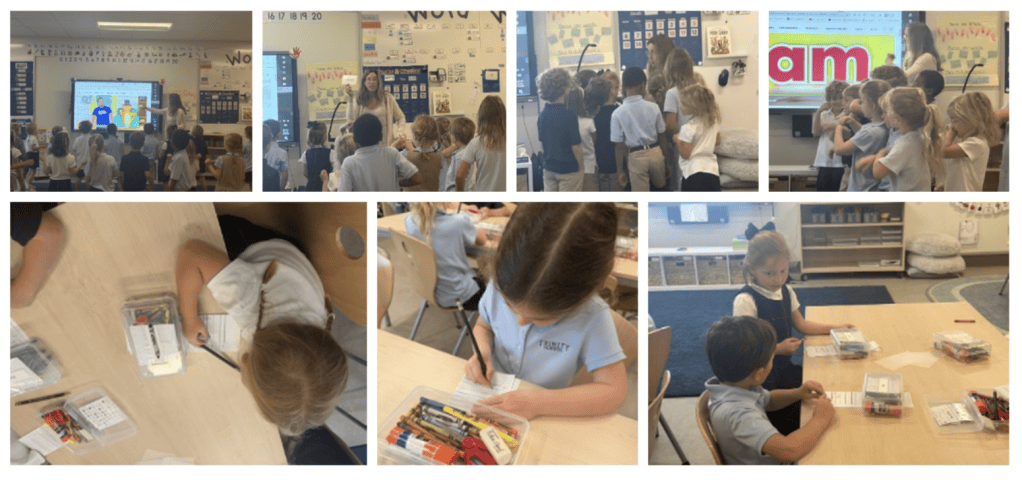
Then back to tables for Trace-Copy-Cover-Close on bumpy paper, tapping out am, two word searches, and finally, am went up on the word wall, ready to be a reference point for weeks to come.
And yes, the “close your eyes” step still brought delight. Joy built into the routine doesn’t wear off.
Why this works
These lessons are Orton-Gillingham in action. Visual, auditory, kinesthetic, and tactile input occur simultaneously, not one after another, which builds stronger, more durable letter and word memory. The regular-versus-irregular distinction is built into the structure of the lesson. And OG names success-oriented, emotionally sound instruction as a core tenet; those giggles aren’t a side effect, they’re part of the design.
This work also lives in the Transcription strand of Joan Sedita’s Writing Rope. Until handwriting and spelling become automatic, they eat up the working memory young writers need for ideas, sentences, and organization. Writing a word from memory, and especially with eyes closed, is retrieval practice: reconstructing rather than copying. The scrambled sentence task reaches further still, into syntax, giving students an early taste of the sentence-level work this automaticity will eventually free them to do.
Still wondering
What made “cover your eyes and write” land so powerfully? Is it the surprise, the risk, or the reveal? And if we can name it, can we design for it on purpose with future words?
Thank you, Marley and Shaun, for the invitation to stay, and Shaun, for inviting me back. Two small words at a time, you are building readers and writers who expect learning to feel like this.

