What happens when we stop to name the why behind the routines we teach every day?
On Wednesday, our EL, Pre-K, and K teachers gathered in the Community Room for a Wednesday Workshop with Michelle Perry: Orton-Gillingham: Refresh and Re-Energize, Building Strong Readers from the Start. These are the teachers who lay the foundation for every reader who walks our halls. My colleague Marsha Harris and I were both in the room, and we left with pages of notes and a lot to think about.
Michelle began by acknowledging that everyone in the room was at a different place in their experience with Orton-Gillingham. That one sentence made the learning open to everyone. Then she made a promise: we wouldn’t just talk about OG. We would experience it as students.
Setting the stage
Michelle opened with a lighthearted video about silent letters and the beautiful mess that is English spelling. We laughed and saw exactly why explicit language instruction matters.
She then made an important distinction. Orton-Gillingham is an approach to teaching reading, writing, and spelling, not a curriculum or program. It is direct, explicit, multisensory, and structured. It is also diagnostic and prescriptive, meaning we teach what each child knows and what they need next.
Michelle shared her personal OG family tree, tracing her own training from Samuel Orton through Page Sharp, David Schenck, Marge Tillman, Rosalie Davis, and Josie Calamari to her. This expertise is handed down teacher to teacher, through practice and mentorship. Every teacher in the room is part of that tree, and every teacher is the next branch.
Nine principles
Michelle walked us through the nine guiding principles of Orton-Gillingham:
- Diagnostic and prescriptive
- Individualized
- Language-based
- Direct and explicit
- Structured, sequential, cumulative, but flexible
- Synthetic and analytic
- Cognitive
- Emotionally sound
- Simultaneous multisensory
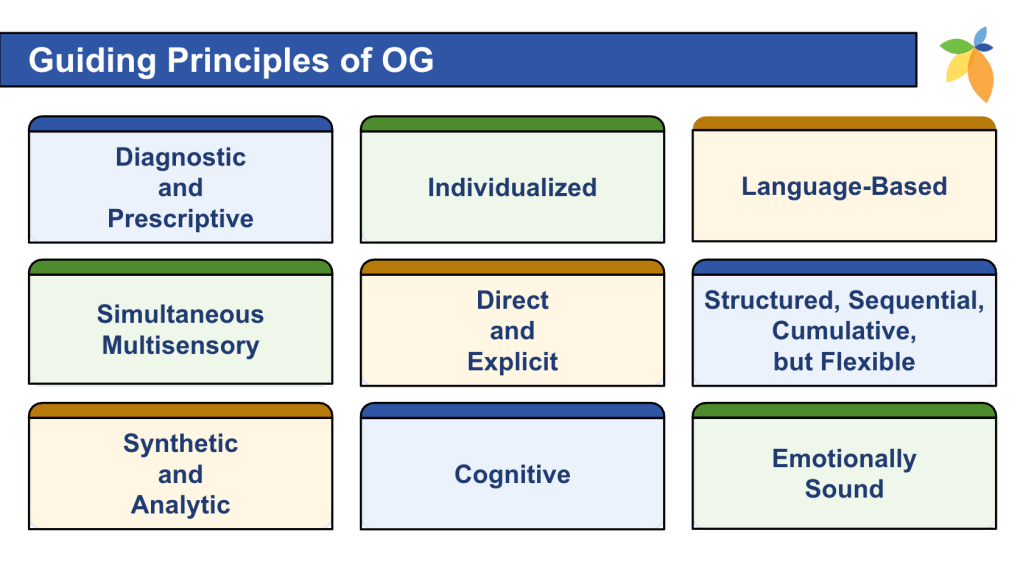
Although OG was first designed for one-to-one instruction, Michelle showed how these principles work in small groups and whole-class, Tier 1 instruction, too.
Two principles stood out. First, multisensory does not mean adding movement to make something fun. The auditory, visual, tactile, and kinesthetic pathways are deliberately combined so they strengthen one another. Second, instruction must be emotionally sound. Children need to trust us and feel successful before their confidence can grow. That idea ran through the whole afternoon.
One child in mind
Here is the move that brought “diagnostic and prescriptive” to life. Michelle designed the entire lesson around one hypothetical student: a child who has trouble telling short e from short i. Every word she chose had one of those two sounds. Every routine was aimed at what that child needed next.
Learn it, experience it, identify it
Then the teachers became the students.
Prime the Pump. We listened for beginning, middle, and ending sounds in short e and short i words, using intentional hand movements. Michelle connected this to Heggerty and was clear that every movement has a purpose.
Drill the Deck. Using bumpy paper, we traced letters with two fingers while looking at each letter and saying its sound. The goal is automaticity. Michelle modeled left-to-right directionality, accurate sound production, and consistent language, and she shared handwriting cues I’ll be hearing in my head for weeks: “Honey B“ and “C my D.“
Blending Drill. Michelle showed how blending moves from individual sounds to continuous blending to fluent word reading, from simple to complex. She covered parts of a word and revealed sounds a little at a time to support children toward success.
Dictation. Michelle calls dictation “the most bang for your buck,” and then showed us why. In one routine, children practice segmenting, sound-symbol correspondence, handwriting, blending, and applying what they have learned. It also tells the teacher what is, and is not, automatic for a child. The routine is simple and memorable:
Say it. Tap it. Write it. Make your pencil talk.
She closed this part by showing how bumpy paper and simultaneous oral spelling build automaticity with trick words.
After each part of the lesson, Michelle returned to the nine principles and asked, “What did you notice? Which principles did you just experience?” She didn’t tell us where the principles were. She asked us to find them. Marsha described the structure perfectly: learn it, experience it, identify it.
The ones doing the talking are the ones learning, and the room was full of talk. Teachers were moving, responding, asking questions, and making connections. By the end, the nine principles were no longer a list to remember. They were a lens we could use.
The best tip of the workshop: “Be quiet!”
Marsha’s favorite tip of the afternoon may be my favorite, too. After you give a sound or a word, be quiet. Give children time to think instead of repeating the prompt. Michelle showed how something as small as pointing to her mouth can offer a cue without taking away the thinking. She also talked about giving a cue before an error when you know a child is likely to make one.
Wait time is a gift. It tells a child, I believe you can figure this out.
Marsha summed up the afternoon beautifully:
“Nothing felt like an activity for the sake of an activity.”
The words, the movements, the materials, the cues, and even the silences were all connected to how children learn. Michelle taught OG the OG way: structured, cumulative, multisensory, explicit, and emotionally sound from the very first laugh. Returning to the principles after every routine was retrieval practice with spacing built in, and asking us to identify rather than recall added elaboration and metacognition. We didn’t just hear about the approach; we lived it.
Two strands of the rope
This session built on last week’s workshop on language comprehension. Together, the two sessions give our early childhood teachers both strands of Scarborough’s Reading Rope: word recognition and language comprehension. Strong readers need both, woven together, from the very start.
Wonderings to try
Choose one routine you teach every day.
- Which of the nine principles are embedded in it? Which is easiest to see? Which is hardest?
- Who is the child you have in mind when you plan it?
- Where could you say less and wait longer?
What might happen if a grade-level team looked at one routine together and named the principles out loud?
Michelle closed with Anna Gillingham’s reminder, and it’s one I’ll be carrying with me:
“Go as fast as you can, but as slow as you must.”
Thank you, Michelle, for helping us see the why in what we do. And thank you, Marsha, for adding your eyes and ears to this observation.

