What helps learning stick? How do our students know what they know, and how do we?
This fall, several of our faculty identified the same action step toward their professional goals: reading Smart Teaching Stronger Learning: Practical Tips From 10 Cognitive Scientists, edited by Pooja K. Agarwal, Ph.D. When a few colleagues independently choose the same book, it feels like an invitation. So we’re going to read it together.
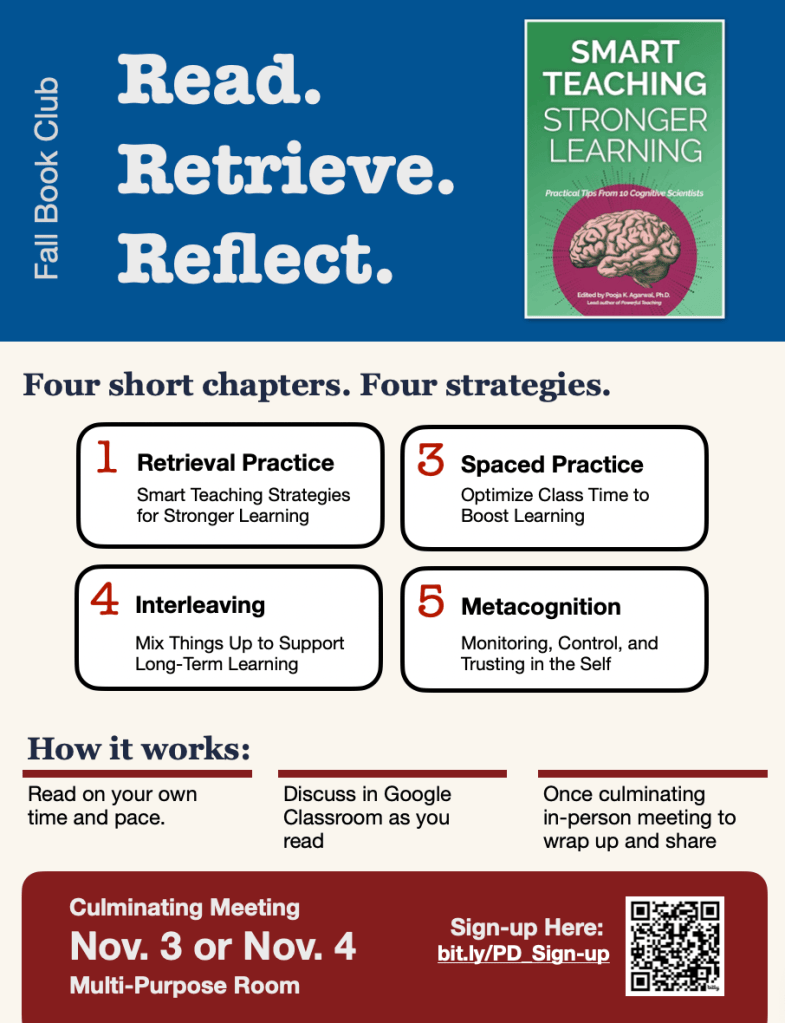
Each chapter comes from a cognitive scientist who is also a classroom teacher. The research is current and grounded in real classrooms, and the strategies are practical. Each chapter is about 10 pages. That’s short enough for a busy teacher, and every chapter offers ideas we can try tomorrow without adding prep or grading.
We chose four chapters that build on each other:
- (Chapter 1) Retrieval Practice: Smart Teaching Strategies for Stronger Learning
- (Chapter 3) Spaced Practice: Optimize Class Time to Boost Learning
- (Chapter 4) Interleaving: Mix Things Up to Support Long-Term Learning, or
(Chapter 2) Early Childhood Education: Retrieval-Based Learning for Children - (Chapter 5) Metacognition: Monitoring, Control, and Trusting in the Self
Teachers of our youngest learners will read Early Childhood Education (Chapter 2) instead of Interleaving. It explores what retrieval-based learning looks like with young children. I’m especially excited about this pairing. When we share across chapters, every teacher gets a view of learning from the early years through our oldest students.
We want to protect teachers’ time and deepen our thinking. Those two goals shaped the design of this book club.
Most of our conversation will happen asynchronously in Google Classroom. For each chapter, teachers will recall what they remember before rereading, share a strategy they tried, and respond to a colleague. The spacing between chapters is intentional. So is mixing ideas across chapters, and so is pausing to ask, “What do I know now that I didn’t before?”
In other words, we’ll be learning about retrieval, spacing, interleaving, and metacognition by doing them. We ask our students to learn this way, and I think it’s important for us to experience it as learners too.
In early November, we’ll meet once to connect ideas across grade levels and divisions. We’ll celebrate what teachers tried, learn from each other’s classrooms, and name the strategies we want to keep using. The ones doing the talking are the ones learning, and I can’t wait to hear the talk.
When teachers practice these strategies as learners, we notice things that are easy to miss from the front of the room. For example, we notice the productive struggle of retrieval. We notice the relief of coming back to an idea after some time away. We notice the surprise of realizing we knew more, or less, than we thought. I’m curious what our faculty will notice, and how it will show up in their classrooms.
How do you help learning stick? I’d love to hear what’s working for you.
While our Google Classroom is for Trinity Faculty, I have been asked to open this book club up to other teachers. I have a public Google Classroon that you can join, if interested. Just send me your name, school, and gmail address. I’ll add you right away.


Jill, I would love to join hit your learning community!
LikeLike
Send me your email address and I’ll add you to the Google Classroom!
LikeLike
angel.kytle@lovett.org
LikeLike