“The ones doing the talking are the ones learning.”
This afternoon, our 4th-, 5th-, and 6th-grade teachers gathered face-to-face in the UED Hub for our Wednesday Workshop on numeracy. We anchored our work in two learning goals:
- I can help students make their thinking visible.
- I can plan activities that help students become fluent mathematicians.
What if the best way to plan for students is to experience the learning as students first?
Starting with Retrieval
We opened with retrieval practice, using spaced and distributed practice to bring earlier learning back to the surface. Before learning anything new, we pulled from memory. It’s the same move we want students to experience daily: effortful recall strengthens what we know and reveals what we don’t yet know. Before stepping up to the boards, we reviewed our Building Thinking Classrooms norms. Norms matter. They set the conditions for risk-taking, collaboration, and shared sense-making, for adults as much as for students.
Thin-Slicing Fractions
We spent the heart of our time in two thin-sliced sequences: equivalent fractions, then adding and subtracting fractions. Each task stepped just slightly beyond the last, keeping us in that productive space between too easy and too hard.
Each vertical non-permanent surface was also magnetic, so groups worked with magnetic fraction strips right on the board. Suddenly, the task was multisensory: we could touch, move, compare, and rearrange the fractions while we reasoned about them.
We made two deliberate shifts from what we’ve been reading in Peter Liljedahl’s Building Thinking Classrooms.
Shift #1: A Role for Everyone
Each member of the three-person group took on a specific responsibility, and with each new task, they traded roles:
- Visualize – use the magnetic fraction strips to model the task.
- Represent differently – use or draw a number line to show another representation of the same task.
- Write – show all the work to construct a viable argument; we rephrased this as “show your work” so a reader understands without having to ask questions.
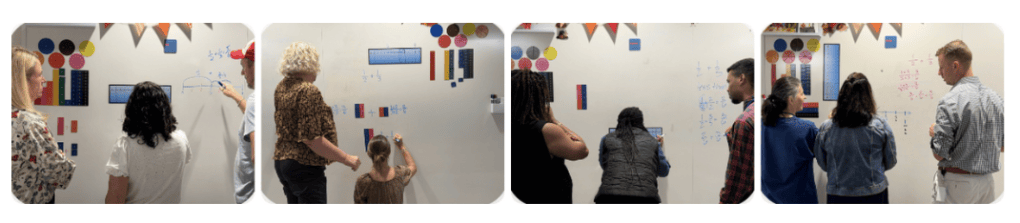
Everyone had a job. Every representation had a place. And the connections between the strips, the number line, and the written argument became the conversation.
How might giving each student a distinct role change who talks, who thinks, and who learns in our classrooms?
Shift #2: Studying the Work of Others
Our second shift also differs from Liljedahl’s work. After each task, we paused, sat, and studied other groups’ work. Then we offered affirmations using two stems:
- I notice…
- I like…
Yes, it slowed the pace. And it improved the written work. Each round, the ideas got clearer, the arguments more complete, the representations more connected. When we know someone else will read our thinking and writing, and when we’ve just learned from reading theirs, we write for an audience.
We hear it again and again in social media: PD is a waste of time. Too often, professional development means sitting and getting. Someone talks to us about active learning while we sit passively, then we head back to our classrooms with a handout and not much else.
What if PD looked like the classrooms we want to build? That’s the promise we’re working toward in our Wednesday Workshops. If we want students to retrieve, collaborate, reason, and make their thinking visible, then we need to do the same. Not just hear about it. Do it. Feel the productive struggle, the uncertainty of a new task, and the relief of a teammate’s idea.
When we learn the way we want our students to learn, we build more than knowledge of a strategy. We gain empathy for the learner and a clear picture of what it looks, sounds, and feels like. We also leave ready to try it tomorrow.
PD doesn’t have to be something we survive. It can be something we’d want our students to experience.
This is what PD with purpose looks like: adults learning the way we hope our students will, and leaving with something they can use tomorrow.
I’m grateful for a team willing to step up to the boards, work with manipulatives, draw number lines, and share their thinking out loud. That’s where the learning happened.
How are you helping teachers and students make their thinking visible?

