What happens when teachers who share the same daily puzzles finally get to sit at the same table?
On October 1, Trinity’s World Language Team opened our doors to colleagues from ten other schools across Atlanta for a World Language Café. There was no outside consultant and no slide deck from someone who hasn’t taught a five-year-old to ask ¿Cómo estás? It was just language teachers, coffee, and a shared question: How do we design learning so that a concept keeps coming back, each time a little bigger?
The Café was initiated, planned, and facilitated entirely by our World Language teachers: Deisy Pinto, Lily Catano, Lucretia Cahill, Vesna Galtere, and Sarah Meurisse. The idea grew from their work at a world language gathering at Holy Innocents’ last year. I want to celebrate that, because it matters. Peer-to-peer professional learning is powerful precisely because the expertise in the room is practical expertise. The person sharing has stood where you stand. When a colleague says, “Here’s what my 2nd graders did with this,” we lean in differently.
The Morning
The agenda was simple and generous with time for talk:
- Welcome, breakfast, and mingling gave everyone time to connect before anyone presented anything.
- Introductions let each teacher share their school, level, and language.
- Trinity’s Early Elementary and Upper Elementary teams presented spiral learning at Trinity, followed by Q&A
- Guest teachers shared their own spiral learning ideas in two blocks of sharing, the heart of the morning.
- Discussion closed the morning, with guests sharing games and new ideas.
Notice the balance. Trinity shared first, but the bulk of the morning belonged to our guests. The ones doing the talking are the ones learning, and that was true for everyone in the room.
The Spiral: One Concept. Multiple Encounters. Deeper Learning.
Our team built a shared template grounded in Jerome Bruner’s spiral curriculum. Each concept is traced from Early Learners through 5th and 6th grade through six questions:
- First Encounter: What are students exposed to first?
- Revisit: How does the concept return?
- Add Complexity: How do we continue to build the acquired vocabulary?
- New Context: How is it used differently?
- Deeper Learning: What new concepts are incorporated?
- Transfer: How can students apply this acquired knowledge to real-world situations?
From a Mind, Brain, and Education lens, this is spaced practice and retrieval made visible across years, not just weeks. Students don’t learn the body, or gustar, or greetings once. They meet them again and again, and each return asks a little more of them.
Spanish at Trinity
In Spanish, the spiral begins with Mi Cuerpo and a Phrase of the Month for our youngest learners. In Pre-K and Kindergarten, it returns through the finger play “Este Dedito” and songs that expand students’ body-part vocabulary. In 1st and 2nd grade, the doctor’s unit adds complexity: students use the “En la oficina del doctor” script to describe where they hurt. In 2nd grade, they keep retrieving body parts, now in the third person, building to a Mi muñeco de nieve final project. In 3rd grade, the language moves to a new context with Super YO. In 4th, students go deeper by describing others. By 5th and 6th grade, students transfer it all into Mi rutina, a final project with a rubric that requires them to narrate their own daily lives.
French at Trinity
In French, the first encounter is the song La Fourmi. Pre-K revisits with Le Zoo and Le français en chantant, with a clear target: I can understand a question about a body part and respond with a simple phrase. From EL through 1st grade, the French spiral mirrors the Spanish one. Complexity then builds with Jean-Petit qui danse, a picture dictionary, Les Créatures, and a Chez le médecin script. Third graders play a superhero devinette (guessing game) with an A-B partner activity and compare themselves with superheroes using Seesaw. Fourth graders go deeper with Cache-Cache and the Jean-Paul film project, and older students transfer their language through a routine picture dictionary and the Pauvre Anne book.
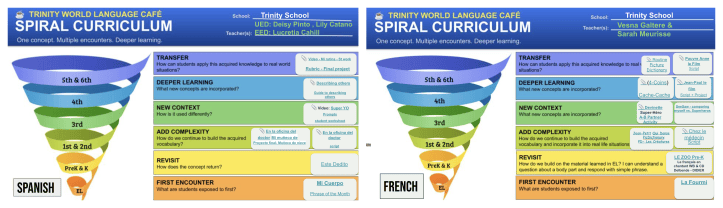
Here is what struck me most: lay the two spirals side by side, and they rhyme. Both include a visit to the doctor in the early grades, superheroes in 3rd, and daily routines at the top. Two languages and two teams share one vision of how language grows. That coherence doesn’t happen by accident. It happens because teachers talk to each other.
What Our Guests Brought
Guest teachers filled in the same spiral template and dropped their work into a shared folder so everyone could leave with ideas in hand.
Teachers joined us from Pace Academy, Mount Paran Christian School, Holy Innocents’ Episcopal School, Woodward Academy (Main and North campuses), Mount Vernon School, The Quadrilingual Academy, The Lovett School, The Walker School, and Mt. Bethel Christian Academy. Here are two of the spirals they shared.
From Lovett, Maria Baloucoune and Jessica Murray shared a K–5 spiral on saludos y sentimientos, or greetings and feelings. They start with the basics and add new phrases year after year, using short songs, comprehension checks between viewings, and stories that put the phrases to work in new contexts.
From Mount Vernon, Andrea Kanai traced the verb gustar from 1st through 5th grade. Her youngest students smell scented markers and share opinions in Spanish. Second graders write and draw about their likes and dislikes. Older students interview one another about hobbies and play movement games that build reading and speaking.
Scented markers! I can only imagine the giggles and the retrieval. Emotion and novelty are memory’s friends.
Why Peer-to-Peer PD Works
When teachers learn from teachers, a few things happen at once:
- The ideas are classroom-tested. Every example came with student work, scripts, rubrics, or videos.
- The language is shared. A common template gave every school a way to show its thinking and to see its own curriculum with fresh eyes.
- Expertise is distributed. No one in the room was the only expert. Everyone was both a teacher and a learner.
- Isolation shrinks. Many world language teachers are the only Spanish or French teachers in their building. A morning like this is a reminder that they have colleagues.
And for our own team, designing and facilitating the Café was its own professional learning. To teach a spiral, you have to see your spiral, with every link, every return, and every gap.
Questions I’m Still Thinking About
- What is the one concept in my grade level or subject that deserves a spiral?
- How do I know when a concept is truly returning with added complexity, and not just repeating?
- Where might our teams across subjects borrow this template?
- Who else might we invite to the table?
Thank you to Deisy, Lily, Lucretia, Vesna, and Sarah for imagining this, building it, and opening our doors. And thank you to every guest teacher who came, shared generously, and left a little of their brilliance in our folder.
One concept. Multiple encounters. Deeper learning. That’s true for students, and it’s true for us.

