In September, I wrote ten observations: classrooms, a data meeting, faculty workshops, and a mountainside field trip. I observe because you can’t see yourself teach. Each write-up is meant to be a mirror for a colleague, but each one also taught me something.
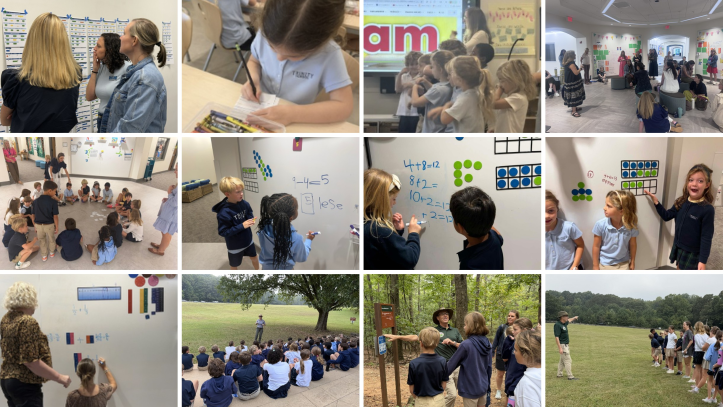
I visited 5th-grade math, kindergarten literacy (twice), 1st-grade math (twice), a Tier III Orton-Gillingham tutoring session, the UED Learning Team’s blind data review, two faculty workshops on the Reading Rope, and 5th-grade at Kennesaw Mountain. Here is what I learned by watching our teachers teach.
1. Same task, two classrooms, two strong designs
When teachers learn a task as learners and leave with the tools in hand, the work reaches children within days. Five days after our 1st–3rd grade Wednesday Workshop on We’re Frameous, both 1st grade teams were running it with six- and seven-year-olds: visibly random groups, oral stories, listening and scribing roles, magnetic 10-frames, and vertical surfaces.
What fascinated me was how differently two teams made the same task their own.
- Hilary and Melissa held the gallery walk for the final round. Don’t erase. We want to see your thinking. Saving the thinking for the end made it feel valued and public.
- Abbie and Julianne stopped to notice and wonder after every story. Students named each other’s strategies (“board 1 moved 2 to complete the 10-frame”) and compared how teams showed subtraction: X’s, empty circles, leaves moved out of the frame, apples drawn “in the pie.”
Both are responsive, thoughtful decisions about consolidation. I learned that a shared task does not produce identical lessons, and that the differences between classrooms are exactly what we should be talking about together.
2. Yesterday’s errors become today’s plan
The strongest instruction I saw this month started from evidence about specific learners. Teachers looked closely, named what they saw, and planned straight from it.
- Sarah Mokotoff built her tutoring lesson from the previous session’s error summary: b/d confusion, -ce endings, and VCCV words. Those errors reappeared on purpose in the drill, the review, and the dictation. Her plan was a response to the learner, not a script to cover.
- Brian Toth and Vicki Eyles read their fluency and accuracy data, confirmed the multiplication gaps they had been noticing, and then took a full week to learn and plan before launching retrieval practice. Urgency, but not haste.
- The UED Learning Team (Samantha, Mary Jacob, Sarah, and Laurel) reviewed Heggerty, DIBELS, high-frequency, and nonsense-word data for the entire 2nd and 3rd grades and immediately identified more students for additional support.
This is diagnostic and prescriptive teaching, one of Orton-Gillingham’s nine guiding principles, showing up in math, in tutoring, and in a team meeting. I learned that our best data use is small and specific: this child, this error, this next move.
3. Honest data over tidy data
Twice this month, the data refused to sort neatly, and twice the teachers chose honesty over a clean outcome.
In the blind data review, the protocol called for three groups. The team’s thinking produced four, with two distinct levels of watch-and-wait. They kept four. In 5th grade, not every student finished the leveled multiplication assessment, including students without a documented need for extended time. Brian and Vicki named it, reassured students, and treated it as a data point worth understanding.
The blind review taught me something else, too. Holding names back until after the first sort asked teachers to set aside the stories they already knew and look at the pattern first. Then the reveal became a deliberate second pass: where do instinct and data agree, and where don’t they? I learned that protecting independent thinking (quiet think time first, names later) helps a team avoid anchoring to the first voice in the room.
4. Professional learning that models what it teaches
Our two September literacy workshops were designed the way we hope teachers will design for children. Together, they gave our faculty the whole Reading Rope.
- Michelle Perry taught Orton-Gillingham the OG way. Teachers became students in a full lesson, chunked into Prime the Pump, Drill the Deck, the blending drill, dictation, and reading words and sentences. After each chunk, she brought back the nine principles and asked, Which ones are embedded here? Seven passes turned a list into a lens.
- Marsha Harris let 4th, 5th, and 6th-grade teachers feel the problem before naming it. The dax was reluctant to relinquish the vorpal, which made the gap between decoding and comprehension feel real within minutes. She modeled the five language comprehension strands on one sentence from Because of Winn-Dixie, then moved to a jigsaw on Chapter 1, and then to each team’s upcoming novel study. I should note that Marsha’s lesson was presented in EL, Pre-K, and Kindergarten sessions and in 1st-, 2nd-, and 3rd-grade sessions, using Tops and Bottoms as the anchor text.
Marsha’s progression (a nonsense sentence, a real sentence, a chapter, your own unit) is gradual release for adults. Michelle’s (learn it, experience it, name it) is retrieval practice with spacing built in. I learned that when the design of a session matches its content, teachers leave with more than information. They leave having lived the practice.
One more thing I noticed: Marsha also wrote an observation of Michelle’s session. Colleagues observing colleagues and naming each other’s strengths is a culture I want to continue to grow.
5. Joy and safety are part of the instruction
The moments I remember most from September were moments of delight, and none of them were extras. They were built into the method.
- In kindergarten, Marley West and Shaun McCarthy’s students wrote me and my with their eyes closed during Trace-Copy-Cover-Close. The giggles when they uncovered their eyes were genuine. Shaun’s slanted “blind” my showed children that their teacher’s attempt didn’t need to be perfect either.
- A week later, Shaun’s “close your eyes” step brought the same delight to at and am, and the heart drawn around the tricky letter told students which part they just have to know.
- Sarah Mokotoff’s student who struggles with b and d was corrected warmly and positively, and the lesson maintained its pace. He clearly felt safe to take risks to learn.
- In 5th grade, Brian and Vicki framed the multiplication assessment as ungraded and for learning only, tied to something students already know at Trinity: checking pace with RAN without attaching a grade.
Orton-Gillingham calls this emotionally sound instruction, and Michelle reminded us that children need to trust us and feel successful before confidence can grow. I learned that safety is what allows a student to take the risks that learning requires.
6. Routines give time back, then become students’ own
The clearest sign that a routine is working is when students start running it without being asked. I saw that happen more than once.
- In Sarah’s session, her student asked, “Can I say the sound as I write them?” Her consistent language (“pound it,” “make your pen talk,” “count back three”) had become his way of coaching himself.
- In Abbie and Julianne’s room, listen. Select roles. Turn to listen, the 15-second reset, and know your job? kept transitions short. By the fourth story, teams sat down on their own when they finished.
- In Hilary and Melissa’s lesson, the erase, clear the frames, switch jobs, and reset kept eight teams moving through a busy Hub.
- In Kindergarten, the shared language of the sky, plane, and grass lines gave every child a repeatable way to know where their pencil should go.
I learned that consistent, portable language is a gift to students. When the words mean the same thing every time, students can carry them into new work and use them without us.
7. Learning needs a place to stand
On September 30, all four 5th grade classes spent the day at Kennesaw Mountain, and I hiked with one class. Students looked down the Confederate line of sight, crossed the field where Union soldiers stood, and stopped at the Georgia, Alabama, Illinois, and Indiana monuments.
Every idea was attached to the ground. High ground and a 3,000-pound cannon made the strategy make sense. Dogwood bark boiled into tea turned the trees along the trail into part of the story. The rail line explained why Atlanta mattered.
In a quieter way, the same thing happened in our classrooms. Magnets on a 10-frame gave first graders a place for 7 + 6 to stand. Bumpy paper gave kindergarten letters a shape students could feel. Chips on the table gave a tutoring student something to touch before he held sounds in his head. I learned that concrete, physical anchors are not a step we rush past. They are where understanding begins.
This day happened because Kate Burton led it from start to finish, with the whole 5th grade team hiking, listening, and filling water bottles alongside students.
What I’m wondering next
A month of observing left me with more questions than answers, which feels exactly right.
- Spacing: When is the right time to revisit what we taught in September? The second multiplication assessment, the dogwood and the cannons, and this month’s heart words all deserve a return visit.
- Self-monitoring: How might “Did your brain say that didn’t make sense?” travel from the classroom into student learning?
- Comparison stories: When are our first graders ready to move from take-away to which is larger, and by how much?
- Seeing ourselves teach: Could we film a lesson, as I wondered with Michelle, and use it to help teachers spot the principles in their own practice?
- Productive use of time: Will our 1st-grade teams run We’re Frameous again? What did it give them that was worth the time?
Thank you
Thank you to Brian Toth, Vicki Eyles, Samantha Steinberg, Mary Jacob Harris, Sarah Mokotoff, Laurel Martin, Marley West, Shaun McCarthy, Michelle Perry, Marsha Harris, Hilary Daigre, Melissa Cooney, Abbie Shaw, Julianne Schaaf, Kate Burton, and the entire 5th-grade team for opening your doors.
Each of these teachers let me observe teaching so I could hold up a mirror. In return, I understand what our school looks like when we learn together. What might you learn if you looked across your own month of teaching? How might we keep looking and keep learning in October?

