We know a lot about how learning sticks. Pull information out of memory instead of just putting it in. Come back to ideas over time. Make thinking visible. Give every learner a turn to do the work.
So why does so much professional learning look the opposite? We gather after school, someone shares slides, we nod along, and by Monday, most of it has quietly slipped away. We ask teachers to build retrieval and spacing into their classrooms, and then we offer them one-time exposure and hope it lasts.
This fall, I wanted to try something different.
A book club built on the book
Two groups of educators are reading Smart Teaching, Stronger Learning (Agarwal, ed.) together. One group is made up of Trinity faculty, and the other is colleagues from outside our school. We meet asynchronously in Google Classroom, with a single culminating conversation in November. The goal is to protect teachers’ time while deepening their thinking.
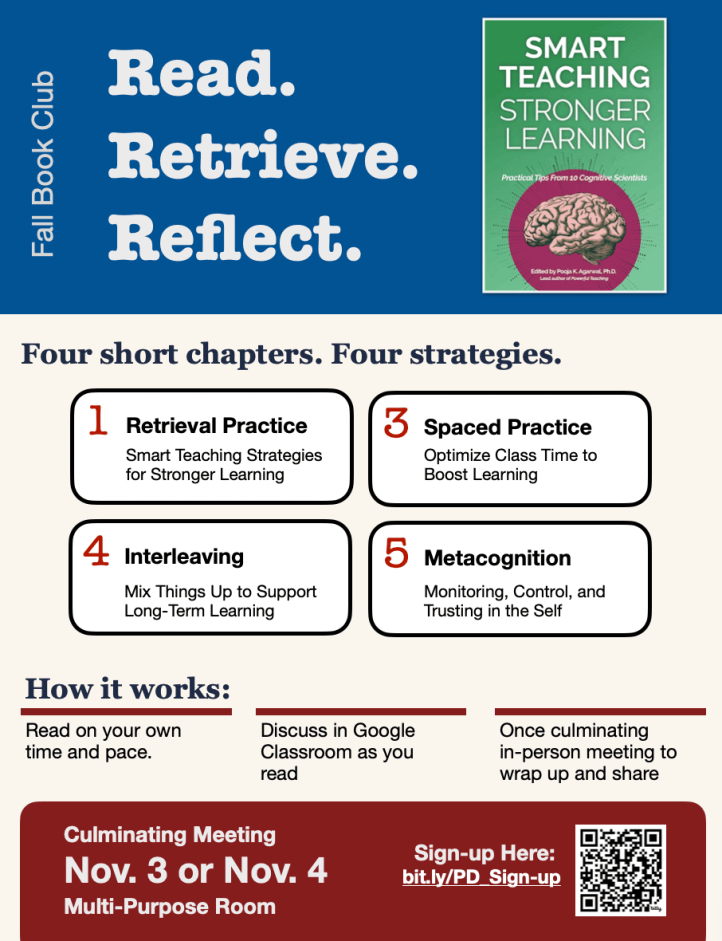
The design is simple. After each chapter, participants make three moves:
- Close the book. In a sentence or two, what is the strategy, and why does it work?
- Try it. Use one strategy from the chapter with students this week. What did you try, and what did you notice?
- Connect. Respond to a colleague with a question or an idea you’d borrow.
That first move matters most to me. Before anyone writes a word, they close the book and retrieve information. The professional learning is the strategy. The second move sends the learning straight into classrooms, where it belongs. The third move keeps us in conversation, because the ones doing the talking are the ones learning.
What we saw in week one
Teachers made the ideas their own. AK described retrieval as finding one document in the pile on your desk. Each search strengthens the connection, and the path gets clearer. JS emphasized why it’s called practice: it strengthens a skill rather than just measuring one. These weren’t definitions copied from the page. They were ideas pulled from memory and reshaped in each teacher’s own words.
The learning showed up in classrooms within days. JL cut the names off her kindergarten shape cards. Students could no longer guess from letter sounds, so they had to study sides and points and recall the name. AP had students write a letter on whiteboards and draw something that begins with its sound. She could see at a glance who had it and who needed support. JS paired the chapter with Anita Archer’s call for frequent, all-student responses and found her class more attentive.
People were honest about what didn’t work. This might be my favorite part. MJH tried a brain dump on index cards and watched her students freeze. One student’s expression said it all: You’re the teacher. Why am I doing the explaining? As she wrote her reflection, she realized a whiteboard, with its eraser and its permission to be wrong, might change everything. Later, it did. Meanwhile, SM’s fourth-grader loved the same strategy because there was no pressure to give a single right answer. A colleague noticed the contrast, and a rich conversation followed about why the same strategy lands so differently.
That kind of reflection rarely happens in a one-and-done workshop. There’s no time, and there’s no next week.
Colleagues borrowed from each other. LC and VG, both teaching first-grade world language, are sharing songs and vocabulary games. AK and MS connected over concept mapping. And SDP, one of our division leaders, modeled the strategy herself with a six-point brain dump from memory. Her first point may be the heart of the whole book: what we teach is not the same as what students learn.
What I’m learning as a facilitator
Reading these posts, I keep noticing parallels to what we want in classrooms.
The asynchronous format works like wait time. Teachers think, try, and come back with something real to say, instead of responding on the spot.
Every participant contributes, which is a lot like whiteboards for adults. In a live session, a few voices carry the room. Here, I hear from everyone.
The posts are also formative data for me. I can see what’s resonating and where the misconceptions are. My replies serve as feedback, so I can push someone’s thinking a little further or point them toward a colleague who is trying something similar.
And because teachers try a strategy between readings, the learning doesn’t stay in the book. It travels to students the same week.
None of this requires more time. It requires designing professional learning in the way we hope teachers will design learning for students.
Up next: Spaced Practice
Chapter 3 is about spaced practice: returning to learning over time instead of all at once. Letting a little forgetting happen makes the next retrieval harder, and that effort is part of what makes learning last.
Our participants are already ahead of me. SDP wrote that “spiraling information is a good thing.” AK is experimenting with timing her math entry ticket, first thing in the morning versus right before class, which is really a question about spacing. And when a student misses a card in LC’s rapid retrieval game, what if it came back later for another try?
Here’s what I love most: the book club itself is spaced practice. Each week, we come back, retrieve, connect, and build. I’m curious to see what that structure does for our own learning over the next month.
So I’ll leave you with the questions I’m sitting with. What would change if your next professional learning session asked people to close the book first? Where could the learning go straight into classrooms instead of waiting for a follow-up that may never come? And how might we give every adult learner, not just the confident few, a turn to do the thinking?

