What if PD felt like the best version of our own classrooms? What if teachers left energized, carrying something they could try with students the very next morning?
That was the question behind our professional learning day at Trinity on Tuesday, October 13.
We are a community of learners
At Trinity, we ask our students to be curious, to take risks, and to keep growing. We hold ourselves to the same expectation. Continuous learning isn’t something we schedule a few times a year. It’s part of who we are as a faculty.
That commitment shows up in our Wednesday Workshops, our book studies, our New Faculty Academy, and on days like Tuesday. It also showed up in who was in the room. Our Admissions team joined us for the day, learning right alongside our teachers. When the people who welcome new families understand what learning looks and sounds like in our classrooms, they can tell that story with real conviction. Thank you, Admissions, for learning with us!
Practice what we preach
Our day began with a keynote from Dr. Jamey Peavler on managing cognitive load through instructional design. Her central idea is simple and powerful: working memory is limited. Even a beautifully designed lesson falls flat when it asks students to hold more than they can.
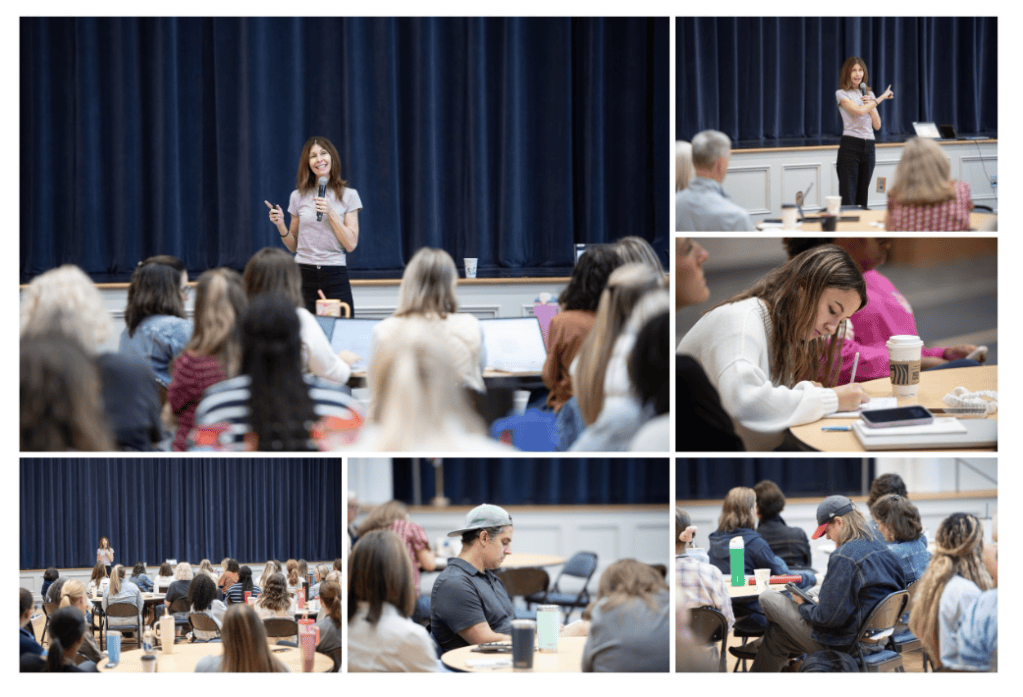
Jamey helped us see three kinds of load competing for that limited space:
- Intrinsic load comes from the difficulty of the content itself and any gaps in prerequisite skills.
- Extraneous load comes from everything else pulling at attention, like visual clutter, unclear directions, or routines and language that shift from room to room.
- Germane load is the productive thinking we actually want.
Our job as designers is to manage the first two so there is room for the third.
She also reminded us that practice is not one thing. Blocked practice builds accuracy when a skill is new. Interleaved practice mixes things up so students learn to tell similar ideas apart. Spaced practice feels slower, but it’s what makes learning last.
Here is the part I love. We didn’t just hear about these ideas. We tried to design the rest of the day around them. If spaced retrieval matters for students, it matters for us too. So throughout the day, we came back to the keynote, retrieved it, talked about it, and connected it to our own classrooms.
Learning by doing
Not one session asked teachers to sit and listen for 90 minutes.
- Building Thinking Classrooms: Our 4th through 6th-grade numeracy teachers anchored their work in Building Thinking Classrooms and Thin-Slicing multiplication of fractions. We connected to the hierarchy of learning from Jamey’s session: fluency before automaticity. We employed visible random grouping in vertical non-permanent writing spaces to visualize ways to help our student strengthen their understanding of fraction multiplication using strategies, number lines, and area models.
- AI Tools and Tips: Our Specials teams worked hands-on with Jeff Morrison. The biggest takeaway that teachers have discussed with me is the art and science of prompting. They ran independent tasks to explore how AI can streamline planning and administrative work. Throughout, the focus stayed on responsible, teacher-guided use.
- Language Comprehension: Our Base and Learning Team teachers spent extended time with Jamey, building on our work with Scarborough’s Reading Rope. Comprehension isn’t one skill we can teach in isolation. It grows from background knowledge, vocabulary, and an understanding of how sentences work. Teachers left with concrete next steps. Early elementary teams are planning knowledge-rich interactive read-alouds. Upper elementary teams are looking at the knowledge, vocabulary, and sentence-level demands of upcoming novels and units.
- Team Teaching: In our UED meeting, teaching partners read The Trinity Way together, shared user manuals, and worked through a partner questionnaire. Strong partnerships between adults make for calmer, clearer classrooms for students.
- Environment as an Additional Teacher: In our EED meeting, faculty reviewed what we are learning and applying from our Reggio studies as a division, and then moved into action. First, they offered observation and feedback to a single classroom on its contribution to learning. Then, as teaching pairs, they analyzed and reflected on the environment of their design.
The ones doing the talking are the ones learning. That’s true for our students, and it was true on Tuesday.
Where we’ll see the impact
The real measure of a PD day isn’t how it felt at 2:30. It’s what changes in classrooms on Wednesday, next week, and next month. Here is what I’ll be looking for when I visit:
- Lessons with less clutter and clearer, more concise directions
- Shared language and routines across classrooms, so students can spend their energy on learning instead of logistics
- Retrieval practice that comes back again and again over time, not just once
- Read-alouds and texts chosen and planned for the knowledge and language they build, not just the strategy they practice
- Students at the boards, talking, and making their thinking visible
Still learning
PD doesn’t have to be something we endure. It can be interactive, grounded in research, and designed with the same care we ask of our own lessons. Most of all, it can make a difference for students.
So I’ll leave you with the questions I’m sitting with. What made the best professional learning you’ve ever experienced worth your time? And what one idea will you try with your students this week?

