You can’t see yourself teaching. That’s why I love the invitation to sit beside a colleague and hold up a mirror. This morning, I spent 45 minutes with Samantha Steinberg and RE, a second grader, in a one-to-one literacy session. I’m still smiling about how it ended. But let’s start at the beginning.
Connection before content
Samantha opened by asking RE about her weekend. Pumpkins. Starbucks. It took less than a minute, and it set the tone: this is your space, and I’m glad you’re here. Then the work began. And what work it was.
Sounds first, no print
Samantha said a word. RE said it back. Then RE added a sound to the end or removed the final sound. Samantha’s hands did the thinking out loud: one palm held the word while the other hand added or pulled away the final sound. RE’s hands moved right along with hers.
There was no print, just ears, voice, and hands. This is where strong readers are built: noticing and moving the individual sounds inside words.
Remember last time?
Before anything new, RE reread her dictation from the last session, words on one side and phrases and a sentence on the other. Samantha offered quick, warm corrections in the moment, so the right pattern was the one RE practiced.
How often do we ask learners to go back and retrieve what they did last time before we pile on something new?
Bumpy paper and keywords
Samantha pulled out bumpy paper, and RE traced the ending blends with her finger while naming the key word for each one:
- -lb like lightbulb
- -ld like held
- -lf like elf
- -lk like milk
- -lm like elm
- -lp like help
- -lt like kilt
Along the way, Samantha narrated the journey: “We’ve got more.” “We’ve got three more.” “Last -l blend!” RE always knew where she was and how much was left. What a gift for a young learner.
The question that changed the lesson
Samantha explained that an ending blend needs a vowel before it. Then RE asked: “Can it be in the middle?”
Samantha didn’t answer. She said, “Give me an example.”RE offered leapt. Together, they tapped it out and discovered the vowel team in the middle. Then Samantha stated the rule clearly. RE ‘s curiosity drove the teaching, and RE did the thinking.
The ones doing the talking are the ones learning.
Word chains: one sound at a time
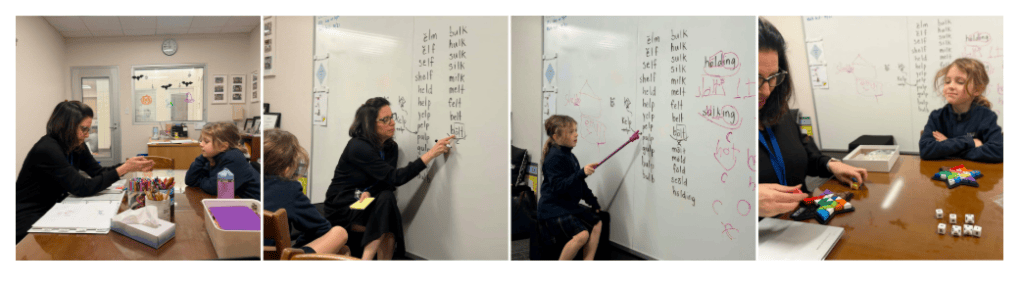
At the whiteboard, Samantha became the writer and RE the reader. The chain moved one sound at a time:
elm, elf, self, shelf, held, help, yelp, pelp, pulp, gulp, bulp, bulb…
bulk, hulk, sulk, silk, milk, melt, felt, belt, bolt, molt, mold, fold, scold, holding
Real words and nonsense words were mixed together (“Nonsense word, ready?”), which means RE had to use the code rather than her memory.
When RE noticed that pelp was close to kelp, Samantha followed her lead. “How did you know it was a k and not a c? If it started with a c, how would it sound?” Up went a little kite and a little cat on the board as keywords.
Then RE took the marker. She boxed blends, circled endings, marked vowels, and scooped syllables in holding, folder, sulking, and belts. Those last two sparked big conversations about syllable types. Finally, RE grabbed a pointer and read the entire chain, standing tall and fully in charge.
Dictation: “Check yourself. You can fix it.”
RE picked a purple pen, wrote the date, and took dictation: sounds, real words, nonsense words, trick words, phrases, and two sentences:
He crept down the hall to his bed.
The bats come out at dusk.
Listen to Samantha’s prompts:
- “How do you start a sentence?”
- “Oh, is that a blend you know? You were right the first time!”
- “Check yourself. You can fix it.”
- “What needs to go at the end?”
- “Can you use clues to write lowercase b and d?”
Each one hands the thinking back to RE. She isn’t waiting to be corrected. She is learning to check her own work.
The ending
Stand up. Stretch. “Really good work today.”
Then two minutes of Genius Star. Samantha rolled the dice and groaned, “Oh no! This is a terrible roll (of the dice). It’s so hard.”
RE looked up and said:
“I like doing hard things.”
The lesson ended right on time.
What I’m wondering
When I think about this session, I keep coming back to a few questions:
- What happens when every part of a lesson, from sounds to tracing to reading to writing, points at the same small set of patterns?
- How might we follow a student’s question, like RE’s “Can it be in the middle?”, instead of rushing past it?
- How often do our prompts hand the thinking back to the learner?
- What does it take for an eight-year-old to say “I like hard things” and mean it?
I think the answer to that last one was in the room all morning: warmth, clarity, high expectations, and a teacher who believes deeply in her student.
Thank you, Samantha, for opening your door and letting me learn alongside you and RE.

