Two weeks after our book club read Chapter 1 of Smart Teaching, Stronger Learning, I asked everyone to do something before opening Chapter 3: close the book and tell me what you remember about retrieval practice.
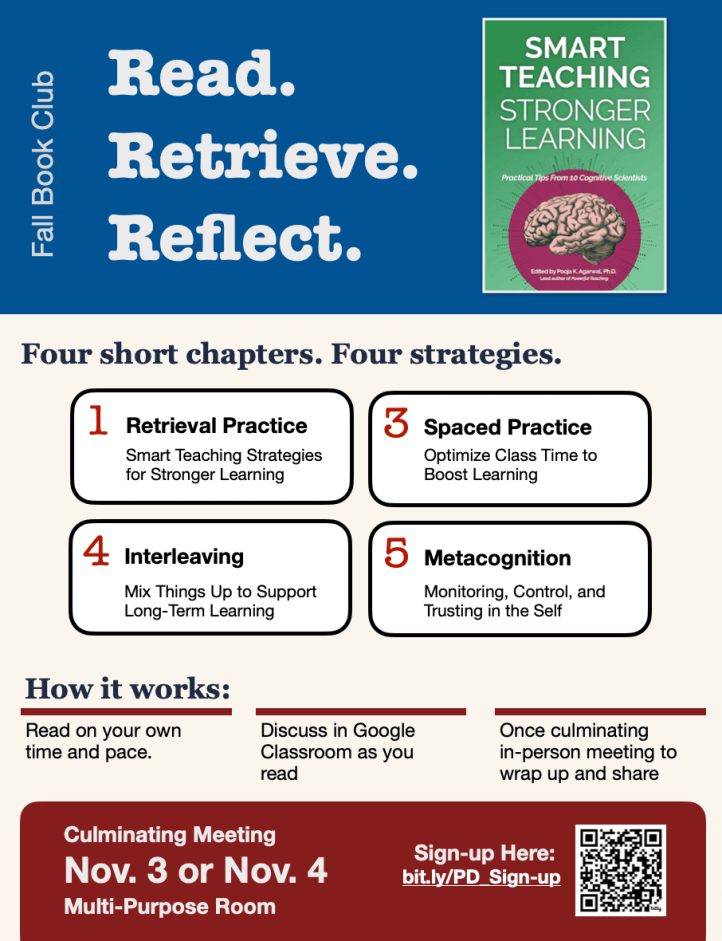
It was a small move, but it was the point. Chapter 3 is about spaced practice, the idea that learning lasts longer when we return to it over time instead of practicing it all at once. So we spaced our own learning. We let two weeks pass, and then we reached back.
Here’s what came back. Whiteboards, again and again. The freedom to erase and try again. AK’s metaphor of finding one document in the pile on your desk. One teacher remembered only that the chapter was about retrieval practice, and that’s honest, too. Some ideas stuck, and some faded. That is exactly what Chapter 3 says will happen, and exactly why it matters when we come back.
Spacing is already hiding in our routines
Many teachers found that spaced practice is already built into the programs they use every day.
JS described her first-grade Fundations dictation. New patterns, like glued sounds, get layered on top of short vowels and digraphs, and earlier patterns keep returning in sounds, words, and sentences. SM shared how Orton-Gillingham works the same way. Once a syllable type is taught, it keeps showing up in the visual and auditory drills and in blending all year long.
Our world language teachers stretched spacing across years. LC and VG are teaching body parts in first grade. Children first met many of those words in songs and games in Early Learning, Pre-K, and Kindergarten. Now they bring them back and use them in real dialogue, like “At the doctor’s office.” Polite phrases like bonjour and merci have been returning since Pre-K, and that’s why they stick.
The spacing even reaches high school. SG described his Algebra 2 class, in which students first explored intercepts and maximums of a standard quadratic equation. Next week, they’ll find the same quantities again through factoring, completing the square, and the quadratic formula. Same ideas, new route, a little time in between.
The honest tension: “We have to keep up”
Not everyone found spacing easy to fit in, and I appreciated the honesty.
SS noticed that in 4th and 5th grade, the curriculum keeps moving forward. When students “go back” to multi-digit multiplication or parts of speech, they seem to have lost some of what they knew during the massed practice stage. SM saw the same thing with her fourth graders, who weren’t retaining basic facts about the American Revolution. AK admitted that when class time gets tight, the review weeks are the first thing to go.
This is the real tension teachers live with, and the chapter offers a hopeful reframe. Forgetting isn’t a sign that teaching failed. A little forgetting makes the next retrieval harder, and that effort helps learning last. Spacing also doesn’t require a full review lesson. Two or three minutes at the start of class, pulling in a skill from a few weeks ago, can be enough. Short, frequent, and spread out often does more than one long review.
Planning with a calendar in mind
The posts I learned the most from had a timeline.
AP mapped out sight word practice across time: whiteboards next week, bumpy screens and SOS writing next month, then decodable texts and independent writing next quarter. She also borrowed an idea from AB’s Chapter 1 post about students making their own flash cards.
MJH’s plan stretches the gaps as learning gets stronger: every few days, then weekly, then every other week, then monthly, all year long. SS plans to bring suffix rules back weekly, then biweekly. AK wants students to keep identifying the job a word does in a sentence over several weeks, so they’re always retrieving rather than just memorizing lists.
These teachers aren’t asking whether to revisit learning. They’re deciding when.
What spacing reveals
Coming back to learning also shows us what isn’t solid yet.
MJH is working with a fourth grader on adding fractions. She realized he wasn’t yet fluent with equivalent fractions, unit fractions, or factors and multiples. She called it “assumed practice.” We expect foundational skills to be practiced along the way through harder work. But when the foundation is shaky, it becomes a barrier. So she spends five minutes each session on the foundations. Her observation: each time, she talks less, and he writes more.
JS noticed something similar in first-grade writing. Students practice capitalization and end punctuation every day, yet some still forget. When young writers are holding a sentence in mind, segmenting sounds, spelling a new pattern, and forming letters, working memory fills up fast. Conventions are often the first thing to drop. Spacing helps, and so does a quick self-check: Point to your capital. Point to your end mark.
What I’m noticing as a facilitator
The book club itself is spaced practice. We read, try, and connect, then step away and return to retrieve again. Teachers are reaching back for colleagues’ ideas from weeks ago: AP borrowing from AB, SS cheering on VG’s use of song, and LC and VG trading games across their classrooms.
And no one waited for a workshop to try something. The plans in these posts are going into classrooms next week, next month, and next quarter. That’s what I hope professional learning can be: not one afternoon we forget by Monday, but learning that keeps coming back.
Up next: Interleaving
Chapter 4 takes us one step further. Interleaving mixes different skills or problem types within practice, so students have to decide which strategy to use rather than knowing in advance. Several teachers are already leaning that way. Think of AK’s sentence of the day that rotates through parts of speech, or MJH mixing problems that need a common denominator with ones that don’t.
So I’ll leave you with the questions I’m carrying into Chapter 4. What do you teach once and move on from? Where could two minutes of the way-back machine fit into a routine you already have? And how will you know when it’s time to stretch the gap?

