Who gets through the door, and what do we do about the ones who don’t?
That question kept coming up for me on Day 1 of NCSM 2026 in Denver. I sat in four very different sessions: a keynote on school culture, a joyful “Maths Party” on algebra and number sense, a slow walk through rate of change from first grade to AP Calculus, and a hard look at what our assessments actually value. Different speakers, different grade bands, different slides. One thread.
School Culture: Anthony Muhammad
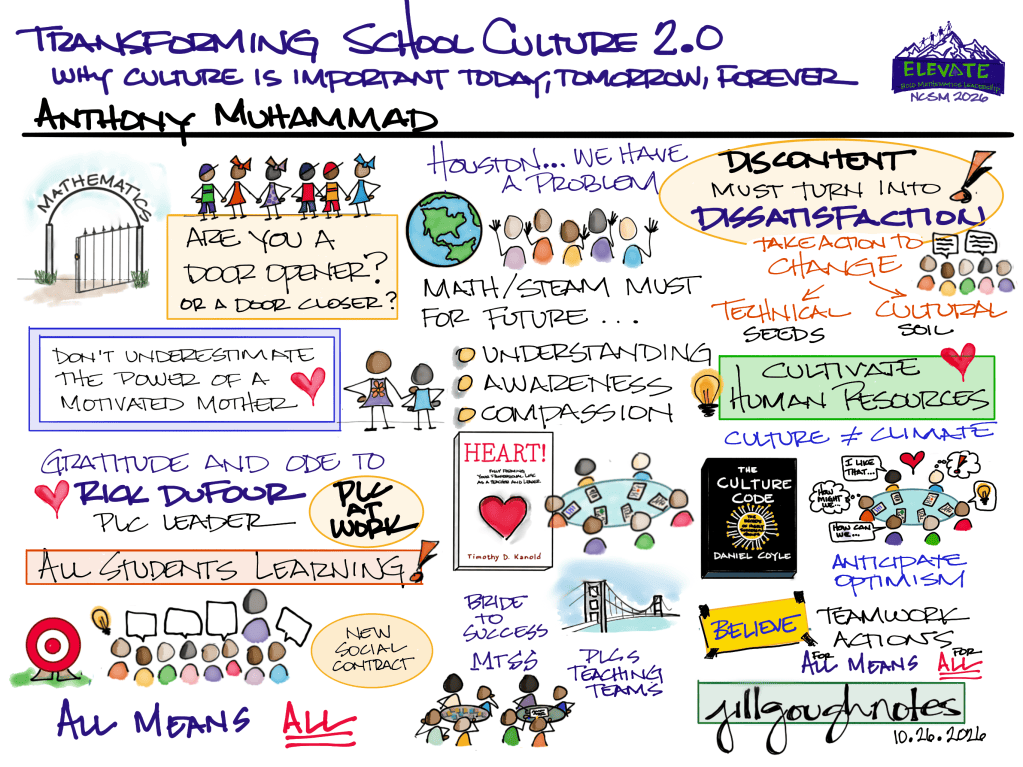
Dr. Anthony Muhammad opened the conference with Transforming School Culture 2.0 and a question I’m still sitting with: Are you a door-opener or a door-closer?
He pictured mathematics as a gate. Some students walk through with ease. Others find it locked. We hold the key, and every task, interaction, and expectation either opens that gate a little wider or quietly pulls it shut.
He asked us to move from discontent (noticing something is wrong) to dissatisfaction (being bothered enough to act). And he separated two kinds of change:
- Technical change is the seed: programs, structures, strategies.
- Cultural change is the soil: the beliefs, relationships, and norms that decide whether those seeds grow.
The slide I most want to bring home was his new social contract:
| Old contract | New contract |
|---|---|
| Curricular autonomy – close my door, do it my way | Curricular collaboration – common, viable learning |
| Assessment autonomy – my test, my way | Assessment collaboration – assess what we value |
| Process oriented – I taught it. | Results oriented – They learned. |
He closed where he began. All means all. Not most. Not only those who arrive ready.
Mind the gap: Cathy Williams
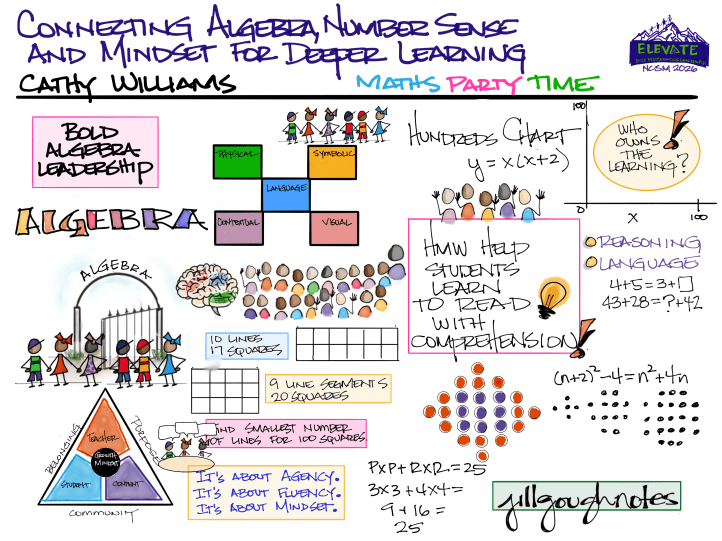
Cathy Williams showed us where the door gets closed. She put a familiar textbook page on the screen (thirty polynomial division problems – you know the ones!) along with a child in a cardboard space helmet, pointing at the stars. Her point is that there is nothing wrong with our students’ beautiful mathematical minds. We left them at the wall of narrow maths.
The data made the gap visible. Across grades 4 through 12 (n = 4,889), only 16% to 29% of students could sketch, place on a number line, name, or explain a simple fraction. A student’s four-square work on 1½ ÷ ¾ told the same story: a flawless procedure and a real-life situation that stopped at “Rose had 1½ candy bars and…” The procedure was there. The story was not yet.
So what helps? Cathy asked us how we would solve the subtraction problem, 108 − 106. Stack and regroup, or see the distance between the numbers? Then she moved us into growing patterns, where a variable is a case number that changes, not a mystery to solve. That is the heart of youcubed’s Mathematical Mindset Algebra: start with patterns, and “solve for x” becomes one special case of a bigger idea.
It’s about agency. It’s about fluency. It’s about mindset.
Five Principles for Powerful Learning: Linda Antinone and Gail Burrill
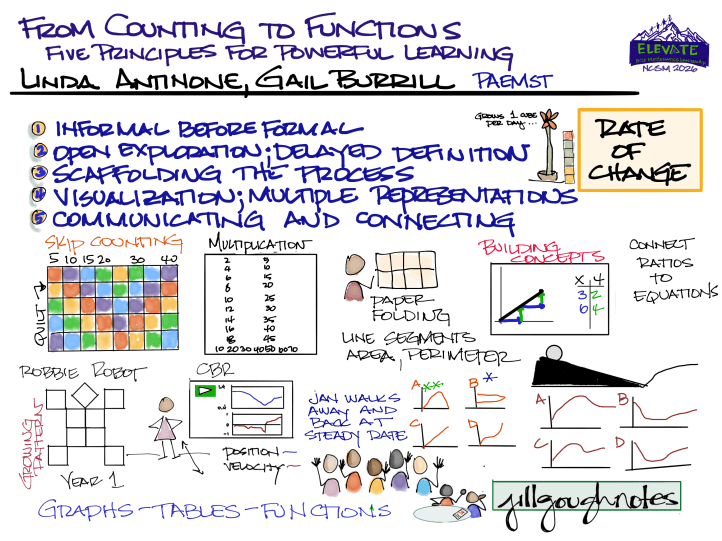
If Cathy named the gap, Linda Antinone and Gail Burrill showed us how to build a bridge across it. Their session, From Counting to Functions: Five Principles for Powerful Learning from the Classrooms of Presidential Awardees, followed one big idea, rate of change, from kindergarten to AP Calculus.
They opened with a question for partners: at what grade do students begin learning about rate of change? Then they answered it by showing us, slowly, grade by grade:
- A giant amaryllis grows about one unifix cube a day, and first graders skip count by 2s.
- Upper elementary students notice how numbers change across a multiplication table, then fold paper and discover change that doubles instead of adds.
- Middle schoolers link tables, graphs, and equations, and confront the graph-as-picture misconception.
- AP Calculus students sketch graphs that meet Rolle’s theorem’s conditions, and the theorem is built from their graphs.
By the time we reached Rolle’s theorem, the formal statement felt earned. Each stop asked the same question in a new costume: What is changing, and how is it changing?
Their five principles were reflected on with every task, so we experienced each one before we discussed it: Informal before Formal, Open Exploration and Delayed Definitions, Scaffolding the Process, Visualizations and Multiple Representations, and Communicating and Connecting.
Evaluating what we value: Peter Liljedahl
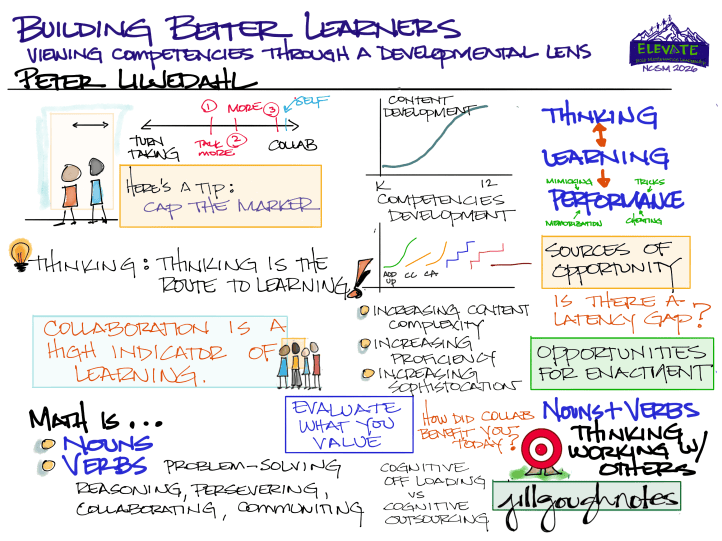
Peter Liljedahl turned the same lens on assessment. He opened with a chart of all fourteen Building Thinking Classrooms practices alongside test results. The tallest bar was not Thinking tasks or random groups. It was Evaluate Your Values, just ahead of formative assessment and launch.
His frame: learning mathematics is competencies plus content. We tend to assess the content because it is easier to see and score. The competencies (reasoning, collaborating, persevering, making sense) often live only in our hopes. Kerr’s Folly named it plainly: hoping for B while rewarding A.
Peter argued that competencies are developmental, and they grow in three ways: content complexity, proficiency, and sophistication. Collaboration matures from sharing work to integrating each other’s ideas to negotiating meaning to co-constructing understanding. But none of that growth happens without the first lens he named: opportunity. A student cannot grow in a competency they never get to practice.
He also gave us three kinds of value a competency can carry:
- Declarative: the teacher says it matters.
- Extrinsic: it is evaluated or rewarded.
- Functional: students see why it matters to themselves.
Most of us live in declarative value. Perseverance is on the poster. Functional value is the goal.
The threads that tie the day together
Looking back at my sketchnotes, three ideas kept showing up in every room.
Opportunity comes first. Anthony called it opening doors. Cathy called it minding the gap. Peter called it opportunity to enact. Linda and Gail showed it as an amaryllis on a first-grade windowsill. Before we ask why students aren’t reasoning, persevering, or making sense, we have to ask whether our tasks ever invited them to.
Learning grows across the grades, and so should our design. Linda and Gail traced rate of change from counting to calculus. Peter traced collaboration from sharing to co-constructing. Cathy traced algebra back to number sense and pattern. None of this works if each grade plans alone, which brings us right back to Anthony’s new social contract.
What we assess tells students what we value. Cathy’s fraction data, Peter’s Kerr’s Folly, and Anthony’s shift from process to results all asked the same thing: Does our evidence match our hopes?
The ones doing the talking are the ones learning. Day 1 pushed me a step further. The ones whose thinking we notice, value, and build on are the ones who walk through the doors into new opportunities.
Questions I’m carrying home to Trinity
- Which doors in our math classrooms are still locked for some learners?
- What would it look like for our grade-level teams to trace one big idea across Early Elementary and Upper Elementary together?
- Where are we asking students to compute when we could ask them to reason about relationships?
- If a student only saw our gradebook, what would they think matters in math class? Where are we hoping for B while rewarding A?
- Which competencies do we name, and do they carry declarative, extrinsic, or functional value right now?
- What does all means all look like on a Tuesday morning?
I’d love to hear how you are opening doors and minding the gaps in your school.
Sketchnotes: #jillgoughnotes, NCSM 2026

