Two sessions, one question: what can our students do?
Day 2 of NCSM 2026 in Denver asked me to look at students and teachers through the lens of their strengths. In the morning, Amy Lucenta and Grace Kelemanik challenged us to replace ability labels with evidence of strengths. In the afternoon, Sarah Schaefer and Jennifer Bay-Williams challenged us to replace the Mad Minute with an assessment that shows strategy, flexibility, and growth.
Between sessions, I walked the exhibit hall with one mission: find new magnetic resources for our Building Thinking Classrooms work at Trinity, for our teachers, and for the PD sessions coming up this year.
What if the question that drives our planning, our assessment, and our professional learning is simply this: What can our students do, and what are they ready for next?
Seeing Strengths: Areas of Cognition with Amy Lucenta and Grace Kelemanik
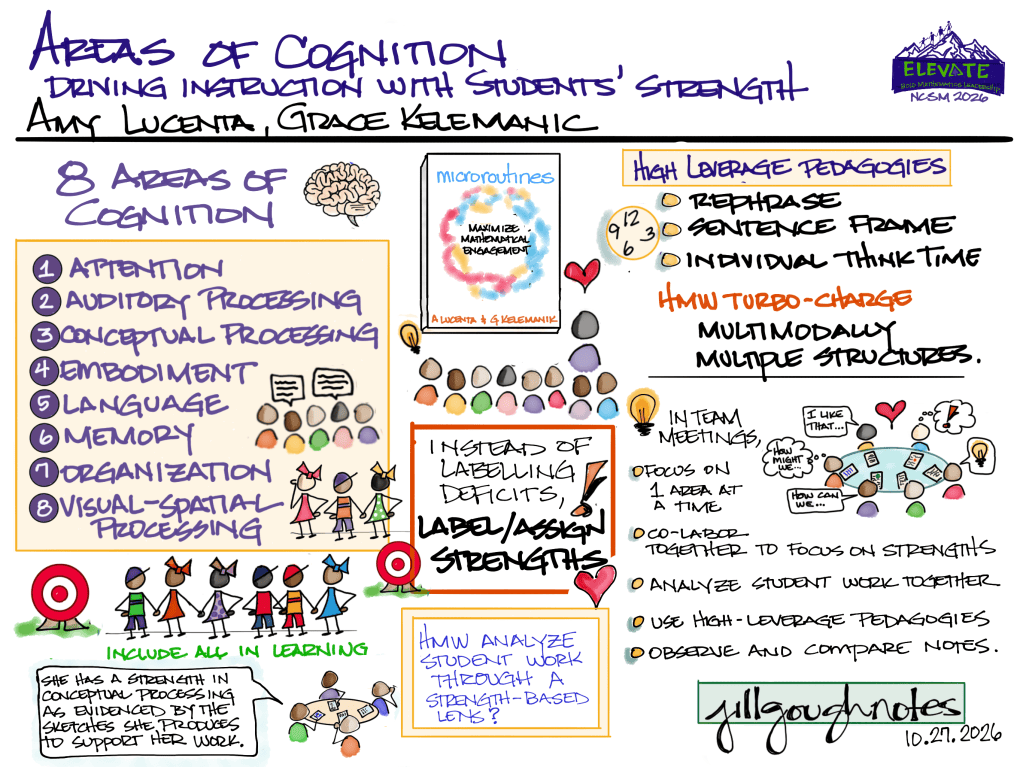
Amy and Grace opened with a wall of familiar labels: low, strugglers, at risk, bottom kid, fast finishers, gifted in math, Tier 3, not a math person. Many of these live in our planning documents, data meetings, and hallway conversations. Then they crossed them out, pointing to NCTM’s position that ability labeling and high-quality teaching are fundamentally incompatible. Their invitation: instead of labeling deficits, can we label and identify strengths?
The tool for that work is eight Areas of Cognition, drawn from EDC’s Addressing Accessibilities in Mathematics:
- Attention
- Auditory Processing
- Conceptual Processing
- Embodiment
- Language
- Memory
- Organization
- Visual-Spatial Processing
Before we looked at students, we named our own areas of strength. That move matters. Leaders who notice their own strengths are better prepared to notice them in others.
We then met Rohan through a short learning profile and rated each area using a reflection tool with columns for evidence, questions, and future observations. The sample analysis marked “Not sure” when the profile offered no evidence, and turned that uncertainty into a next step. The tool holds the observer to evidence rather than assumption.
Next came high-leverage pedagogies: rephrasing, sentence frames, and individual think time. For each, we completed two frames: A rephrase plays to a student’s strength in ____ by ____ and compensates for a challenge in ____ by ____. Then Amy and Grace showed how to turbo-charge a routine. Post the sentence frame so students see it, model it so they hear it, and invite gesture, and the same routine now reaches Visual-Spatial Processing, Memory, and Embodiment too.
My favorite moment was two pieces of student work on one task: 232 people waiting for a ride, 5 people per car. One student partitioned 232 into 100, 100, and 32 on a tape diagram. Another built a ratio table from 5 people in 1 car to 200 in 40, then reasoned to 47 cars. Same answer, very different residue of thinking, each revealing different strengths.
The practical takeaway I am bringing home is a sentence frame for every team meeting:
“____ has a strength in ____ as evidenced by ____.”
And the advice for getting started: one area of cognition, one or two students, observed alongside a colleague. Cast down your bucket where you are.
Building fluency: alternative assessment with Sarah Schaefer and Jennifer Bay-Williams
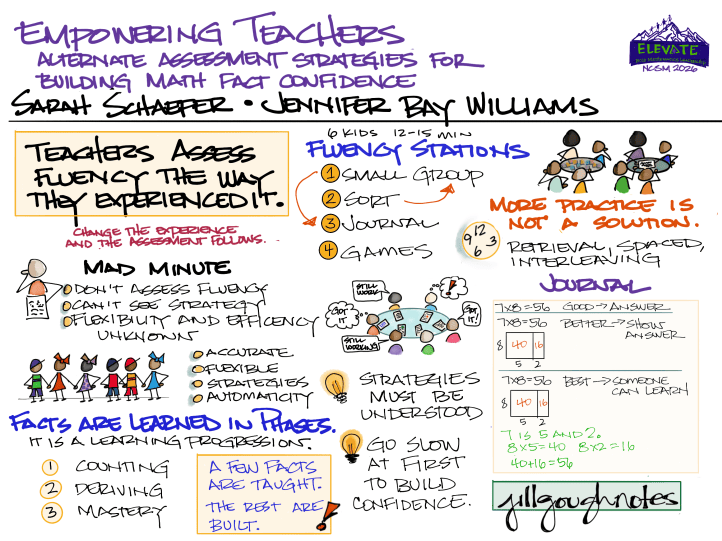
Sarah and Jenny opened with a sentence that stopped me: Teachers assess fluency the way they experienced it. Then they offered the hopeful half: change the experience, and the assessment follows.
What does a Mad Minute actually measure? It doesn’t assess fluency; we can’t see the strategy a student used, and flexibility and efficiency remain unknown. Fluency is accurate, efficient, and flexible, built on strategies and leading to automaticity. And more practice is not a solution. What helps is the right practice at the right time: retrieval, spaced, and interleaved.
Fact learning moves through three phases, drawing on Baroody’s work: counting, deriving, and mastery. The deriving phase is where strategies live, and strategies must be understood, not memorized as tricks. My favorite line: a few facts are taught; the rest are built.
The heart of the session was a fluency day with four stations, about six students each, rotating every 12 to 15 minutes. Each station answers one question: What does it leave behind?
| Station | What happens | What it leaves behind |
|---|---|---|
| 1. Small group, with the teacher | Reteach the strategy, go back a row, or extend | Notes on the class record |
| 2. Sort | Twenty cards, two piles: Got it! or Still Working! The student decides. | A card and a tracker |
| 3. Journal | One prompt, read against Good, Better, Best | Written thinking, marked |
| 4. Game | Practice that runs without an adult | A whiteboard of student work |
The journal’s “Best” for 7 × 8 is written so someone else can learn from it: “7 is 5 and 2. 8 × 5 = 40. 8 × 2 = 16. 40 + 16 = 56.” That is the language-rich mathematics classroom in action.
For leaders, Sarah and Jenny laid out a coaching cycle that mirrors what we ask of teachers: model, co-teach, observe, and debrief from student evidence, not the lesson plan. They also prepared us for what we will hear. When a teacher says, “I learned facts this way,” the answer is to let them experience the other way first.
In the booths: magnetic resources for our thinking classrooms
At Trinity, many of our vertical non-permanent surfaces are also magnetic, and that has changed what is possible at the boards. Magnetic fraction strips and 10-frames turn a board task into a multisensory one: students touch, move, compare, and rearrange the materials while they reason about the mathematics. I spent my time between sessions looking for more tools like these for our teachers’ classrooms and the upcoming PD sessions.
What I was looking for:
- Manipulatives that live on the board, so the model, the representation, and the written argument share one space.
- Tools that work across grade bands, from early elementary counting and composing to upper elementary fractions and beyond.
- Resources teachers can experience first in PD, so they learn with the tool as students before they teach with it.
This connects directly to both sessions today. A magnetic model on the board is a high-leverage support that plays to Visual-Spatial Processing and Embodiment. It also leaves behind evidence of strategy that a timed test never will.
Threads that connect the day
Labels and scores tell us less than evidence does. “Tier 3” and “3 out of 60 in a minute” both hide what a child can do. A reflection tool marked “Not sure” and a fact tracker marked “Still Working!” both point to a next step.
Leave something behind. The student works on the 232-person task, and the journal’s Good, Better, Best both make thinking visible. So does a magnetic model on a vertical board. When the thinking stays on the page or the board, teachers can plan from it.
Experience it first. Amy and Grace had us name our own strengths before analyzing Rohan. Sarah and Jenny argued that teachers assess fluency the way they experienced it. The magnetic tools I went looking for are only as good as the PD where teachers use them as learners first.
The ones doing the talking are the ones learning. Rephrase, sentence frames, partner talk during the sort, and saying the whole sentence in the game all put students’ voices at the center of the mathematics.
Questions I’m carrying home to Trinity
- Which labels still live in our planning documents and team meetings, and what strength-based language could replace them?
- What if our blind data reviews opened with “____ has a strength in ____ as evidenced by ____”?
- Which one area of cognition should a grade-level team start with this year?
- How did we each experience learning facts, and how is that showing up in how we assess them?
- Where could a tracker or a journal replace a timed score in what we share with families?
- Which magnetic tools would make our board tasks more multisensory, and which PD session should teachers experience them in first?
I left Day 2 thinking about every student who has been called “low” or believes they are “bad at math.” Our job is to see what they can do, and to design classrooms, assessments, and professional learning that let them show it.

