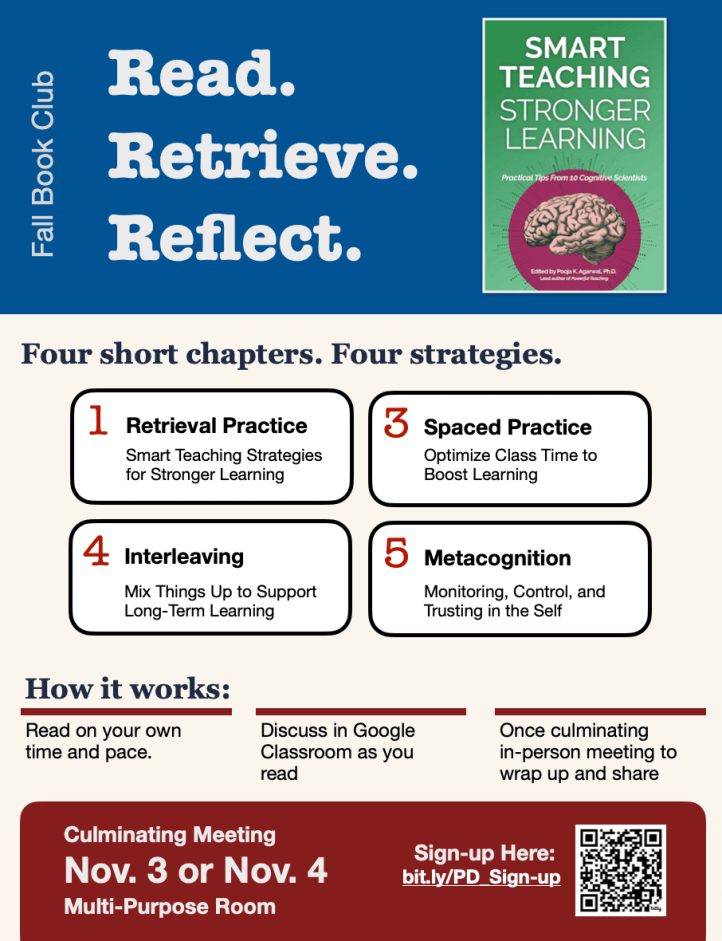
For our final chapter of Smart Teaching, Stronger Learning, I asked teachers to try something before they wrote a word about metacognition: rate their own confidence in explaining spacing and interleaving to a parent.
It was a small move, but by now you know the pattern. Each prompt asked teachers to practice the very strategy they were reading about. This time, they had to think about their own thinking.
What happened next was my favorite moment of the whole book club.
Teachers thinking about their own thinking
SS rated herself a 2. Then she reread her explanation and changed her mind: “I think I actually did better than I thought! I will give myself a 3.” That one sentence captures metacognition. She noticed what she knew, checked it against the evidence, and adjusted.
LC explained spacing using a dinner table metaphor, teaching a child one table-manner at a time. Then she paused and added a note: she might have lost the parents’ attention, so she would tighten up her explanation. She was monitoring her own message as she wrote it.
AK rated herself a 3 to 4 and offered a clear explanation. Spacing breaks practice into smaller pieces across sessions, so learners keep returning to retrieval. Interleaving weaves different skills together, so learners must first decide which skill is needed. Both tighten the connections in the brain.
Teachers weren’t just reading about metacognition. They were doing it.
The illusion of knowing
Many posts named the same challenge: students often think they know something when they don’t yet.
SS sees it most with 4th through 6th graders who “study” by rereading their notes. Everything looks familiar, and familiar feels like knowing. Then the quiz arrives, and they discover they can recognize the information but can’t recall it on their own.
SM watched this unfold with a fourth grader. The student said she understood the lesson well and walked through how she used jumps on a number line to find 7/3. Then SM asked, playing the role of a curious student, how she could show it another way. The student realized she was unsure. With some prompting, she had a lightbulb moment and then successfully retaught SM. As SM put it, the student was able to reflect on what she didn’t know, even though she thought she did.
VE described a frustration many secondary teachers will recognize. After each lesson, her students complete a Cool Down and get immediate feedback. Some nod and carry on without using the extra help that’s available. On the last unit test, students confused material from different sections and tried to make every problem an area problem.
That last detail connects all four chapters. Students who practice one skill at a time may know the steps without knowing when to use them. VE and her teaching partner are already responding: they plan to add a review question to each Cool Down so that students continue to retrieve earlier material as the unit progresses. That’s spacing and interleaving working together to build the judgment students need on the test.
Metacognition has to be taught
AK said it plainly: metacognition doesn’t work well unless it’s taught directly. We can’t assume students know how to reflect, or what to do with what they notice.
Her classroom shows what that teaching looks like. Students reflect and re-engage after every summative assessment. They revisit their Unfinished Work Folder, which treats learning as something still in progress. They reflect at the end of each semester. Every reflection ends with the same questions: What worked well? What is the next best step?
She also teaches students to check their independent work against a key, and if they miss a chunk, to ask for help. Some children are doing this well. Others still need support to move past the “check the box, I’m done!” mentality. As she put it, it’s a process.
Then she offered the line I keep coming back to: teaching metacognition may feel like it slows learning down, but it doesn’t. It amplifies learning, as long as we focus on the long game rather than short-term gains.
Making thinking visible
SS named the central challenge: we can’t see our students’ thinking. So the teachers in this book club found ways to make it visible.
- Ask students to teach it back. SM’s “you be the teacher” move revealed what her student knew and what she didn’t yet. SS replied that she’s definitely trying it.
- Ask how they remembered. LC regularly asks her Spanish students how they remembered a word or phrase. When one child says, “I remembered it from the song,” classmates gain a strategy they can borrow.
- Ask simple, repeatable questions. SS, a self-described sticky note fan, offered three questions any teacher could use tomorrow: Where did you get stuck in your first attempt? How did you solve it? What changed to help you figure it out?
- Use the body. LC noted that our youngest learners lean on songs, gestures, and sign language to retrieve words. Their hands help their memory find the word.
Learning from each other, again
Once again, some of the richest learning happened in the replies. LC, who teaches Spanish to our youngest learners, offered VE an idea for her secondary math tests: make the headings for each skill impossible to miss. VE replied that her tests already include skill headings, but she’d try emphasizing them.
Their exchange raised a question I’d love us to explore together. Clear headings help students on the test. But what helps students choose the right skill when no heading tells them which one? That may be exactly what spaced, interleaved practice builds during the unit.
VE also noticed that students are more likely to come to office hours when they bring a buddy. Help-seeking is a learning skill and a social one, too.
What this book club taught me
Over five weeks, our book club practiced what the book preaches. We retrieved before we read on. We spaced our learning across weeks. We mixed ideas from different chapters and grade levels. And in this final chapter, we paused to ask what we knew and what we didn’t yet know.
Teachers from Early Learning through secondary math found something to try, and they tried it with students the same week. They also found each other. A world language teacher interacting with a math teacher. An interventionist borrowed a move from a specialist. A first-grade routine sparked an idea for a fifth-grade classroom.
This week, we’ll finally gather in person. I postponed our conversation by a week so everyone had a little more time to catch up, because learning is the constant; time is the variable. That’s true for our students, and it’s true for us.
So I’ll leave you with the questions I’m carrying forward. How do your students know what they know? When do they notice they’re stuck, and what do they do next? And how might we teach reflection directly, so it becomes something students own?

