What if the behavior that baffles us most is actually a message?
On Monday, November 9, fourteen Trinity faculty members open Robyn Gobbel’s Raising Kids with Big, Baffling Behaviors together. Joe Marshall and I are co-moderating this asynchronous book club in Google Classroom from now through February, reading in four parts, with two weeks for each part.
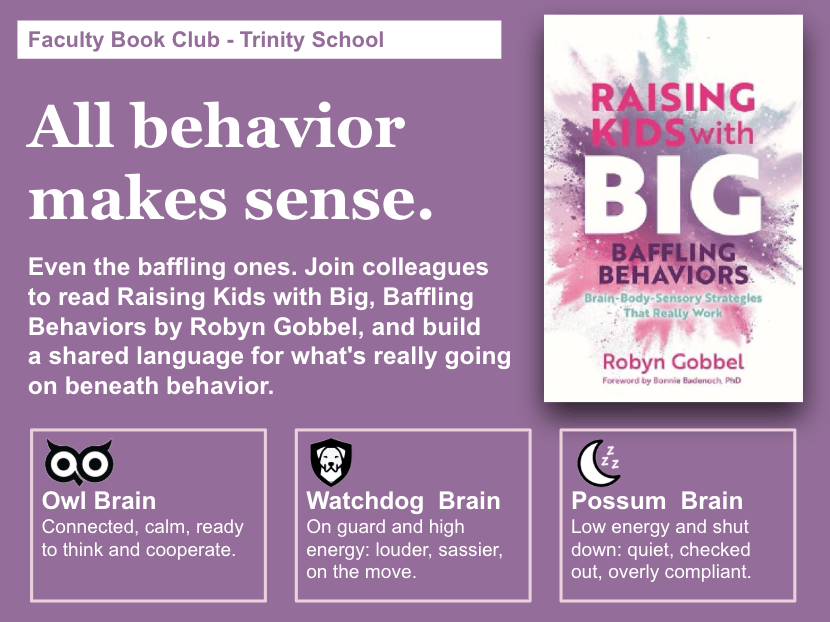
Why this book, why now
Every teacher knows the student whose behavior makes us pause and wonder, “What is going on?” Gobbel offers a different starting place. Instead of asking how to stop a behavior, she asks what the behavior is telling us. That shift is simple to say and hard to live. It asks us to get curious before we get corrective.
Gobbel writes for one parent and one child. We teach in classrooms of 18 to 21. Part of our work together is translation. What does this idea look like at morning arrival, during the walk to specials, or in the last ten minutes before dismissal?
How we will learn together
Before reading a single page, we agreed on norms that care for our students and each other:
- We use “a student” or “a 2nd grader,” never names, initials, or identifying details.
- We are learning to read behavior, not label children.
- The book is clear that baffling behavior isn’t a character flaw in kids. The same grace applies to colleagues.
- Our job is to figure out what an idea looks like in a room with 18 to 21 students.
We also designed a predictable routine. After each part, everyone shares:
- one idea that changed how you see a student,
- one moment from your week that you’d now read differently, and
- one question you’re still holding.
Using the same structure every time lowers the barrier to posting. No one has to wonder what a “good” reflection looks like. We also ask each reader to reply to one colleague in their own division and one outside it. The ones doing the talking are the ones learning, and conversations across divisions stretch all of us.
Part I: Behavior is a clue
Our first reading is the Preface and Section 1 (pages 15-74). Gobbel lays the foundation for everything that follows:
- Behavior is a clue to what’s happening inside a child.
- Felt safety drives connection or protection.
- Regulation underpins everything.
She also introduces three animal brains that give us shared language:
- Owl Brain is connection mode. Children can use logic, cooperate, show empathy, and pause before reacting.
- Watchdog Brain is high-energy protection.
- Possum Brain is low-energy protection.
I’m especially curious about the possum. Watchdog behavior gets our attention. Possum behavior can look like ignoring us or being overly compliant, and it is easy to miss. A quiet, compliant child is not always a regulated one.
A noticing day
After reading, each of us will spend one day noticing owl, watchdog, and possum moments, in students and in ourselves. Just noticing. No intervening differently yet. Seeing comes before changing.
Reading with purpose
To help us read with intent, each person chooses one prompt to anchor their reflection:
- Think of a student whose behavior baffles you. What might that behavior be about?
- Which animal brain do you see most often in your room? At what time of day, and during which transitions?
- Possum behaviors can include ignoring you or being overly compliant. Whom might we be missing because they’re quiet?
Wondering with you
I’m grateful to the fourteen colleagues who said yes to this learning, and to Joe for reading alongside us. If you’re reading along from afar, I’d love to hear your thinking too:
- When have you noticed your own Watchdog or Possum Brain show up during the school day?
- What helps your students, or you, find the way back to Owl Brain?
I’ll share what we’re learning as we go.

