Not all children walk at the same time. Not all children talk at the same time. Some take their first steps at nine months. Others wait until fifteen months, and then they run. Some babble early. Others are quiet for a long time and then speak in full sentences.
And yet, they end up walking and talking.
We don’t send a toddler home with a progress report that says “Walking: Late.” We wait. We hold their hands. We give them more chances. We celebrate when it happens, whenever it happens.
So I keep wondering: what if the pace of school isn’t always the pace of learning?
A confession about pacing
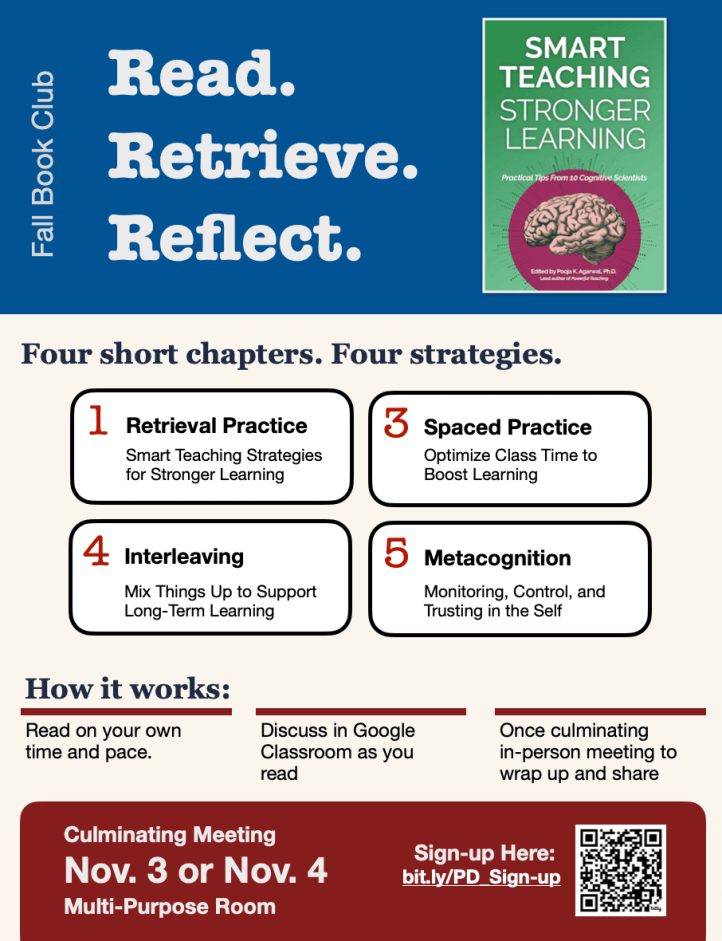
We just finished our Smart Teaching, Stronger Learning book club. When I set the pace in September, I looked at chapters of 8 to 12 pages and thought, this is doable. A chapter, a reflection, a week. Not too much.
And yet…
I didn’t plan for the busyness of school. Halloween. Progress report checklists. Parent-teacher conferences. All the wonderful, demanding, full parts of fall in an elementary school. That’s on me. The readings weren’t too long. The weeks were too full.
So I pushed our closing meeting back a week. Then I invited everyone to my office for coffee and pastries to talk about what we’d learned and what comes next. I asked each person to bring two things:
- One strategy you tried and plan to keep using
- One thing you learned from a colleague’s post
That was it. No other preparation needed. Just coffee and thinking.
What “Done late” really tells us
Google Classroom tracks everything. It marks submissions “Done late” and flags others “Missing” in red. When I look at our book club page, I see a lot of both.
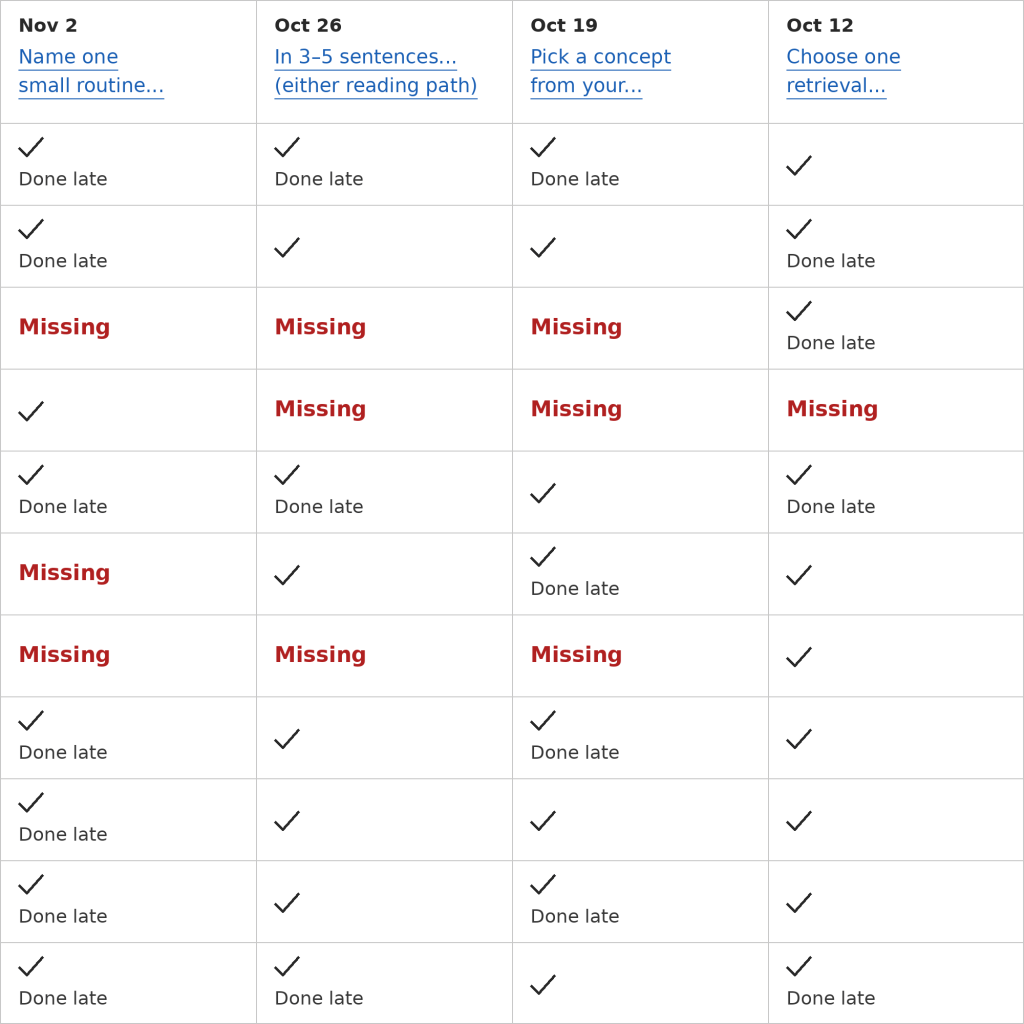
But look closer at “Done late.” There’s a checkmark right above those words. The thinking happened. The reflection got written. A colleague read it and learned from it. The timestamp is a detail about pace. It doesn’t tell us anything about learning.
There were no grades in this book club. My goal was faculty learning. My goal was stronger student learning. A Tuesday post and a Saturday post serve those goals equally well.
This morning we agreed: if you want to finish over the holiday break, please keep reading and writing. And please let me know, so I can read your thinking and respond. I love that so much. The door is still open, because the learning is still happening.
Grace and the umbrella of mercy
This experience brought me right back to our norm of offering grace and the umbrella of mercy. Things come up. Things happen. If learning is our focus, we adjust.
That should be just as true for our students.
High school athletes, thespians, and students who volunteer in our community have a lot more to do after school than homework. Middle schoolers do too. And our elementary children have almost no control over their own timelines. They adjust to a parent’s travel, a parent’s work schedule, a grandparent who needs care, a new baby, a move. They don’t choose when life gets full. They just carry it into our classrooms.
We don’t want to run out of time before our students learn. That worry is real, and it matters. But I keep coming back to this:
Learning is the constant; time is the variable.
If that’s true, then the question isn’t “Did they finish on time?” The question is “What do they know and understand now, and what do they need next?”
Moves that make room for more time
So what can we do for learners who need more time? Here are a few moves I’m thinking about, and I’d love to hear yours.
- Separate the evidence from the timestamp.
Look at what the work shows about understanding before you look at when it came in. - Offer a window, not a wall.
A range of days (“sometime this week”) respects that weeks look different for different families. - Keep the door open.
Let students revisit, revise, or show their learning again. “Not yet” is a powerful phrase. - Use retrieval and spacing on purpose.
A student who missed a lesson isn’t lost if we return to key ideas again and again. Spaced practice is also a built-in second chance. - Name what’s essential.
When time is short, decide which learning matters most and protect it. Not everything has to be finished. The big ideas do. - Adjust out loud.
When I misjudge pacing, I can say so, the way I did with my colleagues. Students learn a lot from watching adults adjust with grace. - Confer and ask.
A two-minute conversation (“What’s getting in the way this week?”) often tells us more than a red “Missing” ever could.
Questions I’m carrying forward
How are we designing for learning when time is the variable and learning is the constant? When does a deadline serve learning, and when does it just serve the calendar? How might we tell the difference?
And for you: What moves do you make to support learners who need more time?
I’d love to learn from you.

