09.16.2026 Wednesday Workshop Recap
- 2:15-3:15 EL, PK, K Literacy: Language Comprehension with Marsha Harris
- 3:30-4:30 Specials Teachers: MyLearning with Marsha Harris and Jill Gough
- 3:30-4:30 4th, 5th, 6th Numeracy (Asynchronous) Multiplication Fluency
Scroll through educator social media on any PD day, and the pattern is easy to spot. Memes about sitting in the auditorium. Jokes about the keynote that could have been an email. Teachers are counting the minutes until they can get back to their classrooms and do the work that actually matters.
I understand where that comes from. Too many of us have sat through professional development that was done to us rather than with us. But what if it doesn’t have to be that way? What if our professional learning looked like the classrooms we want for our students: interactive, purposeful, grounded in evidence, and connected directly to the children in front of us?
On Wednesday, September 16, our Wednesday Workshop offered three very different sessions. Each one tells a piece of that story.
EL–K: Literacy (Language Comprehension)
Our Early Learners, Pre-K, and Kindergarten teachers gathered in the Community Room with three learning goals:
- I can explain how language comprehension supports skilled reading and oral communication.
- I can notice oral-language strengths and instructional signals.
- I can plan routines that build knowledge, vocabulary, syntax, reasoning, and talk.
Marsha opened by naming what is already true. Our EL–K team is strong in Word Recognition, the lower strands of Scarborough’s Rope. Then she made the pivot explicit: today we zoom in on the other half.
And she didn’t lecture about it. She gave us a sentence full of nonsense words (dax, vorpal, glippet) that every teacher in the room could decode perfectly, and not one of us could understand. In about a minute, the room felt the difference between reading words and comprehending language. That is what good instruction does. It creates the experience before it names the concept.
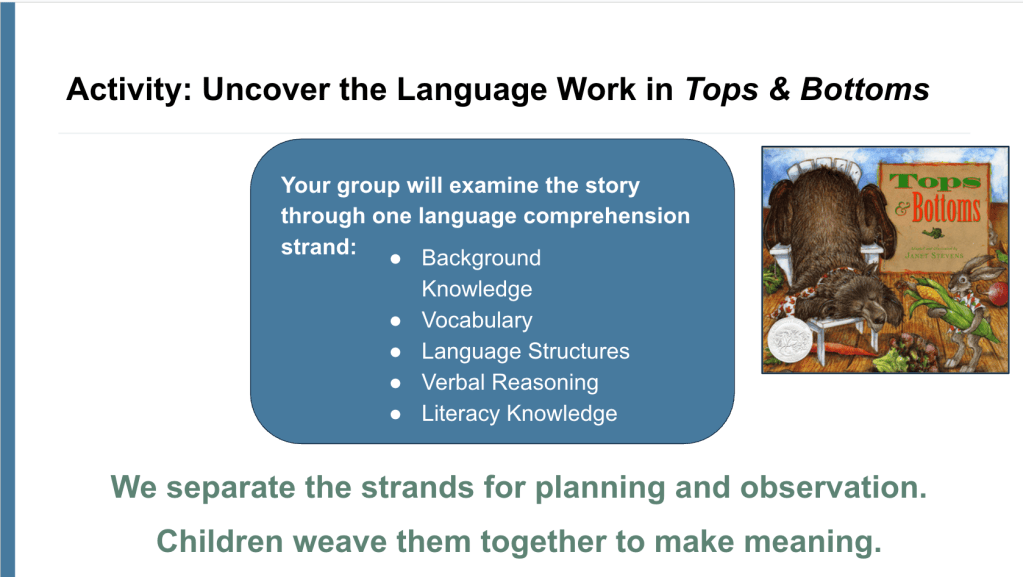
From there, teachers jigsawed into strand groups: background knowledge, vocabulary, language structures, verbal reasoning, and literacy knowledge. Each group read Tops and Bottoms through the lens of its strand, then returned to base teams to teach one another. Marsha also offered parallel “I can” statements in a child’s voice for both halves of the Rope, a model teachers can carry straight into their classrooms.
The session closed with compliments and appreciations flowing in both directions. Time was spent purposefully, academically, and in service of skill building.
Specials: MyLearning (Face-to-Face)
Our Specials teachers worked toward one focused goal: I can make a plan for MyLearning entries and activities that focus on growth over time and/or metacognition.
Instead of a presentation about MyLearning, teachers picked a partner and toured already existing posts from their peers. They were asked: What do you notice about student work and learning? Are there comments or feedback from teachers or parents? Is there a variety of post types, such as images, video, and voice-over? Is the learning or purpose clear?
Then each pair selected one artifact to share and explained why they chose it.
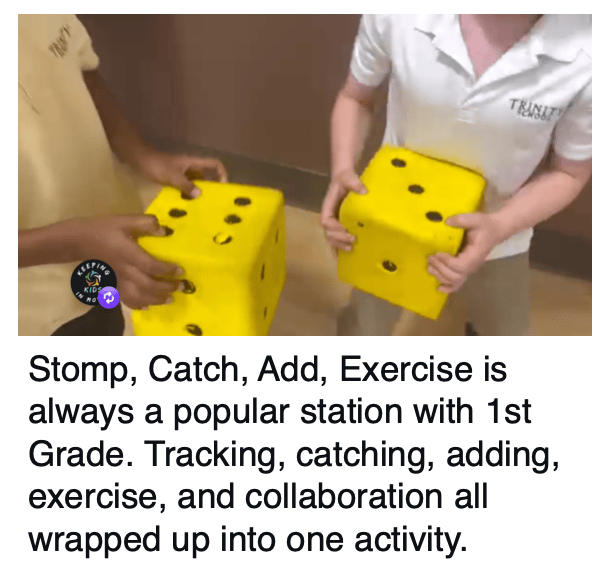
We also made space to honestly name all the reasons this work is challenging for Specials teachers, who see many students across many grades. Naming the constraint is the first step toward designing around it.
The session ended with a plan rather than a promise. Our September 30 asynchronous workshop is protected time to post, with a focus on the students for whom each teacher is writing progress reports. The learning doesn’t end when the meeting does. It has a next step and the time to take it.
4th–6th: Numeracy (Asynchronous)
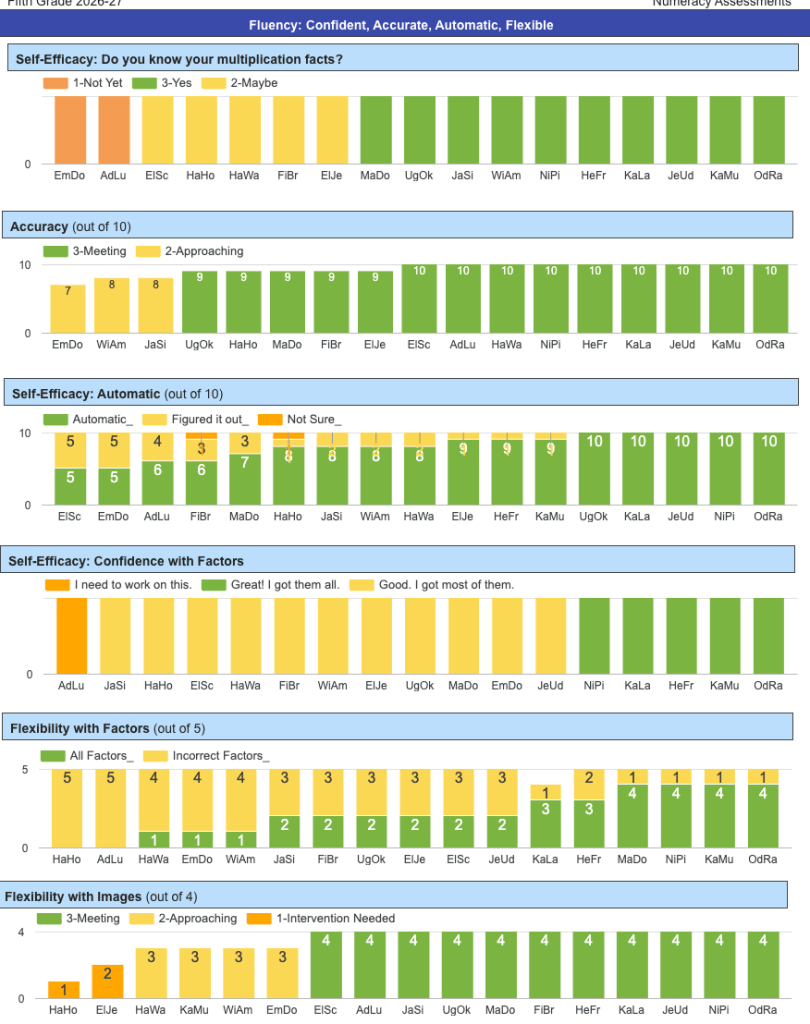
Asynchronous does not have to mean passive. Our 4th, 5th, and 6th-grade math teams spent this session with their own students’ fluency and accuracy data, asking questions that matter:
- What does the data tell us? Who is meeting or exceeding the goal, approaching it, or in need of intervention?
- Is our retrieval practice helping? Is it too early to tell? What adjustments do we need to make?
- Who needs targeted small-group intervention, and who needs enrichment?
Teams then planned next steps using the 5 Practices for Orchestrating Productive Mathematics Discussions: select tasks, anticipate the flexible ways students might respond, and then select, sequence, and connect in class using Building Thinking Classrooms moves.
What struck me most was how deeply teachers looked beyond right-or-wrong answers. Fifth-grade teams examined accuracy, efficiency (automatic recall versus “figured it out”), flexibility with factors, flexibility with images, and student confidence. They noticed bright spots, such as whole classes with strong visual and array sense. They noticed nuanced profiles, like a student who computes forward with ease but struggles to work backward from a product to its factors. In one class, the pattern was broad enough to suggest a whole-class mini-lesson on reverse thinking rather than individual intervention alone.
That is not compliance work. That is teachers thinking like researchers about their own classrooms.
What These Sessions Have in Common
Three sessions. Three formats. Three content areas. And yet they share a design:
- Clear “I can” goals so every participant knows the target.
- Active learning, whether a jigsaw, a partner tour, or a data sort, rather than sit and get.
- Job-embedded work with real students, real artifacts, and real data.
- Evidence-based practice, including the Science of Reading, retrieval practice, and the 5 Practices.
- A next step, with time attached, so learning moves into classrooms.
We ask our students to retrieve, discuss, reason, and reflect. Shouldn’t we ask the same of ourselves? When professional learning models the instruction we value, it stops being something teachers endure and becomes something they use.
So, I’ll leave you with the questions I keep asking myself. What would it take for every professional learning session to feel like one of our best classrooms? And what do you notice when it does?

