How might we strive to deeply ensure that every child is known, seen, and valued? That question lies beneath so much of what we do, but it’s easy to answer in the abstract. The harder, more honest version of the question is this: what if we actually took the time to look? Really look. To uncover what the data is telling us, not what we assume it’s telling us.
We are not a test-driven school. But at least three times a year, we check whether progress is being made, and we do it as a team.
How the data comes together
Our base classroom teachers assess high-frequency words and nonsense words and administer the Heggerty assessment. A separate DIBELS team administers the DIBELS assessment. All of that reported data comes to me, and I turn the results around into visual form so the team can actually work with it.
The blind data review
Once the data is produced in graph form, the UED Learning Team takes a whole-grade approach to analyzing it. We conduct what we call a blind data review: student names are hidden, so we look at the data without the rest of the story.
This matters more than it might sound like it should. Sometimes we miss what the data is telling us because of our prior knowledge. A name attached to a data point brings a whole narrative with it: what we already believe about that child, that classroom, that family. During the first pass, we deliberately remove what we know to see what’s actually there.
There’s a cognitive load piece in this design, too. A full grade’s worth of assessment data is a lot to hold in mind at once. Strip away the names, and the team isn’t spending working memory managing a story for each child; that capacity is freed up to focus on the pattern in front of them. Less load, more room to think.
Here’s the process once the data is printed in graph form:
- Data is posted so that the entire grade of students is represented.
- Approximately five minutes of quiet, individual think time is provided to review the data as a whole. What trends do you notice for the grade?
- Then, in ten-minute rounds of affinity work, we sort the data into three groups:
- We have no concerns about these students; they are performing at a level expected for their age/grade at this time.
- We have concerns that these students need more instruction, time, and repetition.
- We want to pay attention to these students and check in again after they’ve worked through our curriculum for a few weeks.
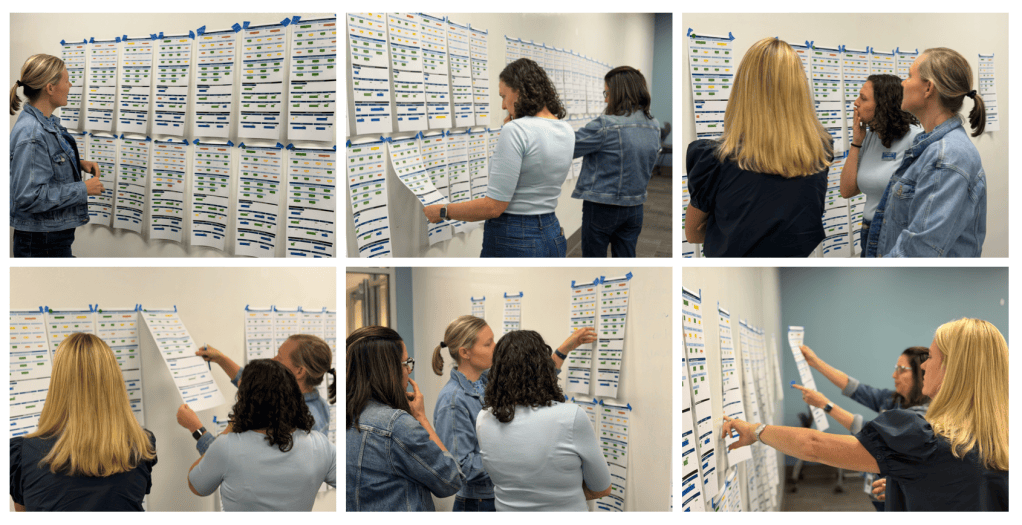
While that sounds tidy, in reality, we formed four groups with two levels of watch-and-wait. We left that intact rather than forcing it back into three neat categories, because it was true to what the team actually saw.
The quiet think time does more than give people time to settle. Before anyone talks, each person has a chance to retrieve what they already know: about typical development, about our curriculum, about what “on track” looks like at this point in the year, and to test that against the data in front of them. That’s retrieval practice, not just for students but for the team. It’s part of why we protect the individual think time before the group work starts; without it, the first idea spoken aloud tends to shape everyone else’s thinking too quickly.
What the team noticed, and wondered
From there, the real work began. We revealed the student names and, working back through what we’d sorted, noted where we were not surprised, based on what we know about our students, their journey, and their family history, and where we were surprised. That comparison mattered almost as much as the sorting itself: it showed us where our instincts and the data agreed, and where they didn’t.
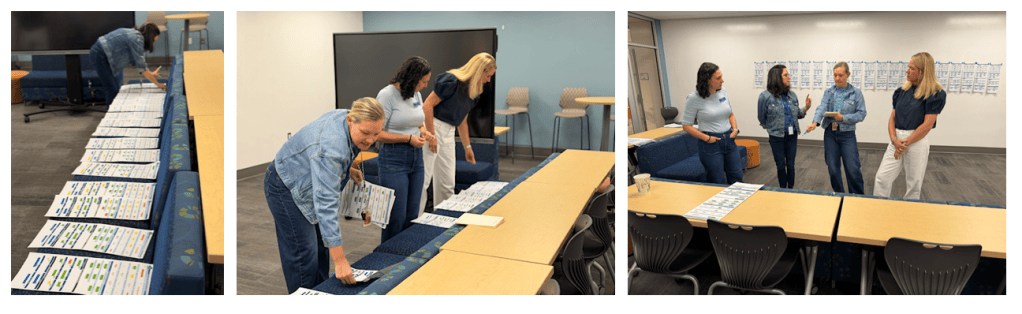
Then came the noticing and wondering about students’ results together. What might be of most help? How might we help our students become stronger listeners, readers, and writers?
And just as important, we didn’t only look for problems. We also noticed strengths across the grade and discussed what’s going very well in our program, because a data review that only hunts for deficits misses half the story, too.
This work happens because of the expertise and commitment this team brings to the table. Reading assessment data well, really well, takes training, practice, and a shared understanding of what early literacy development looks like. Our team doesn’t take that lightly. And underneath all of it is a commitment that doesn’t waver: every student’s needs will be met, whatever that takes, whatever adjustments in pace or instruction are required. The blind data review isn’t a one-time event. It’s one expression of a much larger, ongoing commitment to knowing, seeing, and caring for every child we serve.
If your team is considering a blind data review, start small. Pick one assessment window, hide the names, and give people real quiet think time before the conversation starts. It’s a small thing to protect, and it tends to shape the rest of the conversation.

