As a community, we continue to learn. At Pre-Planning, we pitched a system of teacher-choice levels of observation opportunities. On September 4, I received the following email:
Hi Jill,
Sheree reached out to us and asked us to contact you. 🙂 Melissa and I would love it if you would come in to observe us sometime soon. When you can, please send us some dates and times that you could come in to hang out with us.
Thank you,
H & M
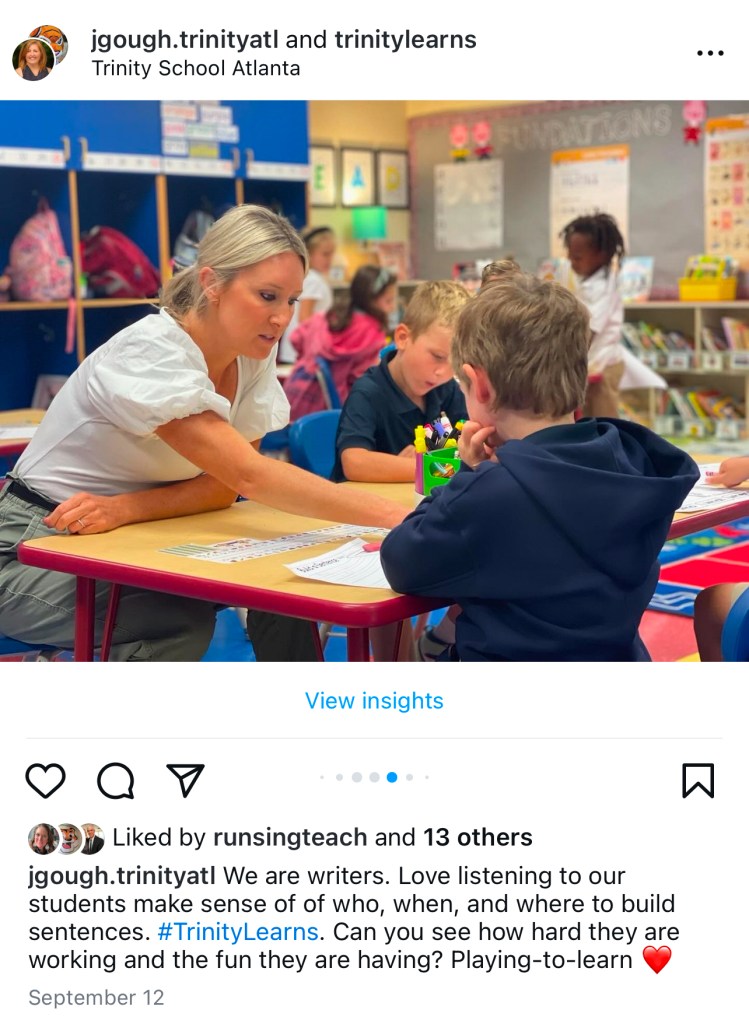
We agreed that I would observe on September 12. To observe, I try to find a quiet spot where I can sketch-note the observed lesson. When the observation concluded, I immediately sent my sketch to the observed teacher(s) and posted the following on Instagram.
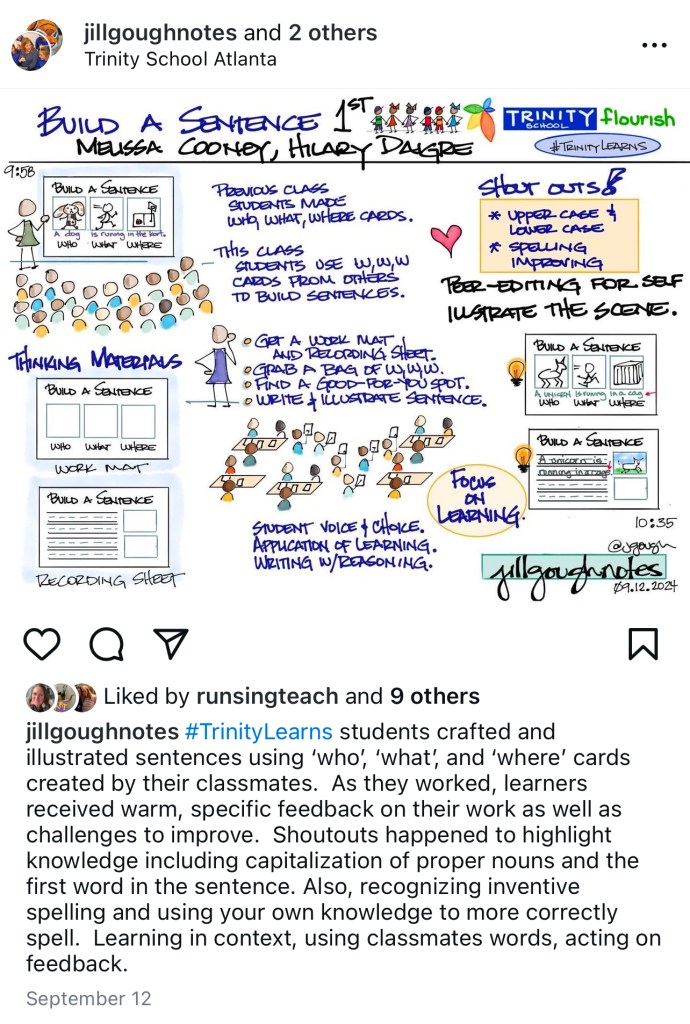
Within 24 hours, I also shared a detailed written observation with the observed teachers and asked for a time to debrief after they had a chance to review my notes.
With their permission, I am sharing my sketch, notes, and photos from their observation.
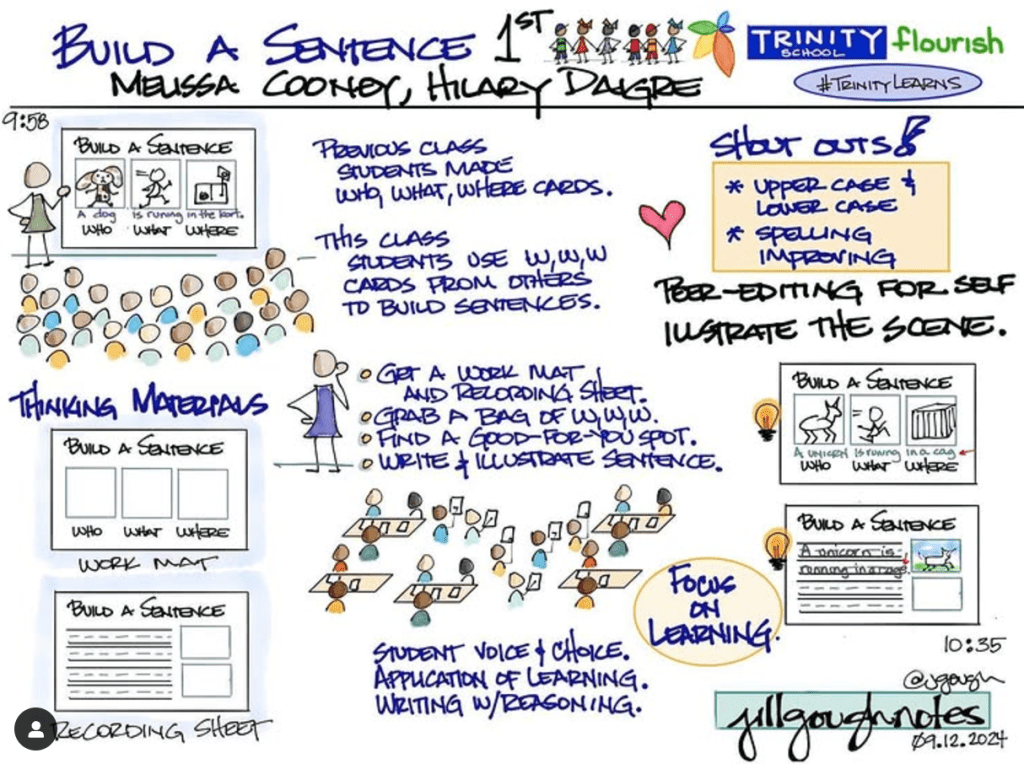
Visited Teachers: Melissa Cooney and Hilary Daigre
Date Visited: 09/12/2024
Class or Grade: 1st Grade Literacy
Observer: Jill Gough
(Capitalization errors and misspelled words are captured as shared by our students, and the inventive spelling is age-appropriate.)
My notes:
I arrived at 9:58. Students were seated on the rug in the front of the room. Using the document camera, Melissa was beginning to build a sentence using who, what, and where from using a student’s cards. (A dog is runing on the kort.) (A dog is running on the court.) With the class, Melissa methodically built a sentence from the cards, emphasizing sense-making and using the illustrations. She modeled using the recording sheet and talked about illustrating the sentence using the entire area on the recording sheet.
Hilary asked the students what to do if they could not read their classmates who, what, and where cards. Student responses varied: ask the author, ask the teacher, and use the picture.
Students were given the next steps:
- Get a work mat and a recording sheet.
- Graph a bag of a classmate’s ‘who’, ‘what’, and ‘where’ cards.
- Find a good-for-you spot.
- Build and illustrate sentences.
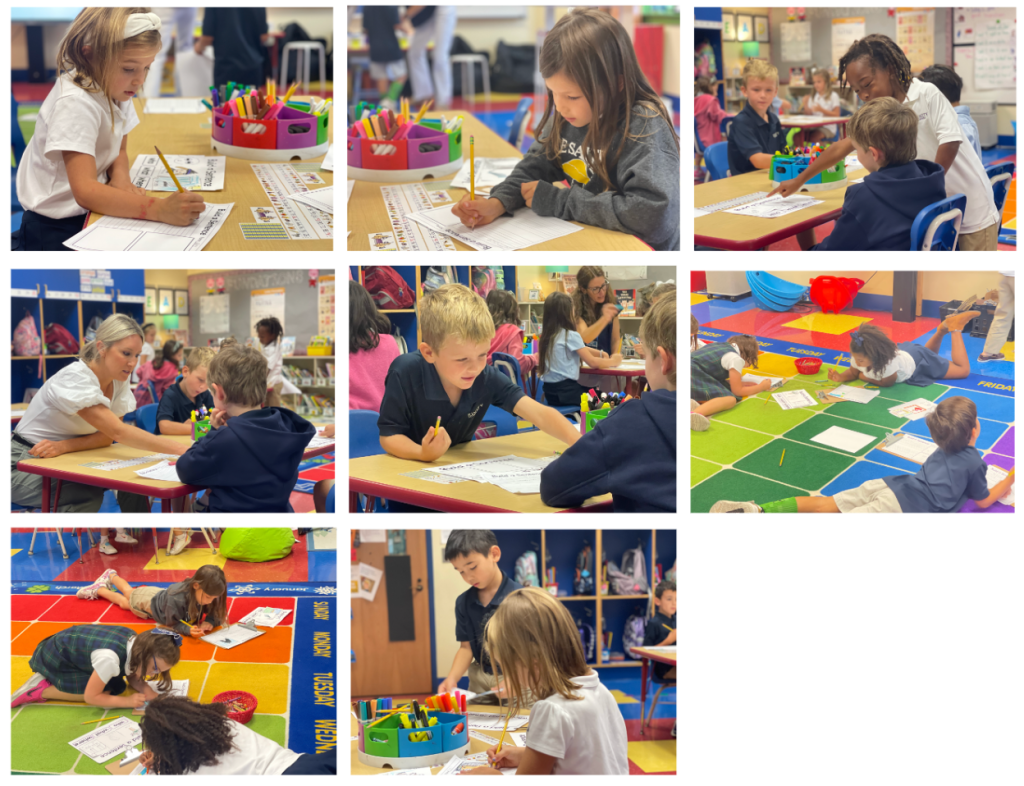
Students gathered their materials and got to writing. I think there were 6 students on the carpet and 14 students at their tables. Melissa and Hilary moved through the room, reading sentences, encouraging students, and celebrating success.
Both teachers’ feedback was intentional, targeted, warm, and constructive. I loved the moments when you paused the class for shout-outs, highlighting your teaching points and directions. Proper nouns are always capitalized. “It says Michael jordan; does your last name start with an uppercase letter? So should Michael’s!” You celebrated the use of magic-e to change cag to cage so that the sentence makes sense!
Lesson ended at 10:38.
Observed strengths:
- Assigning strengths to students collectively and individually
- Norming session with students for experience-based directions and to-dos
- Student voice was cultivated and invited
- Teacher clarity again and again
- Feedback was immediate, kind, and direct
- Student agency was clearly evident
I’d love to debrief with the two of you if you have the time and/or if you have questions, let’s talk again. I learned a lot in the quick 30-minute lesson.
Jill
Photos from the lesson:
Hi Jill,
We loved having you! We definitely want the opportunity to meet to debrief with you next week. Hilary and I are free on Wednesday 9/18 at 11:30. Does that work for you? And thanks for tagging us on Instagram!
Melissa and Hilary
We met for lunch, and a face-to-face debrief with Q&A.
 Experiments in Learning by Doing