When we think about professional development, we often picture a scheduled session: a room, an agenda, a facilitator, a slide deck. Those sessions matter. Our Wednesday Workshops give us shared language, shared research, and shared time. But some of the most important learning I get to be part of never appears on a calendar at all. It happens at the elbow.
Strong thinkers, lighter load
Our 5th graders are strong mathematical thinkers. They reason, explain, question each other, and persevere through challenging problems. Brian Toth and Vicki Eyles want to make that thinking even easier by helping students make multiplication automatic.
Here’s why that matters. When 7 × 8 comes to mind instantly, working memory is free to focus on the interesting part: noticing patterns, testing strategies, and making sense of a problem. When a fact takes effort to retrieve, some of that energy is spent before the real thinking even begins. Automaticity isn’t the goal. It’s what makes room for the goal.
So Brian and Vicki were intentional from the start. During the first full week of school, they invited students to take a multiplication accuracy assessment and a fluency self-assessment, in which students reflected honestly on their own confidence, accuracy, and flexibility. John Hattie’s research reminds us how powerful student self-reported feedback can be, and students’ reflections, alongside the accuracy results, gave us a clear picture of where each learner is ready to grow.
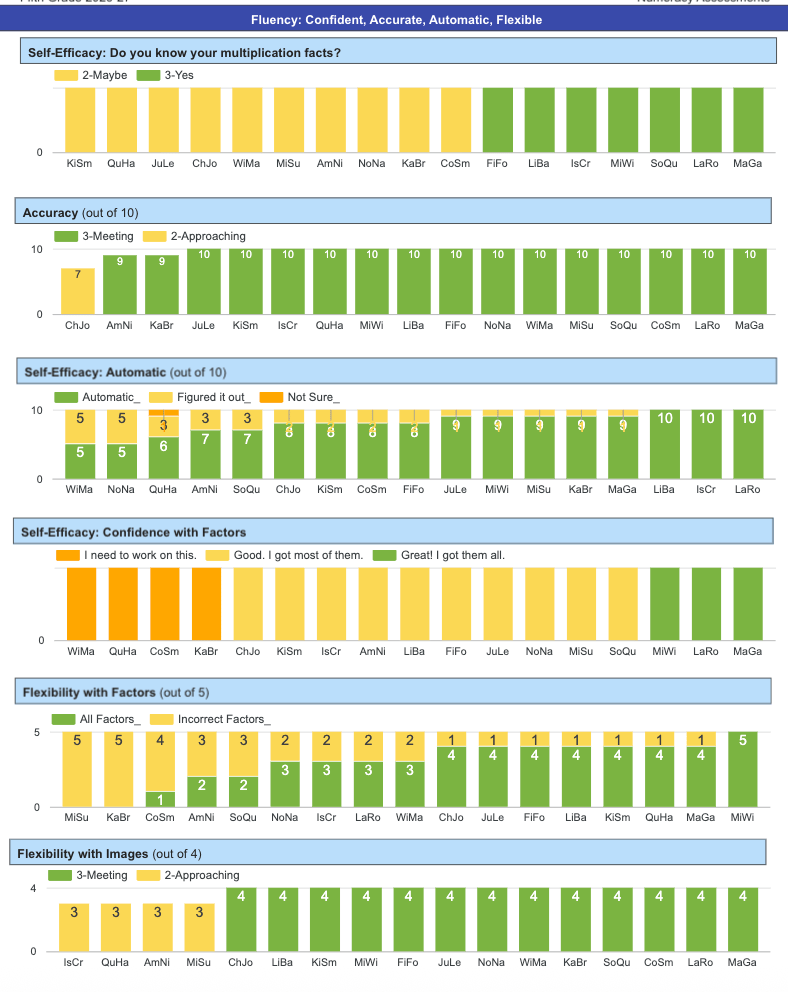
We can see that our students are mathematically accurate and flexible, but they are not as confident as we’d like. That’s when I asked if they’d try an experiment with me around retrieval practice and teacher clarity.
They said yes.
The learning happened before the launch
Here’s the part I want to highlight. Brian and Vicki did not rush. They spent the following week learning and planning, working to understand the process before bringing it to students. What does retrieval practice actually look like in a 5th-grade room? How do we give feedback that is immediate and kind? How do we help students find their just-right level without it feeling like a test?
That week was professional development. No sign-in sheet. No agenda. Just colleagues side by side, asking questions, trying ideas on, and deciding together what to do next.
When they launched, students worked through leveled sets of facts and questions. After completing levels 1-3, each student checked in with Brian or Vicki, got immediate feedback, and made corrections on the spot. Then, together, the student and teacher decided on the next step, the level that offered the right amount of stretch.
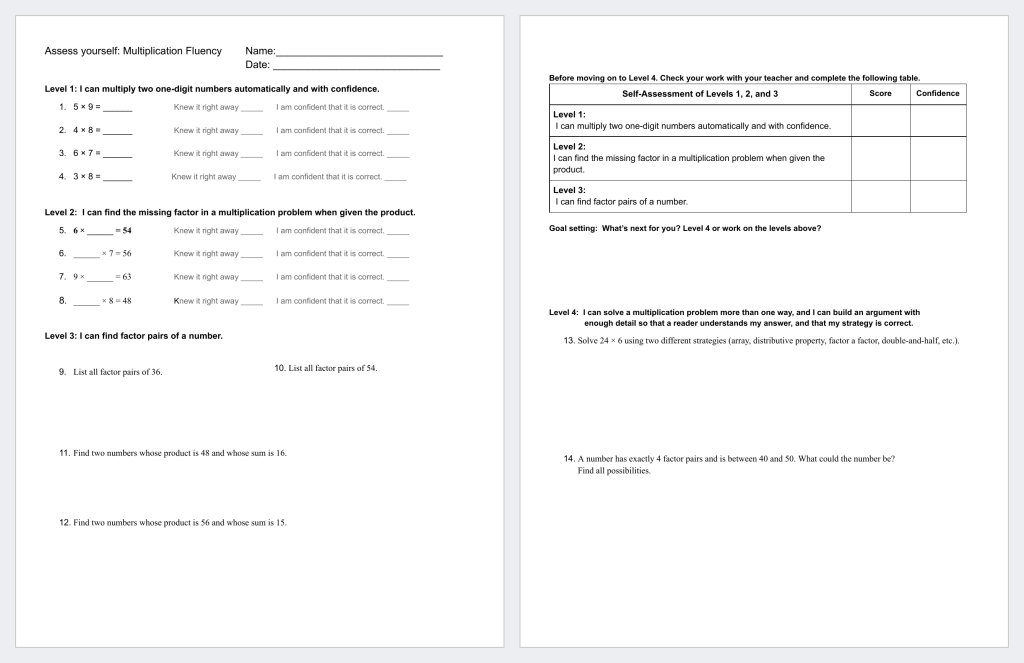
Students heard, clearly and often, that this was for learning, not for a grade. Just like the RAN assessments they know from literacy, the point was to find where they are, so we can work on strengths and stretch without going out of bounds. The goal is to get stronger and fitter, the way practice builds any skill.
Why elbow partners matter
When I sit beside colleagues who are willing to try something new, a few things happen that are hard to replicate in a scheduled session:
- The problem is real. We’re not learning about retrieval practice in general; we’re learning about these students.
- The risk is shared. Trying something new feels different when someone is trying it with you.
- The reflection is immediate. We notice together, wonder together, and adjust together.
- The learning belongs to the teachers. Brian and Vicki did the planning, the thinking, and the decision-making. The ones doing the talking are the ones learning, and that’s as true for adults as it is for students.
This isn’t the first time Brian and Vicki have opened their classroom to experimentation, and I’m grateful every time. Their willingness to say “yes, let’s try it” models exactly the learner stance we hope our students will take.
Wonderings
- Where is elbow-partner learning already happening in your building, and how might we name and honor it as professional development?
- What would it take for more of us to say “yes, let’s try it” with a colleague this year?
- How might we capture what we learn from these small experiments so others can learn alongside us?
Growth Over Time
This work calls for patience and persistence. Confidence and fluency isn’t built in a day or a week; it grows through steady, spaced practice over time, for students and for the adults learning alongside them. We’ve just started. Brian and Vicki have laid a thoughtful foundation, and now comes the steady work of practicing, noticing, and adjusting. Time will tell how much progress we make, and I’m looking forward to learning what it shows us.
Not all PD happens in a scheduled session. Some of the best experiences happen when we pull up a chair, lean in, and figure it out together, and then keep showing up to see it through.

