Last week, our Community Life and Engagement Committee held its first Chat of the year. Many thanks to Emily Graney, Kristen Novay, and Olivia Wall for bringing us together. Dr. Jane Lanier presented Distress Tolerance: Helping Your Child Develop Resilience and Independence.
It was a session for parents, and it was full of reminders for us as educators.
Dr. Lanier used a phrase about limit setting that stuck with me: two things can be true at once. That became my lens for the morning. Every strategy she offered parents is also a strategy for our classrooms. Our students spend a big part of their day with us. How we respond to their struggle, their fear, and their big feelings matters just as much as what happens at home.
Dr. Lanier defined three terms:
- Resilience: bouncing back from challenges
- Emotion regulation: managing and shifting feelings
- Distress tolerance: surviving tough moments
She framed the caregiver’s role as a coach in a serve-and-return relationship. We are supportive guides. We don’t remove all distress. We coach children through hard moments by responding to them.
AND for us as educators: Do our students and families hear the same words and ideas from us that they hear at home? Shared vocabulary between school and home is powerful.
Resilience
Resilience means bouncing back and adapting well when things are hard. It is not a fixed trait. It is a set of skills that children can learn, practice, and strengthen over time with the support of a supportive adult. What matters most, according to research:
- A warm, reliable relationship
- Self-regulation
- Self-efficacy: “I can handle hard things.”
- Hope, meaning, and a sense of competence
- A supportive network of relationships
AND for us as educators: If resilience is taught, practiced, and strengthened, then it is learning. We know how learning works. We model, we practice, we give feedback, and we space and revisit. Which of these skills are we teaching on purpose, and which are we hoping students pick up on their own? And a warm, reliable relationship is the first item on that list. Every student needs at least one adult at school who fits that description.
Resilience is built through age-appropriate challenge, not rescue. The aim is a supported challenge: hard enough to grow, safe enough to try. Three ways to allow healthy struggle:
- Safe failures. Allow safe failures and natural consequences.
- Resist fixing. Ask, “What do you think you will say to your teacher?” Later: “How did that work out? What should you do next week?”
- Real choices. Give real responsibilities and choices that build “I can do this.”
When a child fails, the lesson isn’t “You should have remembered.” It’s “What will help you now, and what will you do next time?”
AND for us as educators: We say we value productive struggle in math, in reading, and in research. Do we value it in executive functioning, too? When a student forgets their folder, do we rescue them, lecture them, or coach them? “What will help you now, and what will you do next time?” works just as well in a classroom as at a kitchen table.
Here’s another thing to keep in mind: some of the questions Dr. Lanier gave to parents are about us. “What do you think you will say to your teacher?” means parents are coaching children to come to us. When they do, how will we receive them? Is it safe to say “I forgot” or “I don’t understand” in our rooms?
Don’t remove every fear. Coach a child through it in small steps. In my words: baby steps to the bus. Avoiding fears makes them grow. Facing them gradually teaches the brain that anxiety is temporary and manageable. Four ways to coach through worry and fear:
- Normalize: “Everyone feels nervous sometimes. That’s your body sending you a signal.”
- Graded steps: Break a scary thing into small, doable steps.
- Narrate and cheer: “You’ve got this. You’re being so brave.”
- Praise the try: “You were nervous, and you did it anyway. That took courage.”
AND for us as educators: Think about the student who dreads presenting, reading aloud, or taking a test. Do we excuse them, or do we build graded steps toward the thing? Presenting to a partner, then to a small group, then to the class is a set of baby steps to the bus. “You were nervous, and you did it anyway” might be the most important feedback we give all week.
Emotion Regulation
Emotion regulation means understanding and shifting feelings over time. It lowers the “fuel” that makes feelings explode. Children are managing internal shifts, such as brain changes and hormonal changes, and external stressors, such as friendships and school pressure. Each child’s window of tolerance is made up of their biological sensitivities and the regulation resources they have available right now.
- Things that open the window: walking into a new place with a friend, arriving on time or early, getting good sleep, knowing what to expect, playing, and being active.
- Things that close the window: crowded places, being yelled at, feeling left out, getting a bad grade, being alone in the dark, and running late.
AND for us as educators: Look at those lists again. Knowing what to expect. Feeling left out. Getting a bad grade. Running late. So much of what opens and closes a child’s window can happen at school. Predictable routines, a posted agenda, and a warm greeting at the door are not extras; they are regulation resources. And how we hand back an assessment can open a window or slam it shut. What is our classroom doing to widen windows?
Skills to try
- Name it to tame it. Build a feelings vocabulary beyond “mad” and “sad.” “Good” is not an option!
- Protect the basics. Sleep, food, movement, and limited screens.
- Do the opposite. When sad and wanting to hide, take one small action.
- Catch and stretch worries. “Let’s check the facts. What’s most likely to actually happen?”
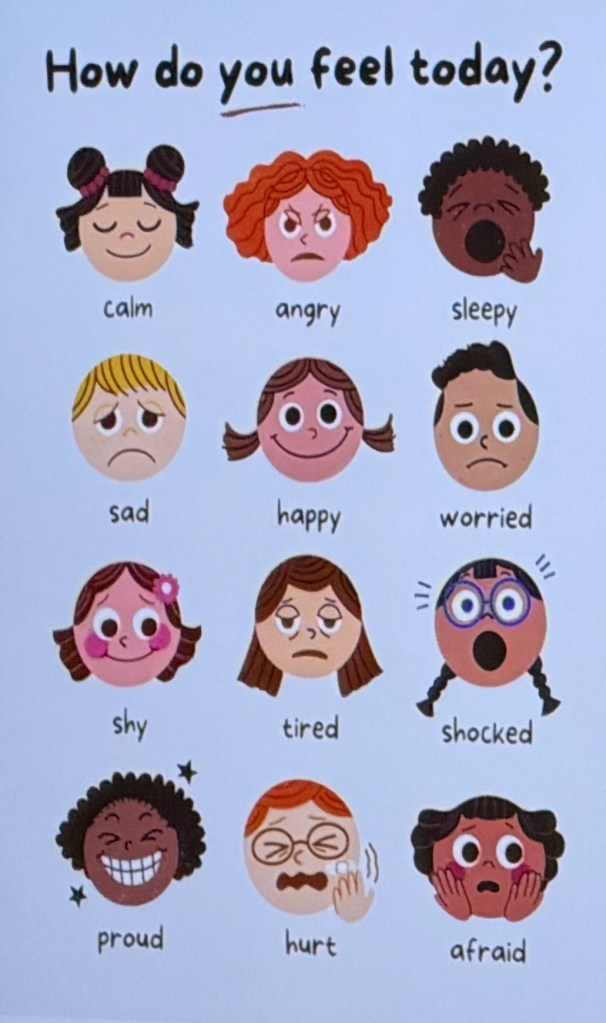
AND for us as educators: Feelings vocabulary is vocabulary. We are experts at building vocabulary. Could we treat emotion words with the same intention we give to academic language? And “catch and stretch” is really evidence-based reasoning. What’s the evidence? Is it really true? We ask students those questions about texts every day.
Distress tolerance
When a child is upset, follow this order:
- Connect. Get down to eye level, use a soft voice, and offer a hand.
- Validate. “This is really disappointing. I get that you’re upset.”
- Coach one skill. “Let’s do our box breathing together.”
- Problem-solve. LATER, when calm: “What happened? What could we try next time?”
Dr. Lanier’s distress tolerance skills fell into three groups:
- Breathing and grounding: belly breathing (“Smell the flower, blow out the candle”), prop breathing with a pinwheel or bubbles for ages 5–7, and 5-4-3-2-1 grounding for ages 8–10.
- Cool down and shift: something cold for the hands or face, big-muscle movement like jumping jacks or wall pushes, and distracting with a puzzle, drawing, or a small task.
- Soothe and comfort: a cozy corner, a calm-down kit, and “ride the wave” for ages 8–10: feelings get big, reach the top, then come back down.
AND for us as educators: Problem-solving comes last, and later. In the middle of a classroom moment, how often do we jump straight to “What happened?” or “Why did you do that?” Connect and validate first. Many of our classrooms already have calm corners and breathing routines. Imagine if those matched what families are practicing at home, so a child reaches for the same tool in both places.
Kids copy what we do far more than what we say. Dr. Lanier asked caregivers to be the emotional container. When a child aims big feelings at us, staying calm teaches them their storm is survivable.
She encouraged mono-tasking: one task at a time, limited technology use in a child’s presence, and setting an intention, such as “I intend to be present and patient at dinner.”
And one reframing line has stayed with me all day: “They are not giving me a hard time; they are having a hard time.” Words matter.
AND for us as educators: Swap “dinner” for “morning meeting.” I intend to be present and patient during Morning Meeting. What would change if each of us set one intention before students arrived? And what about our own devices during small group or recess duty? Students notice where our attention goes.
C. A. L. M. S.: Five support strategies
C: Co-regulate
Your state of calm is stronger than a child’s state of upset. Her rule of thumb: De-escalate, don’t investigate. A dysregulated adult cannot help a dysregulated child regulate. Ask yourself: Who holds the energy here?
Model healthy behavior three ways:
- Narrate coping: “I’m frustrated this didn’t work. I’m going to take some deep breaths and try again.”
- Show mistakes: “I messed up, and here’s what I learned.”
- Give specific praise: “You waited so patiently for your turn,” instead of “good job.”
AND for us as educators: We are the adults in the room for 20 or more children at once. That makes our regulation the most important regulation in the room. When a lesson goes sideways or the technology fails, narrating our coping out loud is a lesson in itself. And specific praise is simply good feedback. It names what the student did, so they can do it again.
A: Attunement
Find out what a child needs and support without rescuing. Five steps: Attention, Turn toward, Understand, Non-defensively listen, Empathize.
AND for us as educators: Non-defensively listening is the one I’m holding onto. (And, that I need to practice.) It applies to students and to parents who come to us with concerns. Attunement is how we build partnerships with families, too.
L: Limit setting
Two things can be true. Validate the feeling first, then hold the limit. Validation is not agreement. It lets a child know the feeling makes sense.
- “I love you,” AND “the answer is still no.”
- “This is really hard,” AND “you can get through it.”
- “You’re disappointed,” AND “we’re not quitting the team.”
Dr. Lanier shared the parenting styles model, which plots responsiveness against demandingness. The authoritative style combines high warmth with high expectations and leads to the best outcomes. The permissive style, doing everything for kids because it’s easier, leaves children feeling disempowered.
AND for us as educators: This is the warm demander. High warmth AND high expectations is exactly the balance we aim for in our classrooms. And these sentence frames work at school: “This is really hard, AND you can get through it.” “You’re disappointed about your score, AND you’re going to revise it.”
M: Mindfulness
Come back to the present when the mind is spinning: before homework meltdowns, at bedtime, or after a rough day. Try a 5-senses check, belly breathing, or notice-and-name: “Sounds like your body feels fizzy and mad right now.”
AND for us as educators: Transitions are our homework meltdowns. Coming in from recess, moving to a test, or switching to a hard task are natural moments for a 60-second reset.
S: Sleep, screens, and special time
The foundations: adequate sleep, limits on screen media, family meals and shared reading, active outdoor play, and prosocial peer activity. Dr. Lanier highlighted structured special time: one-on-one, child-chosen time that builds emotional security.
AND for us as educators: We can’t control sleep or screens at home. We can protect recess and play, build in peer collaboration, and find small moments of one-on-one connection. Two minutes of a student’s choosing, a short check-in, or a lunch bunch is a special time at school.
Start small. Practice skills when everyone is already calm. Practicing during peaceful moments builds the neural pathways children need to reach for these tools during an actual meltdown.
- Pick ONE calm-down skill and practice it daily.
- Build a Calm-Down Kit together.
- Name feelings out loud once a day.
- Make a meltdown plan: Connect, Validate, Coach, (then, later) Problem-solve.
AND for us as educators: This is how learning works. We don’t teach a strategy for the first time on test day. We practice when the stakes are low so students can retrieve it when the stakes are high. Regulation skills deserve the same retrieval practice and spaced practice we give academic skills.
Dr. Lanier closed with an important boundary:
These are wellness and prevention tools for healthy kids, not therapy
She encouraged parents to reach out to their pediatrician if they see persistent distress that interferes with daily life, sudden shifts in sleep or appetite, or any talk of self-harm, which requires immediate professional attention.
AND for us as educators: the same boundary applies. We are not therapists. We notice, we support, and we connect students and families with our counselors and learning specialists when something is more than an everyday struggle.
Dr. Lanier spoke to parents this morning. I couldn’t stop thinking about our classrooms. What might happen if families and faculty used the same language, the same sequence, and the same calm-down tools, so that children heard one consistent message wherever they are? Which one small step will we each take this week? Maybe it’s asking “What will you do next time?” instead of fixing. Maybe it’s setting an intention before students arrive. Maybe it’s best to connect and validate before we investigate.
Thank you, Dr. Lanier, for such a practical, generous morning.

