What happens in the space between a teacher, a student, and the content they are learning together? And how do we make sure everyone in that space knows where the learning is headed?
Those two questions framed this afternoon’s New Faculty Academy session in the Multi-Purpose Room. Our learning goals for the session:
- I can strengthen my focus on learning.
- I can collaborate with my team to strengthen our instructional core practices.
- We can use the results to guide our decisions about how best to serve all learners in our care.
- I can make learning visible for learners.
- I can describe how we use learning progressions to offer targeted feedback.
Starting with what matters most
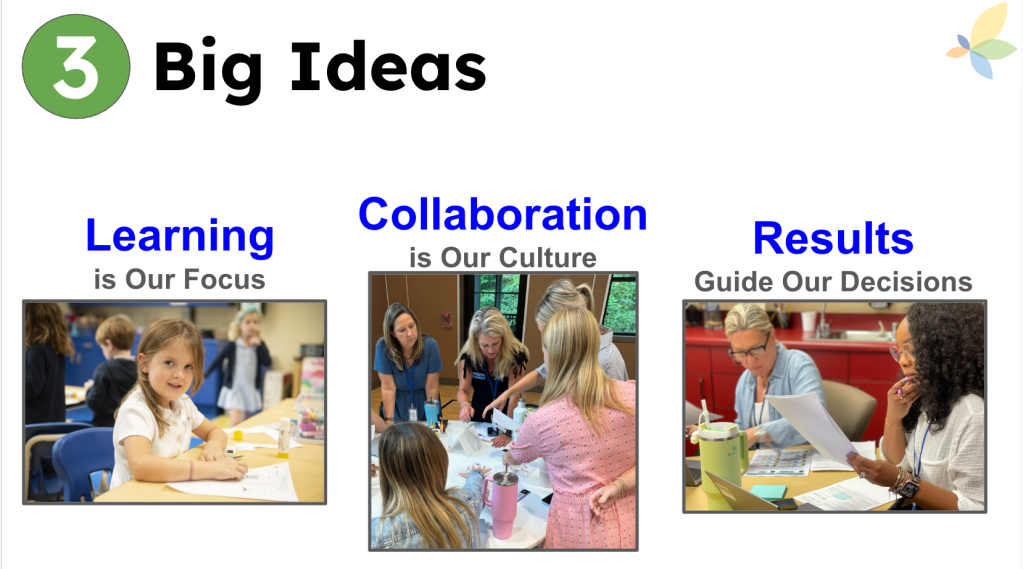
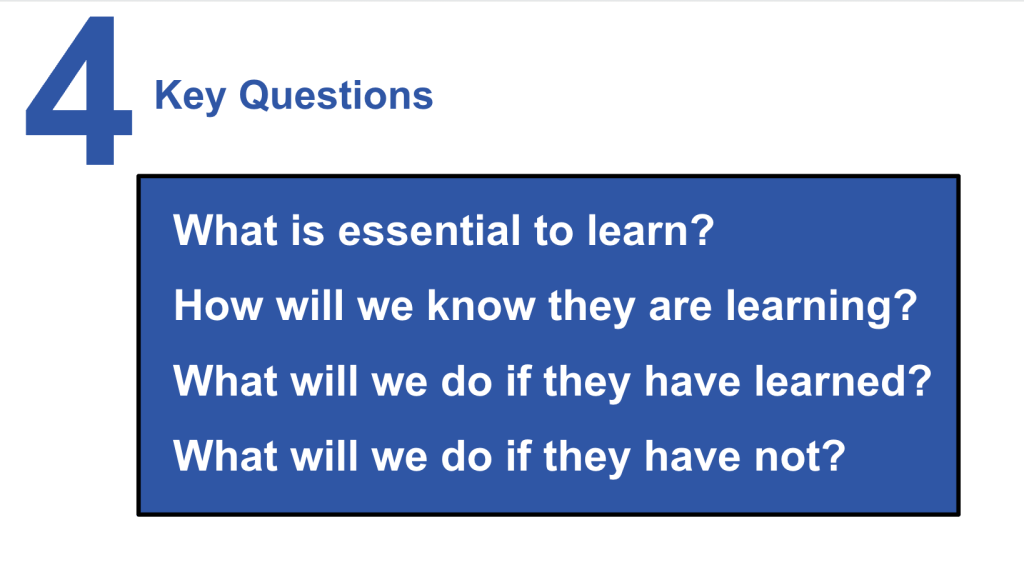
We grounded our work in three big ideas: Learning is our focus. Collaboration is our culture. Results guide our decisions. These sit alongside four questions we return to again and again:
- What is essential to learn?
- How will we know they are learning?
- What will we do if they have learned?
- What will we do if they have not?
The Instructional Core
We can engage in purposeful instructional talk to focus on the instructional core.
Our new colleagues read Richard Elmore’s description of the instructional core and marked it up using the Sentence-Phrase-Word thinking routine. Each person chose the sentence that felt most important, a phrase that moved their thinking, and a single word that captured the big idea. Then they turned and talked, sharing their choices and, more importantly, their reasons.
The ones doing the talking are the ones learning, and the room was buzzing.
Elmore describes three interdependent parts: the teacher’s knowledge and skill, the student’s engagement in their own learning, and academically challenging content. His central claim is that performance does not change unless the instructional core changes. Strengthen teacher practice without raising the level of the content, and you create tension. Raise the content without supporting teachers, and you ask them to teach to a level they have not been equipped for. Do either without changing the student’s role, and students are unlikely to ever take control of their own learning.
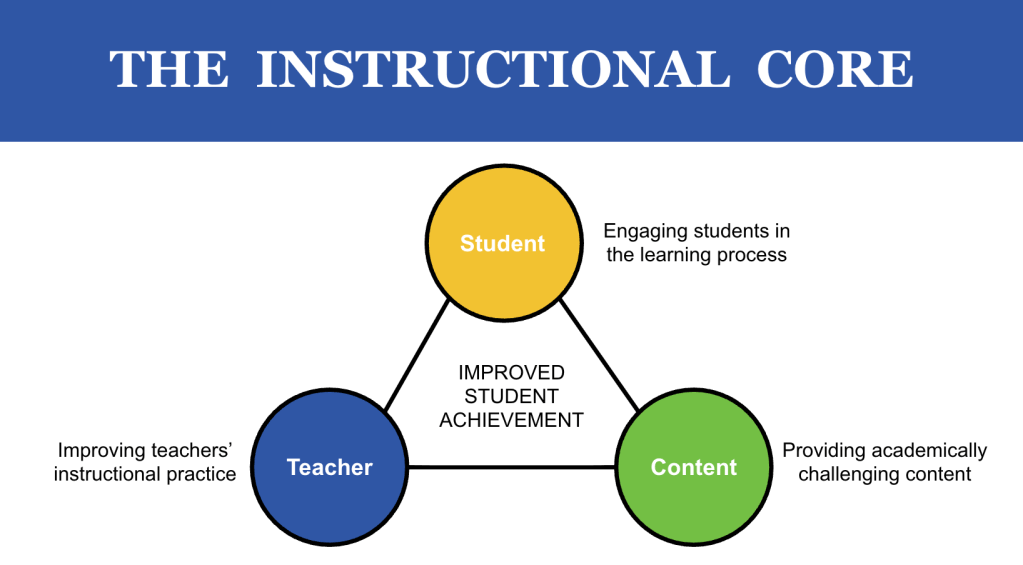
Change one, and you have to attend to all three. That idea gave us a shared lens for everything that followed.
Learning Progressions and Teacher Clarity
We can engage in purposeful instructional talk around teacher clarity.
From there, we moved into learning progressions and our four levels. A progression makes the path visible. When teachers are clear about what learning looks like at each level, students can see where they are, where they are going, and what their next step might be. That clarity is also what makes differentiation and targeted feedback possible.
Using Toddle, we reviewed the Kindergarten Progress Report checklist of skills as an example of how our teams collaborate to develop shared standards for progress reportings. When a team agrees on what each level looks like, a rating means the same thing from one classroom to the next.
A few points I emphasized, because they matter so much:
- Level 3 is the goal. Level 3 means a learner has met the expectation. That is something to celebrate.
- The levels are not letter grades. Level 4, 3, 2, and 1 do not translate to A, B, C, and F.
- Level 4s are rare. Level 4 describes learning that goes beyond expectations. If we find ourselves with a slew of Level 4s, that is our signal to check our expectations together.
Questions I’m still sitting with
- How might the instructional core help us decide where to focus when we plan our next unit?
- How clearly can our learners describe what Level 3 looks like in their own words?
- When we calibrate as a team, what do we learn about our own expectations?
Thank you, New Faculty, for your curiosity and your willingness to lean into the talk. I can’t wait to see how these ideas show up in your classrooms.

