What happens in our classrooms when a child asks a question that makes the adults in the room hold their breath? What do we do when a comment lands hard, or a conversation drifts toward conflict? Do we steer toward safer ground, or do we lean in?
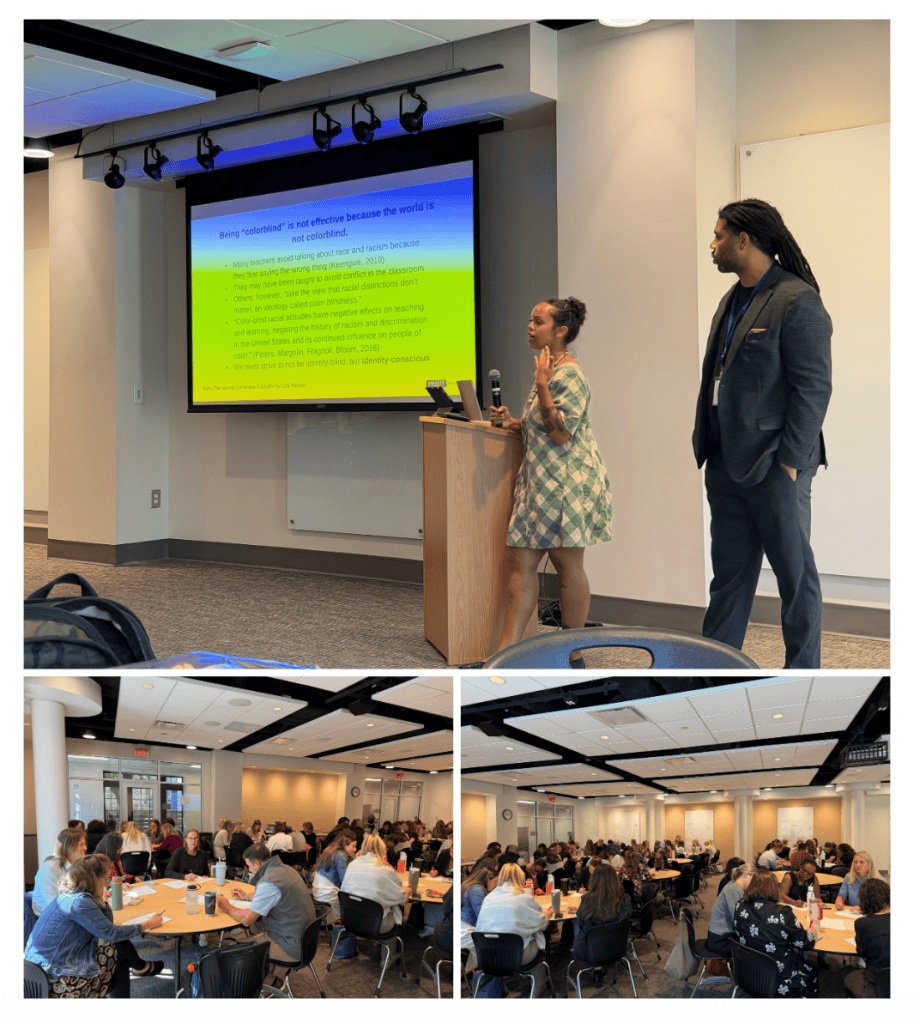
On Wednesday, our entire faculty gathered in the Community Room for an interactive session, Navigating Challenging Conversations, led by Jessi Books and Thomas Cheese. Thomas and Jessi opened with “waterfall.” So calming. It was an intentional choice that set the tone for an hour of brave, honest work.
Our learning targets:
- I can facilitate difficult classroom conversations in calm, age-appropriate, and intentional ways.
- I can address biased or hurtful remarks, explain their impact, and guide students toward more respectful language.
- I can create a classroom community and facilitate productive conflict through an identity-conscious lens.
Grounding Ourselves in Who We Are
Jessi and Thomas anchored us in three words: empathy, dignity, and respect. They also named something many of us felt walking in. October 7 is a significant date that carries heavy weight for some in our community. We paused to honor the dignity of all people, and to remember that we rarely know the heaviness of what others are carrying.
They acknowledged that a session like this could touch tender places for some of us, and they invited us to be brave and courageous anyway. We are TRINITY Strong. We belong. We include. We face tough things together.
That raised a question I keep returning to: How might we discuss hard things without bringing in our preconceptions? Their answer was to bring in our shared beliefs instead: dignity and belonging.
Starting with Ourselves
Before we talked about students, we looked inward. Adapted from an activity in Liza Talusan’s The Identity-Conscious Educator, our folders held a chart of identity categories: race, socioeconomic status, gender, sexual orientation, political beliefs, religion, disability, family structure, and body size and shape. We noted which felt familiar, less familiar, or unfamiliar, and then rated our comfort discussing each one with friends, family, coworkers, and students.
The most revealing part was the final question. Why, if at all, does my level of comfort change depending on who I am talking with? It is very easy to slip into comparison mode without noticing, and this inventory made our own patterns visible.
Young Children Notice
Jessi and Thomas shared research showing that many adults feel most comfortable talking with children about race after about age five (Sullivan, Wilton, & Apfelbaum, 2021). Yet children begin noticing physical differences such as skin color, hair texture, height, and size around age three. Young children notice difference long before they have the words for it.
If children are noticing, they are also forming ideas. As the authors of Courageous Leadership in Early Childhood Education remind us, the messages children receive early on shape how they see one another. They can learn to value people whose backgrounds differ from their own, or they can learn bias.
Identity-Blind or Identity-Conscious?
Many teachers avoid these conversations because they fear saying the wrong thing (Keengwe, 2010). Others adopt a “colorblind” stance. But being colorblind is not effective, because the world is not colorblind.
Drawing on Talusan, we compared two approaches:
- Identity-blind: “I see my students just as my students.” This can fail to see the differences that shape experience, and when we fail to acknowledge differences, we fail to respond to what our community needs.
- Identity-conscious: “Differences matter. I meet my students where they are and respond to what they need.”
Our goal: we strive not to be identity-blind, but identity-conscious. Context and nuance matter, and this work is mission driven.
Welcoming Difficult Conversations
Here is the line that stopped me: We want children to learn from uncomfortable situations. We want children to learn from conflict. Why shouldn’t we as well?
Many of us were taught that conflict is bad. Yet productive conflict is healthy. When students wander into uncomfortable territory, our instinct is often to redirect or move on. Instead, we can acknowledge the discomfort, check in, and help students build skills for engaging with hard topics.
This connected me right back to Dr. Lanier’s session and the idea that two things can be true. This is hard to talk about, and we can trust each other to speak kindly and empathetically.
It Is Okay Not to Know
I appreciated how much grace Jessi and Thomas built into this work. It is okay to be uncomfortable. It is okay to not know. Safe spaces are not the same as perfectly comfortable spaces. “I don’t know, but I will get back to you” is a legitimate, honest response.
They also reminded us that if we are dysregulated as adults, we cannot help children regulate. Know when you are beyond your capacity, and revisit later or call in reinforcements. And if you are not ready for a difficult conversation, that is okay, but do not put it off forever.
We will make mistakes. We reflect on the moments we wish we had handled differently, and we let those reflections turn us toward future action.
Scenarios as Case Studies
Then it was our turn to talk. Seated by teams, we worked through scenarios that felt almost like case studies: a family whose home country is at war, a recess conversation about who can marry whom, a student whose impulsivity is shaping their reputation, a cultural dish at snack that draws unkind comments, and a moment between colleagues when a conversation challenges our own beliefs. The ones doing the talking are the ones learning, and the tables were full of thoughtful, honest talk.
Partnering with Families
We closed by remembering that we are a vast community. Our families bring a wide range of cultural roots, beliefs, languages, family structures, and experiences. We can ask families how they want their culture represented rather than assuming. We can invite guidance without defensiveness. The books on our shelves and the events we recognize send quiet messages about who belongs. We can acknowledge differences without debating beliefs.
We can disagree, and we can respect each other.
Questions I am still sitting with:
- Which identity categories am I least comfortable discussing with students?
- How might I model productive conflict for students in a way that feels safe and brave at the same time?
Thank you, Jessi and Thomas, for leading us with such care and courage.
Resources
- Talusan, L. A. (2022). The Identity-Conscious Educator. Solution Tree Press.
- Sullivan, J., Wilton, L., & Apfelbaum, E. P. (2021). Adults delay conversations about race because they underestimate children’s processing of race. Journal of Experimental Psychology: General, 150(2), 395–400. https://doi.org/10.1037/xge0000851
- Keengwe, J. (2010). Fostering cross-cultural competence in preservice teachers through multicultural education experiences. Early Childhood Education Journal.
- Long, S., Souto-Manning, M., & Vasquez, V. M. (Eds.). (2016). Courageous Leadership in Early Childhood Education: Taking a Stand for Social Justice. Teachers College Press.

