How do we know a teaching practice works? And what do we do when the evidence surprises us?
This fall, our faculty have the opportunity to explore those questions together through Season 1 of Sold a Story, Emily Hanford’s award-winning podcast from APM Reports as an asynchronous “book club.” Hanford investigates why so many children struggle to learn to read and how ideas that research had disproven made their way into classrooms across the country anyway. Over six episodes, we hear from parents, teachers, researchers, and the authors behind some of the most popular approaches to reading instruction.
Why this podcast? Why now?
Literacy is one of our strategic initiatives at Trinity, and our teachers have been learning deeply about the Science of Reading. Sold a Story adds something different: it’s a story about how practices arrive in our classrooms, why we come to trust them, and what it takes to let go of an idea we love.
That question matters in every classroom, not just in reading. It matters in math, science, world languages, the arts, and with our youngest learners. So we’re inviting faculty members to listen and learn, regardless of what they teach.
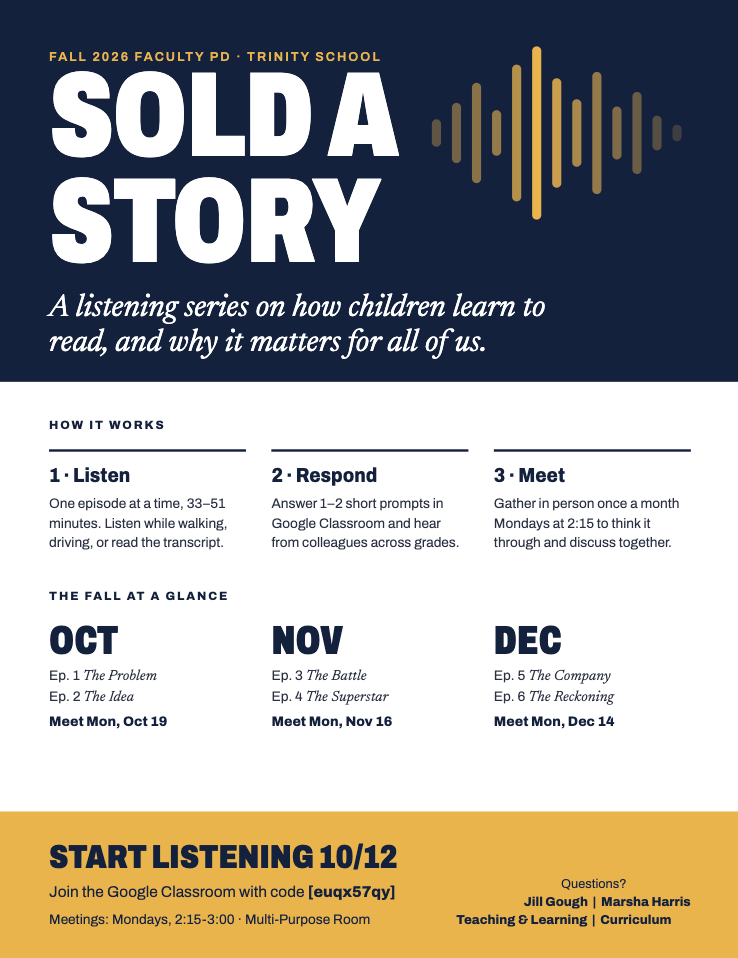
How we’re learning together
Marsha Harris and I designed this series with two goals in mind: to protect teachers’ time and deepen our thinking. Those goals shaped everything.
- Listen on your own time.
About two episodes a month, each 33 to 51 minutes. Teachers can listen while walking or driving, or read the transcript. - Think out loud in writing.
After each episode, teachers respond to a short prompt in Google Classroom with a few paragraphs, a voice memo, or a sketchnote. Then they reply to a colleague whose thinking moves theirs. - Come together in person.
Once a month, in October, November, and December, we’ll gather to connect ideas across grade levels. We’ll experience what it feels like to read like a beginner, look honestly at our own practice, and name what we want to keep, change, or investigate.
The first prompt asks teachers to write down how they would explain how children learn to read. In December, we’ll reread that response and revise it. I can’t wait to see what changes, and what we’re still wondering about.
Our pacing
October
- Oct 12–15: Episode 1, The Problem (33 min)
- Oct 12–19: Episode 2, The Idea (51 min)
- In-person check-in: Monday, October 19
November
- Oct 20–30: Episode 3, The Battle (41 min)
- Nov 2–13: Episode 4, The Superstar (34 min)
- In-person check-in: Monday, November 16
December
- Nov 17–25: Episode 5, The Company (47 min)
- Nov 30–Dec 11: Episode 6, The Reckoning (42 min)
- In-person check-in: Monday, December 14
That’s about 75 to 90 minutes of listening a month, plus a few minutes of writing after each episode.
Our norms
Many of us were trained in approaches to Hanford’s podcast questions. Lots of us loved them, and for good reasons: the joy, the choice, the community of readers. So we agreed on a few norms to guide our conversation, online and in person:
- Write from your own experience and your own classroom.
- Curiosity over verdicts. “I used to think… now I’m wondering…” is a strong response.
Many of us were trained in, and loved, the practices this podcast questions. - Assume good intent in every colleague, including your past self.
- Reply to one colleague when something they wrote prompts a shift in your thinking. Build on it; don’t grade it.
As Marsha and I often remind each other, “I used to think… now I’m wondering…” is one of the most powerful sentences a learner can write. The ones doing the talking are the ones learning, and I’m looking forward to the talk.
What might this mean for our students?
When teachers take the time to question, test, and revisit what we believe about learning, our students benefit. We become more precise about what we teach, more intentional about why we teach it, and more open to what the evidence tells us. We also model what we hope our students will do: stay curious, weigh evidence, and grow.
What’s a practice you once believed in and later rethought? I’d love to hear your story.

