On Monday morning, I spent an hour observing Melissa Johnson in the Johnson-Moore Kindergarten classroom, watching a Fundations lesson on two new letters, j and p. I came to observe. I left having learned a great deal.
Before the lesson began, a student met me at the door and explained that the class was having a snack while Abbey read aloud from The Magic Tree House. She reread the last page of Chapter 6 to remind everyone where they had left off, then read Chapter 7. It was a small moment, and it told me a lot. Children who can welcome a visitor and explain their own routines feel at home in their classroom.
What excellent teaching looks like
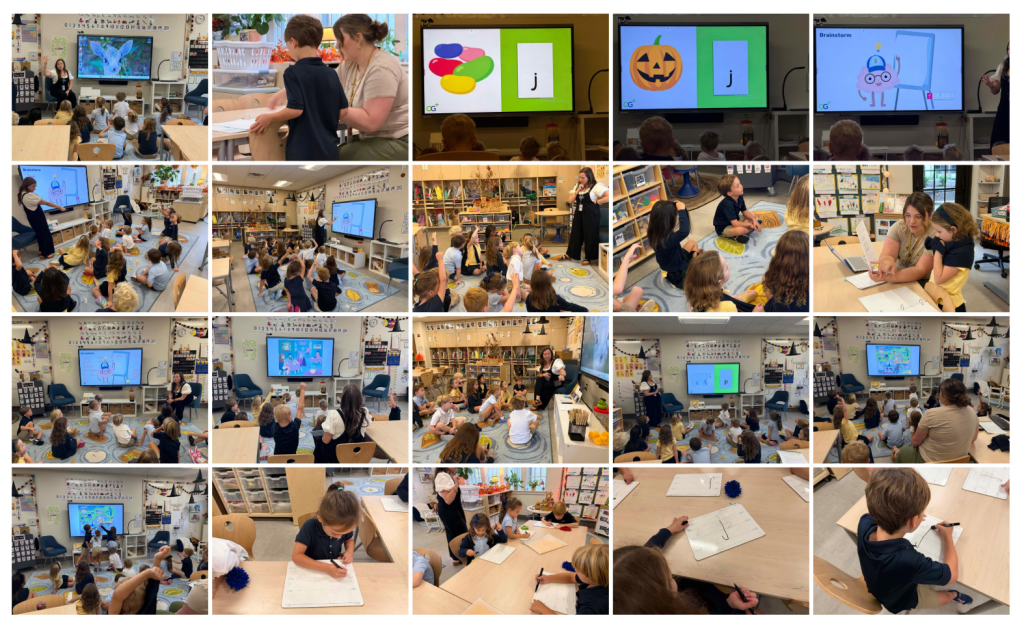
Melissa gathered the class with a clapping pattern, a deep breath, and a reflection: “Breathing helps me calm down.” Then she asked everyone to put on their thinking caps.
What followed was a beautifully designed sequence. Riddles led students to each keyword. An ocean animal you can see through? Jellyfish. A treat at Easter time? Jelly bean. Something that goes really fast? Jet. By the time Melissa asked, “What is our letter?” the room was buzzing.
Students put a hand on their throat to decide whether /j/ is voiced or unvoiced. They noticed what their lips and teeth were doing, then made the mouth movement without making a sound at all. They brainstormed words against a five-minute timer, trying to beat last week’s 27 r-words. They stood to air-write with two fingers: start at the plane line, go down to the worm line, hook it up, and dot on top. Melissa even modeled how not to write a j, so students could see the difference.
Then the whole routine happened again for p, faster and just as rich. The class generated 23 p words, from penguin and pizza to Piedmont Park and Pokémon. When Melissa asked, “When we sort something in our brain, it is called…?” six-year-olds answered, “Schema.” And then: “Kiss your brains.”
Every piece of this lesson is grounded in what we know about how children learn to read. Sound connects to mouth, mouth to letter, letter to meaning. Retrieval practice, metacognition, and joy all live in the same hour.
Great teaching can look effortless, partly because of what you don’t notice. While Melissa taught, Abbey and Lauren Emily quietly pulled individual students for small-group support, and those students returned without disrupting the flow of instruction. Abbey managed cleanup and transitions so Melissa could stay focused on the lesson. Nobody had to stop to explain what was happening. The adults in this room trust each other, and the children benefit from that trust every minute.
What administrators learn by observing
I am convinced that observation is one of the most valuable professional learning experiences I have had, and the learning goes both ways. I get to see our strategic initiatives come alive. I see how the details I read about in research actually play out with twenty children on a carpet.
How often do we, as leaders, give ourselves time to simply watch and learn from our colleagues?
What teachers learn from being observed
When Melissa and I sat down to debrief, she opened by appreciating the details in the write-up. Then she said something I keep thinking about: she learned she was doing things she didn’t realize she was doing.
My reply: You can’t see yourself teaching. That’s why we value observations: they are professional learning experiences.
As we talked, Melissa connected the write-up to her own professional learning. She pointed to moves she had applied from her IMSE summer course and walked me through why she made them. She also named practices she had added after observing her colleagues. Hearing her explain her thinking showed me a teacher who is always learning, and learning that shows up in students’ experience. Professional learning only matters when it reaches the classroom, and here it did, in ways both of us could now name.
When you are in the middle of a lesson, your attention is on the students, as it should be. The moves that make your teaching excellent often become automatic, so automatic that you stop noticing them. A strength-based observation holds up a mirror. It names what is working, so it can be done on purpose, refined, and shared.
We need observations that offer us a mirror into our own pedagogy and instruction. Not a checklist. Not a judgment. A careful, specific record of what learning looked like and sounded like.
What would change if every teacher regularly saw their own teaching through someone else’s eyes?
Thank you, Melissa, Abbey, and Lauren Emily, for letting me learn alongside your students.

