We use the word collaborate a lot in schools. We ask learners to collaborate. We schedule collaborative planning time. We put “collaboration” on agendas, in job descriptions, and in our strategic goals.
But what do we mean when we say it?
In 2018, I wrote that we often complain learners don’t collaborate, yet we seldom define collaboration, teach it, or agree on what it looks like. I drafted a learning progression, Collaboration: How might we level up?, and a Trinity teaching team pushed my thinking enough that I revised it.
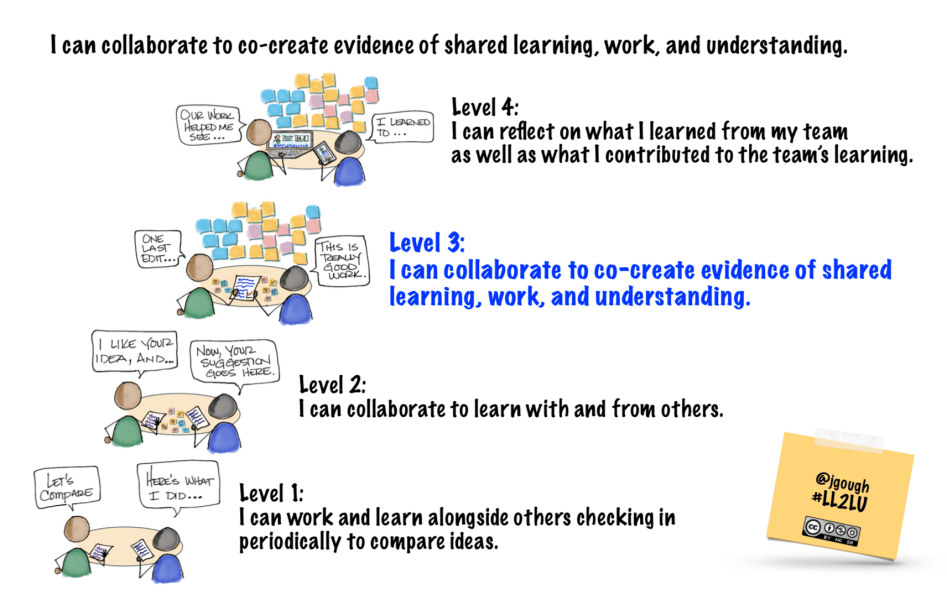
I’ve been wondering whether we hold ourselves, as adult teams, to the same standard. When we say we collaborated, did we? Or did we cooperate, dividing the work so each of us had less to do? Or did we coordinate, agreeing on a shared measure and checking our results?
All three matter. Naming which one we’re doing might matter even more.
This post begins a series of questions I’m exploring:
- How do we teach collaboration?
- How do we model collaboration?
- How do teams move through the stages of collaboration?
- How do we know when we are cooperating, coordinating, or collaborating?
Three words, three kinds of teamwork
In Cooperate or Collaborate?, Zachary Herrmann draws a line I keep coming back to. Cooperative teams work toward everyday goals more efficiently. They share resources, divide tasks, and standardize how things get done. Collaborative teams take on complex problems that no one on the team could solve alone.
What struck me most is how each kind of team handles disagreement. A cooperative team tends to treat conflict as a problem and compromises quickly to keep the work moving. A collaborative team treats different perspectives as a resource for learning.
That makes me wonder: when someone on our team says, “I see it differently,” do we hurry past it, or do we lean in?
A figure from Solution Tree’s Mathematics Coaching and Collaboration in a PLC at Work adds a middle word that helps me: coordination. Its three phases of collaboration give us a shared language:
- Cooperation: We share information, practices, and the workload.
- Coordination: We agree on what proficiency looks like and check whether students have reached it.
- Collaboration: We change instruction based on what we learn, and we learn from the results together.
Seven stages, one step at a time
Parry Graham and Bill Ferriter, in One Step at a Time, describe stages that professional learning teams move through as their focus shifts from teaching to learning. The Solution Tree figure groups those stages into three phases.
| Phase | Stage | The question the team is asking |
|---|---|---|
| Cooperation | 1. Filling the time | What are we supposed to be doing? |
| Cooperation | 2. Sharing personal practice | What is everyone doing in their classroom? |
| Cooperation | 3. Planning, planning, planning | What should we teach, and how can we share the load? |
| Coordination | 4. Developing common assessments | What does proficiency look like? |
| Coordination | 5. Analyzing student learning | Are students learning what we intended, and who is not yet? |
| Collaboration | 6. Adapting instruction to student needs | What do we do for students who are struggling, and for those ready for more? |
| Collaboration | 7. Reflecting on instruction | Which practices work best, and what will we change? |
The question a team spends its time on tells us its stage.
In 2015, I asked each of our teams one question: At what stage do we currently function (most of the time) during team meetings? On one team of five, the answers were Stage 3, Stage 5, Stage 5, Stage 5, and Stage 6.
Same team. Same meetings. Three different stages.
That spread wasn’t a failure. It was information. Before a team can level up, they have to agree on where they are now – the same move I asked of learners in 2018: build a shared definition first.
Three snapshots: which stage is this?
Here are three snapshots from our own work this fall. Together, they climb the ladder.
Snapshot 1: A Wednesday Workshop. On September 23, our faculty professional learning sessions were differentiated. In the 1st- to 3rd-grade numeracy session, teachers worked in visibly random teams of three at vertical surfaces with magnetic 10-frames. Each person had a role: one listened for the first quantity, another for the second, and a third modeled and recorded the math. Then the teams gathered to compare their models of the same story. In the 4th- to 6th-grade literacy session, cross-grade teams each became experts on one strand of language comprehension using Because of Winn-Dixie, then taught the other teams. Both rooms ended with planning how to bring the work into classrooms. (More in The Ones Doing the Talking Are the Ones Learning.)
Where is this team? Stage 2 moving into Stage 3, sharing practice and planning, in the cooperation phase. The questions in the room were “What does this practice look like?” and “How will we use it with our students?” That’s important work, and the structures were collaborative: interdependent roles, expert jigsaws, and comparing different models of the same idea. The ones doing the talking were the ones learning. To level up, teams might ask, “What will proficiency look like when our students use these tools?” That question moves them toward Stage 4.
Snapshot 2: The blind data review. In September, our UED Learning Team sat down with literacy screening data for an entire grade, graphed, with every student’s name hidden. (I wrote about it in Known, Seen, Valued: What a Blind Data Review Teaches Us.) Each person had about five minutes of quiet think time before anyone spoke. Then the team asked, “What trends do you notice for the grade?” and sorted students into groups by need. When the data didn’t fit three groups, they made four. Only then did we reveal names and compare the sort with what we thought we knew about each child: where were we surprised, and where were we not? We closed by naming what’s working and wondering what would help students become stronger listeners, readers, and writers.
Where is this team? Stage 5, Analyzing student learning, crossing into Stage 6, Adapting instruction to student needs. The common assessments were already in place, so Stage 4 work was done. In the room, the team spent its time on the Stage 5 question: are students learning what we intended, and who is not yet?
What makes me hopeful is how they worked. Hidden names, individual think time, and a protocol that looks for strengths as well as gaps are collaborative norms. They protect every voice and let the data, not our assumptions, start the conversation. The team let what they saw change the plan, keeping four groups instead of forcing three.
What happened after the meeting is what moves this team into collaboration. The groups became instruction. In Tier III sessions this fall, Sarah and Samantha taught lessons built directly from each student’s most recent work. Sarah’s lesson plan took its objectives straight from the error summary of the previous session, and those errors came back on purpose throughout the lesson. The plan was not a script to cover; it was a response to what that student needed that day. In Samantha’s session, when a student asked whether an ending blend could appear in the middle of a word, Samantha didn’t rush past it. She asked for an example, and they figured it out together. (More in I Like Doing Hard Things.)
That is Stage 6 at the scale of one learner: notice, adapt, check, adapt again. Near the end of that session, after a hard round, the student said, “I like doing hard things.”
Stage 7 comes at the next assessment window, when the team returns to the data together and asks which moves worked and how we know.
Snapshot 3: Elbow partners in 5th grade. In the first full week of school, 5th graders took a multiplication accuracy assessment and a fluency self-assessment. The data showed students who were accurate and flexible but less confident than we wanted. I asked Brian and Vicki, two of our 5th-grade teachers, whether they would try an experiment involving retrieval practice and teacher clarity. They said yes. We spent the next week learning and planning together: What does retrieval practice look like in a 5th grade room? How do we give feedback that is immediate and kind? How do we keep this from feeling like a test? Then they launched leveled practice sets. After each set, every student met with Brian or Vicki, received feedback, corrected errors on the spot, and chose the next level with their teacher. (I shared more in Elbow Partners: The PD That Doesn’t Show Up on the Calendar.)
Where is this team? Stage 6, Adapting instruction to student needs, in the collaboration phase. The team used assessment evidence (Stage 4), interpreted what it told us about students (Stage 5), and then changed instruction together in response, taking a shared risk with real students. Whole-class fact work became leveled practice, feedback check-ins, and student choice.
The next step is Stage 7: when we look at the next round of data, did confidence grow alongside accuracy, which moves made the difference, and what will we keep?
Notice what changed across the three snapshots. It wasn’t how friendly or efficient the team was. It was the question they were asking.
Every phase has value
It would be easy to read the stages as a ladder where only the top rung counts. I don’t think that’s the point.
Herrmann argues that schools depend on cooperation, and that teams often need both cooperation and collaboration. Sharing a lesson, dividing a unit, or streamlining a process is good work when the problem is well-defined. The trouble comes when we stay in cooperation for problems that need more, like why a group of students isn’t yet proficient.
So the question isn’t only Where are we? It’s also Where does our work need us to be?
Purpose decides the process. When our 5th-grade team took all four classes to Kennesaw Mountain this fall, Kate led the planning, coordinating with the park and handling logistics for each class. On the trails, the whole team showed up: hiking alongside students, asking questions, keeping groups moving and water bottles filled, and connecting what students saw to what they had learned in class. That is cooperation at its best, and it was exactly what the day called for. When the work is understanding why students are stuck, as in the blind data review, or changing instruction in response, as with our elbow partners, the purpose calls for coordination and collaboration.
Learning is the constant; time is the variable. That’s as true for teams as it is for learners.
How might we name what we’re doing?
Here are the questions I’m sitting with. I’d love to hear yours.
- When your team says it collaborated this week, which phase was it really?
- What question did your team spend the most time on in its last meeting?
- If each person on your team answered At what stage do we function most of the time?, would your answers match?
- Which stage does the work in front of your team actually call for?
Next in this series, I’ll turn to learners: how do we teach collaboration, rather than just asking for it? After that, I’ll share a listen-for tool teams can use to hear which stage they’re in.
I wonder what becomes possible when we stop saying collaborate and start naming what we’re doing.
Sources
- Gough, J. (2018). Collaboration: How might we level up?
- Gough, J. (2018). Collaboration: How might we level up again?
- Graham, P., & Ferriter, B. (2008). One step at a time. JSD, 29(3), 38- 42.
- Herrmann, Z. (2019). Cooperate or collaborate? Educational Leadership, 76(9).
- Solution Tree. (2018). The three phases and seven stages of collaboration (Figure 3.4). Mathematics Coaching and Collaboration in a PLC at Work.

