On the other side of the observation
I spend much of my week in classrooms, watching, listening, and writing strength-based observations for colleagues. It is one of my favorite parts of my work. It is also rare for me to be the one observed.
This week, I had the joy of teaching a Building Thinking Classrooms lesson to our third graders in the UED Hub. Their teachers did not watch from the back of the room. They circulated, asked questions, coached groups at the vertical whiteboards, and huddled together mid-lesson to talk about what they were noticing. The lesson was the professional development, and the professional development was the lesson.
Marsha Harris joined us and took notes. What she captured surprised me: she documented not only the mathematics our students did, but the learning our teachers did alongside them. I am grateful to share her write-up here as a guest post.
What might we notice when professional learning happens in real time, with our own students, in our own building?
Guest Post: The Carnival Conundrum
by Marsha Harris
Visited Teacher: Jill Gough, Director of Teaching and Learning
Grade: 3rd Grade, in UED Hub
Observer: Marsha Harris
Instructional Focus: Building Thinking Classrooms, The Carnival Conundrum
8:38 Setting the Stage for Mathematical Thinking
Jill walked with the third graders to the learning space, where students selected cards and quickly formed their groups. It was evident that expectations had already been established before arriving.
Jill began by asking, “What is the difference between taking turns and working collaboratively?” Students discussed how collaboration requires listening, sharing ideas, and working together rather than simply taking turns. Jill reinforced that teachers would be looking for evidence of students thinking and working together.
Jill then introduced The Carnival Conundrum through a wonderful personal story about visiting the fair with her family. Her descriptions of carnival food, rides, and Mr. Gough’s love of carnival games immediately captured students’ attention. I loved this introduction! The storytelling created an engaging context and made the mathematical challenge feel like a game students wanted to solve.
Jill demonstrated the challenge: place five consecutive numbers into five positions so that the sums of two intersecting diagonals are equal. She encouraged students to discuss their ideas and agree on a plan before picking up a marker.
For the third-grade teachers observing, this was an opportunity to see how a thoughtfully designed task could be launched with an engaging hook, clear expectations for collaboration, and just enough information to get students thinking without giving away the mathematics.
8:47 Collaboration and Making Thinking Visible
Students moved quickly into collaborative problem-solving at their vertical workspaces. Teachers circulated, observed, and asked questions while groups explored possible solutions.
At 8:49, Jill called “Waterfall” and invited students to examine the work displayed around the room. She highlighted examples of effective mathematical representations and asked questions such as, “If I check this, is it right?” She reinforced the importance of recording the equations and evidence that demonstrated whether a solution worked.
This was a wonderful example of Jill using student work to model what it means to make mathematical thinking visible. Rather than simply identifying correct answers, she helped students understand how to communicate and justify their reasoning.
The teachers were able to observe Jill’s facilitation techniques while also practicing their own questioning and coaching as they moved among the groups. This combination of observation and active participation made the experience especially valuable as professional learning.
At 8:51, students returned to their boards with renewed purpose. Every student was engaged in discussing, testing, and recording solutions. There was absolutely no downtime, and students remained on task!
8:55 Mathematical Discourse, Vocabulary, and Patterns
Jill paused the groups again, asking whether they had found a solution and whether there might be more than one way to win the game.
She then invited students to examine other groups’ work and consider how they might make their own thinking clearer. Students offered specific compliments about the mathematical representations they observed, including clearly written equations and crossing out strategies that had not worked.
I especially appreciated this opportunity for students to learn from one another. Jill was intentionally developing their ability to communicate mathematical ideas while building a culture of collaboration and appreciation.
As students shared their thinking, Jill introduced and reinforced precise mathematical vocabulary, including diagonal, sum, hypothesis, vertex, and consecutive.
Jill guided students to recognize that 1, 3, and 5 could each serve as the vertex of a successful solution. She encouraged partner discussion about what these numbers had in common, leading students to identify the pattern of odd numbers.
An important misconception emerged when students were unsure whether the vertex should be included when calculating the diagonal sum. There were a few groups that were unsure. Jill used this moment to revisit the representations and clarify the mathematics. Students determined that the diagonal sums were 8, 9, and 10 when the vertices were 1, 3, and 5, respectively.
I loved watching Jill respond to this misunderstanding! Her questioning helped students recognize the importance of mathematical precision while discovering the relationship between the vertex and the diagonal sum.
This was also an especially powerful moment for the teachers to observe. Jill demonstrated how to recognize a misconception, respond to a clarifying question, and use student thinking to guide instruction rather than immediately provide the answer. The teachers were seeing the instructional decision-making that makes this approach so effective.
Jill introduced the word consecutive to describe the pattern in the sums before challenging students with a new set of numbers.
9:08 Extending and Generalizing Mathematical Thinking
Students returned to their boards to solve the Carnival Conundrum using the consecutive numbers 13, 14, 15, 16, and 17.
Students were able to apply the relationships they had discovered with smaller numbers to a more challenging problem. Rather than starting over, many groups recognized that the odd numbers could serve as vertices and used this understanding to guide their work.
As students collaborated, teachers continued facilitating and questioning. They also briefly regrouped to discuss what they were noticing as students worked. This created an opportunity for the teachers to reflect together on student strategies and misconceptions while the learning was unfolding.
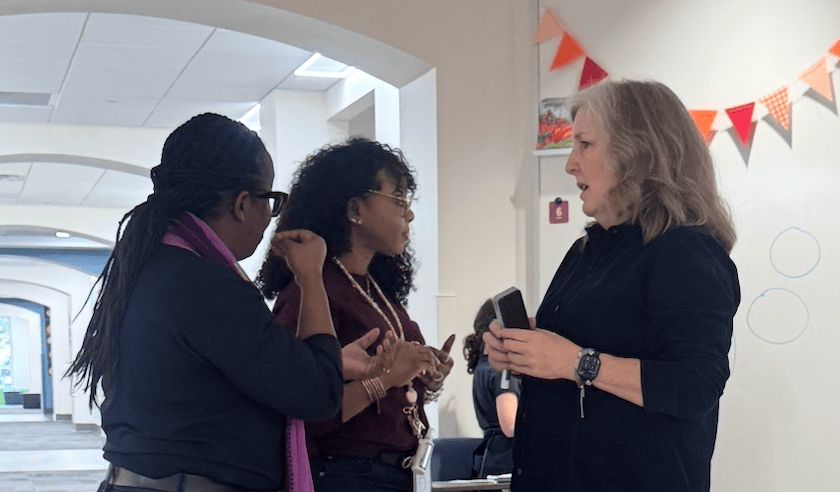
The engagement was remarkable, and even teachers passing through stopped to observe the mathematical thinking taking place. (Laurel Martin, Justin Cahill)
9:17 Consolidating Learning
Jill called “Waterfall” once again and acknowledged how much more mathematical thinking was now visible on the boards.
She asked students to look around the room, identify a board that was different, and consider the patterns they noticed.
Students recognized that 13, 15, and 17 were consecutive odd numbers that could serve as vertices, producing diagonal sums of 44, 45, and 46. Jill also drew attention to a group that had used 14, 15, 16, 17, and 18, helping students explore how an even vertex could produce a successful solution.
Jill skillfully connected the different representations, encouraging students to move beyond finding individual solutions toward recognizing and generalizing mathematical relationships.
For the observing teachers, this consolidation was an important instructional model. Jill demonstrated how to select and connect student work, highlight patterns, introduce mathematical vocabulary, and bring the learning together without removing students’ ownership of the discoveries.
To conclude, Jill introduced an independent handout that included mathematical vocabulary, an opportunity to apply the learning, and an additional challenge for students ready to “level up” by explaining the pattern and extending their thinking.
At 9:25, students returned to their classroom.
Teaching Points and Skills
- Collaborative mathematical problem-solving
- Number sense and flexible thinking
- Addition and equality of sums
- Recognizing odd and even numbers
- Identifying consecutive numbers and numerical patterns
- Mathematical vocabulary: diagonal, vertex, sum, hypothesis, consecutive
- Developing, testing, and revising strategies
- Making mathematical thinking visible through representations
- Explaining, justifying, and communicating mathematical reasoning
- Recognizing and generalizing mathematical relationships
- Learning from others’ strategies and representations
- Applying patterns to increasingly complex problems
Observed Strengths
- Masterful instructional design: Jill intentionally sequenced the task from accessible numbers to more challenging problems, allowing students to discover and apply mathematical relationships.
- Exceptional mathematical questioning: Her questions encouraged students to reason, explain, justify, and make connections rather than simply find correct answers.
- Purposeful mathematical discourse: Students were consistently encouraged to collaborate, listen, share strategies, and learn from one another.
- Making thinking visible: Jill used student work as an instructional tool, highlighting clear representations and helping students communicate their mathematical reasoning.
- Responsive teaching: Jill recognized misconceptions and used them as opportunities to deepen understanding and reinforce mathematical precision.
- Intentional vocabulary development: Mathematical terminology was introduced naturally and explicitly as students encountered concepts during problem-solving.
- High student engagement: Students remained actively involved in challenging, meaningful mathematics throughout the lesson.
- Pattern recognition and generalization: Jill guided students from exploring individual solutions to identifying relationships that could be applied to larger numbers.
- Instructional modeling for colleagues: Jill provided the third-grade teachers with an authentic demonstration of how to launch, facilitate, and consolidate a Building Thinking Classrooms lesson.
- Collaborative professional learning: Teachers had opportunities to observe Jill’s instructional decisions, facilitate student groups, and discuss student thinking together during the lesson.
- Leadership through demonstration: Jill connected professional development directly to classroom practice, supporting teachers in developing the confidence and instructional skills needed to implement Building Thinking Classrooms in their own classrooms.
Final Thoughts
Jill, thank you for inviting me to observe such a wonderful mathematics lesson! I absolutely loved watching you work with our third graders (and their teachers) and seeing the principles of Building Thinking Classrooms come to life.
You are truly a master teacher, and this lesson was such a beautiful example. Your deep understanding of mathematics, combined with your ability to make complex ideas accessible and engaging for children, was evident throughout the experience.
I especially loved how you began with the carnival story. You immediately captured students’ interest and created a reason for them to want to solve the problem. From there, every instructional decision was intentional. You established expectations for collaboration, encouraged students to make their thinking visible, and used their work to guide the mathematical conversation.
What made this lesson particularly special was the intentional opportunity you created for our third-grade teachers to learn alongside their students. So often, professional development involves discussing instructional strategies, watching videos, or planning how something might look in the classroom. You provided something even more meaningful: an opportunity for teachers to see the instructional practices modeled with their own students, in real time.
I loved that the teachers were not simply watching from the sidelines. They were actively involved in facilitating groups, asking questions, observing student thinking, and discussing what they were noticing. They could see firsthand how you launched the task, established expectations for collaboration, encouraged students to make their thinking visible, and used their representations to guide the mathematical discussion. They also witnessed how you responded when misconceptions emerged and how you brought the lesson together by helping students recognize and articulate mathematical patterns.
This is such a powerful model of professional learning because it bridges the gap between learning about an instructional approach and actually implementing it. Teachers were able to observe the subtle instructional moves that are sometimes difficult to capture in a workshop: the timing of a question, when to pause students, how to redirect their attention to the mathematics, and when to step back and allow them to think. Just as importantly, they had opportunities to practice some of these moves themselves with your guidance and support.
Your leadership in bringing Building Thinking Classrooms to Trinity has had such a positive impact on our teachers and students. I have loved seeing teachers embrace these practices and become increasingly confident in creating classrooms where students collaborate, persevere, and make their mathematical thinking visible. This demonstration was another wonderful example of your commitment to providing professional learning that is practical, collaborative, and directly connected to classroom instruction.
It is a joy to work alongside you, learn from you daily, and see who becomes the “first/next followers” of your work.
Marsha
Learning alongside our students
Thank you, Marsha, for your generous eyes and careful notes. Reading your write-up let me see the morning through someone else’s lens, and that is a gift I rarely get.
What stands out to me most is not the lesson itself. It is what our third-grade teachers did with it. They asked questions at the boards. They noticed the misconception about the vertex as it surfaced. They paused mid-lesson to compare what they were seeing. They were doing the thinking, not just watching it. I often say that the ones doing the talking are the ones learning, and that is as true for teachers as it is for students.
Workshops, readings, and videos all have their place. But some teaching moves are hard to capture outside a classroom: when to call a waterfall, which board to highlight, how long to let a group struggle before asking a nudging question. Those decisions are easier to understand when we make them together, in the moment, with students we know.
A few questions I am sitting with, and invite you to consider:
- How might we create more opportunities for teachers to learn in real time, with their own students?
- What would it take for each of us to invite a colleague in to observe, and to be observed?
- How do we make our own instructional decisions as visible to colleagues as we ask students to make their mathematical thinking?
I am grateful to work with colleagues who are willing to try new practices in front of each other, and to be the first and next followers. I can’t wait to see what these third graders and their teachers do next.

