Season 2 of Sold a Story is out, and we’re excited about it. But as a team, we decided it was critical to start at the beginning. Season 1 tells the story of how a wrong idea about reading took root in schools across the country, and why it was so hard to uproot. Whether we were hearing it for the first time or revisiting it, we wanted to understand that story together before taking the next step. (Here’s my initial post about our asynchronous podcast PD.)
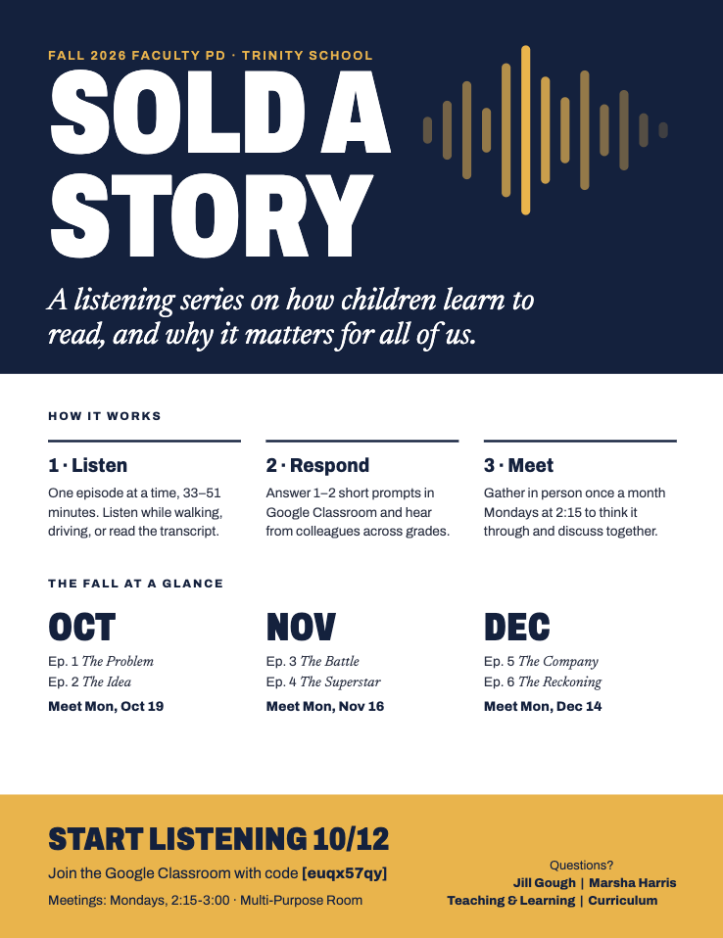
We’ve listened to the first two episodes, written and replied to one another in Google Classroom, and gathered on Monday afternoon to debrief. Here’s some of what we’re learning.
Looking like a reader is not the same as reading
Episode 1: The Problem introduces Zoe, a first-grader who appears to be reading. Her dad, watching her lessons during Zoom school, said it seemed like the kids were being taught to sound like they could read. What Zoe was actually doing was guessing, using the picture, the first letter, and whatever made sense. The strategies made guessing look like competence, so the gap stayed hidden.
Our prompt asked: Describe a time you saw a student look like a reader before you were sure they were one. The responses were powerful.
- One colleague described independent reading time, when a quiet student turning pages looks like a reader. Looking up close tells a different story.
- Another described a student who loved books and knew many sight words, but was rereading stories he had memorized and guessing at everything new. She noticed, spoke up, and helped. He’s now thriving.
- A world language teacher connected this to students who seem to understand Spanish because they’ve memorized phrases, but struggle to read, write, and speak independently. Her check: ask students to read unfamiliar words independently.
- Several of us named the same moment of truth: an unfamiliar word, with no picture or familiar story to lean on.
I thought of the mirror image. When my daughter was six, she told me, “I am the slowest in class, Momma. I finish last every time.” When I asked why, she said, “I like to read what I write… I like to look at it to figure out the words.” By the measures classrooms often notice, she looked behind. In fact, she was doing the slow, careful work of a real reader. (As an adult, she is a voracious reader.) I wonder how many children like Zoe were praised for looking fluent, and how many children like my daughter worried they were failing because they were doing it right.
I’ve seen the same pattern in Algebra I. A correct answer can look like understanding without proving it, and a low score can hide a learner who is close. Speed and surface performance are poor proxies for learning, in reading and in math.
Where the idea came from
Episode 2: The Idea traces those guessing strategies, often called three-cueing, back to Marie Clay’s research in New Zealand. Clay watched children closely and concluded that good readers work like detectives, using meaning, sentence structure, and a quick glance at the letters to figure out words.
Our prompt asked: In your own words, explain the three-cueing idea and why scientists say it gets reading backward. Pretend you’re explaining it to a parent at pickup.
So, parents, here’s what our teachers would tell you at pickup. Three-cueing teaches children to guess an unknown word from the picture, the sentence, and the first letter, with sounding it out as a last resort. The research shows skilled readers do the opposite. Eye-tracking studies found that they process virtually every letter in every word, and even strong adult readers can predict only about one in four words from context. One colleague summed it up perfectly: three-cueing teaches children the habits of struggling readers. Another pointed out where those habits catch up with kids: chapter books with no pictures, and science textbooks full of new words.
What stopped me was the brain research. When we connect a word’s sounds, spelling, and meaning, our brains store that word for good. In one study, people who memorized whole words did better at first, but people who learned how the symbols worked soon pulled ahead and used the brain’s more efficient reading network.
That sounded so much like “just memorize your facts, who cares where they come from!” in math. When children use base ten blocks, number lines, and other tools to see how numbers are composed and decomposed, they build the connections that make facts stick and make sense. Fluency matters. The understanding underneath is what makes it last.
What’s next
We’re itching to get into the next two episodes over the next two weeks. Episode 3 asks why the research had so much trouble reaching classrooms, and Episode 4 explores why so many teachers loved the approaches built on Clay’s ideas. Then, Season 2!
Here’s the question I can’t stop asking: what’s the math equivalent of “look at all the letters”? I’d love to hear your thinking.

