09.23.2026 Wednesday Workshop Recap
- EL – K: Literacy (OG Refresh, Re-Energize) (2:15 – 3:15)
- 1st – 3rd: Numeracy Fluency, Retrieval Practice, BTC
- 4th – 6th: Language Comprehension
One of my favorite phrases is this: the ones doing the talking are the ones learning. It’s true for our students, and it’s just as true for us. On Wednesday afternoon, three groups of Trinity faculty spent their Wednesday Workshop experiencing a lesson as learners and then talking their way to understanding. The content was different in every room. The design was not.
EL–K Literacy: OG Refresh, Re-Energize (Community Room)
Michelle Perry opened with a bit of humor about the quirks of English, and the room relaxed before any content arrived. She gave a quick history of Orton-Gillingham, honoring the “family tree” of teachers who trained her and reminding us that this expertise is passed from teacher to teacher. We are the next branch.
Then Michelle handed the talking to us. She reviewed the nine OG principles and walked us through a full OG lesson in chunks: phonological awareness, drilling the deck, blending, dictation, reading words, phrases, and sentences, connected text, and a game. After every chunk, she asked, Which principles are embedded here? Teachers named them, debated them, and explained their thinking to one another. By the end, seven passes through the same nine principles had turned a list into a lens, and teachers could look at any routine and say out loud what research lives inside it.
Michelle taught OG the OG way: structured, cumulative, multisensory, and explicit. Her framing of OG as an approach, not a program, gives teachers permission to be diagnostic and flexible while staying consistent. And her reminder that dictation offers “the most bang for your buck” is one I suspect we’ll hear echoed in classrooms this week.
This session builds on last week’s work on language comprehension. Together, the two sessions give our early-childhood teachers both strands of Scarborough’s Reading Rope: word recognition and language comprehension.
1st–3rd Numeracy: Fluency, Retrieval Practice, and Building Thinking Classrooms (UED Hub)
Our goals were simple: I can help students make their thinking visible, and I can plan activities that help students become fluent mathematicians. Our guiding principle was thinking, not answer-getting. The work is never really finished.
Kerry and I set up the Hub before teachers arrived, with magnetic 10-frames and base-10 blocks already on the vertical surfaces. After a short launch in the circle to introduce the Building Thinking Classrooms norms (non-permanent vertical surfaces, visibly random groups, tasks given verbally), teams got to work on We’re Frameous.
Each team of three had interdependent roles: one listened for the first quantity, one listened for the second, and one modeled both on the 10-frames and scribed the math. No one could do the task alone, so every team had to talk. After each story, we gathered in the center of the Hub to look at one another’s work and explain what we saw. The same story, modeled and recorded in more than one valid way. That conversation made flexibility visible, and it is exactly the anticipating that Smith and Stein describe in the 5 Practices.
We then moved to Subtraction Is the Main Attraction with base-10 blocks, where the real question was which is larger, and by how much? Framing subtraction as comparison invites reasoning talk rather than answer reporting. Along the way, teachers retrieved and discussed the four strategies and two definitions of subtraction.
We closed by putting the tools straight into teachers’ hands: base-10 magnets for every 2nd and 3rd grade classroom and two sets of 10-frame magnets for every 1st grade classroom. Our hope is that teams teach with these tools in their classrooms and then collaborate to teach with them in the Hub, so that thinking is the goal, and students are the ones doing the talking.
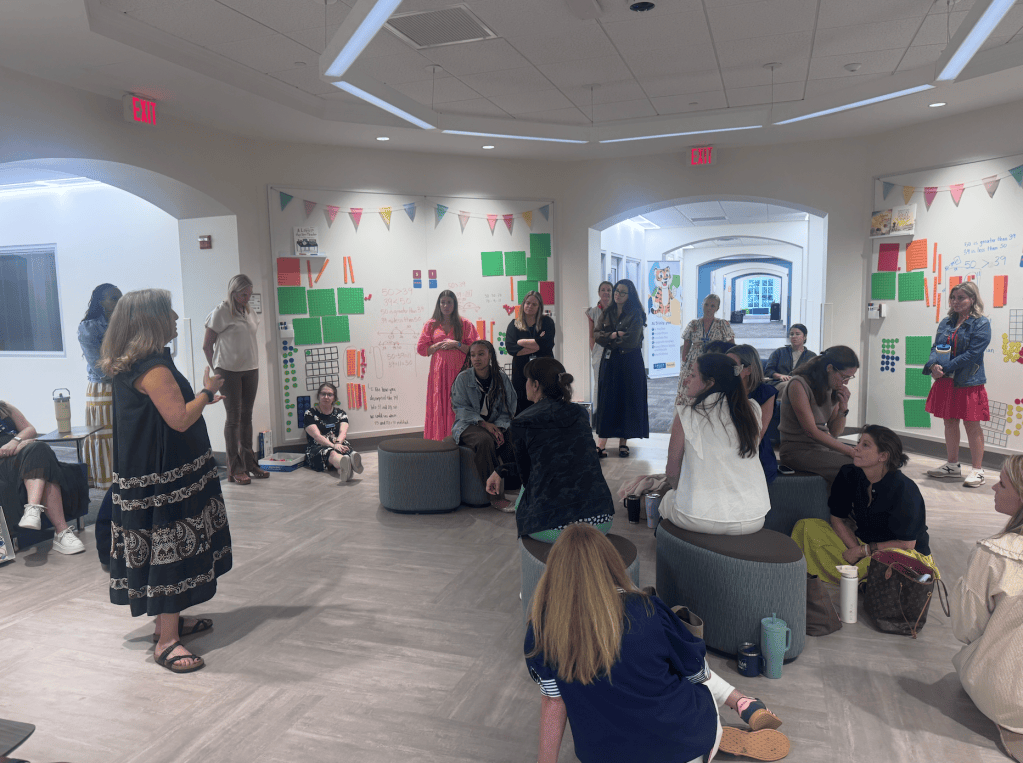
4th–6th Language Comprehension (Multi-Purpose Room)
Marsha Harris set two goals that named both understanding and action: I can explain how language comprehension supports skilled reading and oral communication, and I can plan routines that build knowledge, vocabulary, syntax, reasoning, and talk. Then, rather than explaining language comprehension to us, she let us experience it.
It started with a nonsense sentence. Every word was decodable, and none of it made sense. In a minute or two, the room felt the difference between reading words and understanding them, and that feeling made the Simple View of Reading and Scarborough’s Rope land. For upper elementary readers, once decoding is in place, language comprehension carries so much of the weight.
Then the talking began. Using Because of Winn-Dixie as a common text, cross-grade teams dug into the five language comprehension strands: background knowledge, vocabulary, language structures, verbal reasoning, and literacy knowledge. Each team became the experts on its strand and then taught the others. Teachers weren’t listening to a presentation about the strands; they were explaining them, questioning each other, and pointing to evidence in a text they know well. Fourth, fifth, and sixth-grade teachers talking together about the same book, strand by strand, is vertical alignment happening in real time.
Marsha protected time at the end for practice and application, so teachers kept talking as they planned the routines they’ll use with students. If talk is how teachers make sense of language comprehension on Wednesday, talk is how our students will make sense of what they read. The routines that build rich classroom conversation are the same routines that build stronger readers.
What These Sessions Have in Common
Three rooms. Three content areas. One design:
- Clear “I can” goals so every participant knew the target.
- Experience first. Teachers lived the lesson, the task, or the text as learners before analyzing it as teachers.
- Teachers did the talking. Naming principles, explaining models, teaching strands to peers. The facilitators talked less so teachers could learn more.
- Retrieval built in. Nine principles revisited after every chunk. Subtraction strategies recalled and applied. Strands studied and then taught.
- Evidence-based practice, from Orton-Gillingham and Scarborough’s Rope to Building Thinking Classrooms and Smith and Stein’s 5 Practices.
- A next step with something attached, whether a routine to analyze, a set of manipulatives, or a plan to pilot.
We ask our students to retrieve, discuss, reason, and reflect. On Wednesday, our teachers did the same, and you could hear it in every room.
So I’ll leave you with the questions I keep coming back to. In your classroom this week, who is doing most of the talking? And what might shift if our students talked just a little more than we do? And when you think about the professional learning that has changed your practice, were you listening, or were you the one doing the talking?


[…] In last week’s 1st to 3rd numeracy workshop, Kerry and I set up the UED Hub with magnetic 10-frames on the vertical surfaces. Teachers became learners. After a brief launch of Building Thinking Classrooms norms (e.g., visibly random groups, tasks given verbally, thinking on non-permanent surfaces), teams worked through We’re Frameous. […]
LikeLike