What happens when two master educators who love STEM decide that young children deserve a way into artificial intelligence?
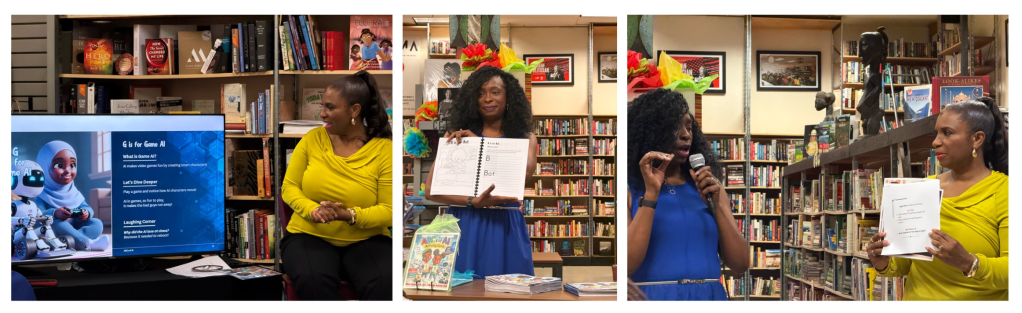
Yesterday afternoon, I went to the launch of ABCs of AI: Artificial Intelligence by Dr. Valerie Bennett, Ph.D., Ed.D., and Dr. Natoshia Anderson, Ed.D., at Akoma Coffee & Books in Stonecrest. The bookstore was full of parents, educators, and families. I left with a signed book and more questions than I came with, which is usually how I know I’ve learned something.
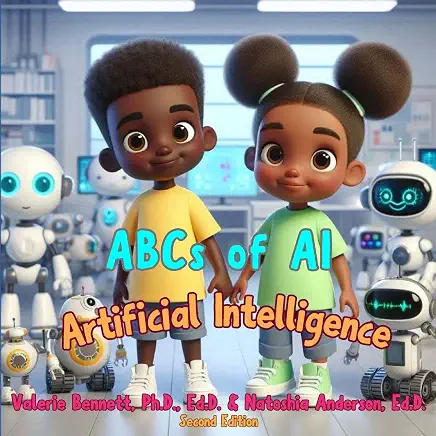
The book launch began with a conversation. Dr. Bennett had an idea, and Dr. Anderson said yes. (Dr. Anderson had already published an ABCs of Engineering.) Their reason is simple: if AI is going to be part of our children’s world, children need to understand the vocabulary and language. They chose to start with the littles, and they were careful with every word. On Instagram, Dr. Bennett wrote:
In a world where AI is on everyone’s lips, one group often overlooked is our youth. This book isn’t just pages and words — it’s a tool for teachers, administrators, parents, and children to build an accessible and confident understanding of AI. Because when our young learners have the language to talk about technology, they gain the power to shape it!
As master teachers, Dr. Bennett and Dr. Anderson invited a high level of engagement right from the start. Using a fill-in-the-blank, turn-and-talk approach, audience members were challenged to provide the term, given the definition. Each letter introduces a term and what it means:
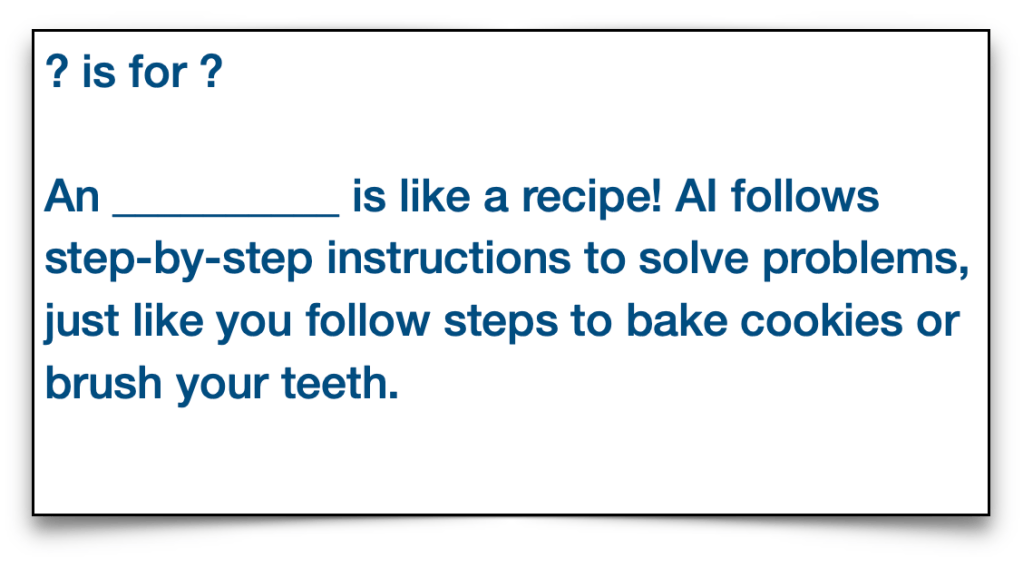
- A is for Algorithm
- D is for Data
- G is for Game AI
- N is for Neural Network
- W is for Website
- X is for XAI (Explainable AI)
What stood out to me as an educator is that every term moves from definition to action. The Algorithm card defines an algorithm as “steps we follow.” Then it asks children to try it by writing the steps for getting ready for bed or washing their hands. Then it asks them to talk about it: What happens if we skip a step? That one question carries the whole idea of an algorithm in language a five-year-old can work with. There is also a Laughing Corner with a joke or pun. The companion Know-Think-Do activity cards take the same approach, turning each letter into something children explore, talk about, and try.
Dr. Bennett and Dr. Anderson reminded us that when we give a thumbs-up or thumbs-down response, we are helping make the models better. That’s a powerful idea to share with children: their feedback matters and shapes the tool.
They also invited us to take up the challenge. Ask an AI image tool to show me a photo of a scientist and look closely at what comes back. Who shows up? Who doesn’t? It’s a quick, concrete way to start talking with children about bias and about whose stories are in the data.
A panel from the audience
My favorite part of the afternoon was when the room became the panel. Educators and parents responded to the question: Why does AI matter at a young age?
“If I’m a parent, what should I be doing?” The honest answer was a big it depends. There isn’t enough evidence-based practice yet to say for sure. We hear conflicting views because we don’t know yet. Every child is different and will learn differently. The advice was to go, do, and explore the world while staying aware of what we don’t know. One comparison stuck with me: we teach stranger danger, and strangers can come from anywhere, including through a screen. Explore, but explore safely. Keep asking, Is this really the right thing to do? Know the safeguards and know where they’re missing. Remember that AI is applied math. It is a tool that makes predictions.
“What happens to children who don’t have access?” AI is showing up everywhere, from calculators to AI toothbrushes. You still have to verify what it tells you. Access is still a real challenge. Others raised superintelligence and security. The thread through the whole conversation was the same: open it up and demystify it.
Productive struggle
The question that stayed with me most came from a conversation about children with disabilities and about how schools are using AI, in ways that help and in ways that don’t: At what point is AI my assistant, and when is it my replacement?
Dr. Bennett pointed to research on cognitive struggle and asked what kind of AI actually focuses on learning. Does it ask a question, or does it give the answer? Does it offer a hint or hand over the solution? An inquiry-based tool keeps the learner doing the thinking. As I keep saying, the ones doing the talking are the ones learning, and the same goes for the ones doing the thinking. We need tools that protect productive struggle, not tools that remove it.
The afternoon ended with a book signing. Next up is the STEM Genius Universe launch on November 7 at MODEX ATL, another chance to learn and connect
Questions I’m still thinking about
- What safeguards are we teaching, and which are we assuming are already there?
- Where do we want AI to ask questions rather than give hints and answers?
- How do we keep productive struggle at the center while the tools keep changing?
With gratitude
Thank you, Dr. Bennett and Dr. Anderson, for the care you put into this work and into sharing it.
Nothing about this book is accidental. You thought carefully about every word, so even our youngest learners can say algorithm, data, and explainable AI and know what they mean. Every term moves from definition to action. Children try an idea, then talk about it, and there’s a Laughing Corner to keep the joy of learning alive. The Know-Think-Do activity cards keep children doing the thinking. Even the illustrations were chosen with intention, so more children can see themselves as the people who will build, question, and shape these tools.
The same care went into today. You planned an afternoon where families and educators could sit together in a neighborhood bookstore, ask honest questions, and hear honest answers, including “we don’t know yet.” You turned the audience into the panel, so the ones doing the talking were the ones learning.
Thank you for starting with the littles and for opening the door to so many of us.
Let’s learn. Let’s lead. Let’s shape the future together.

