Have you ever watched a child melt down, shut down, or push back and quietly wondered, What is really going on here?
I have. More times than I can count, in my own classroom and in the classrooms I visit. What I’ve learned is that the moment I start asking that question with curiosity instead of frustration, everything shifts. What if behavior isn’t the problem to solve, but a clue to understand?
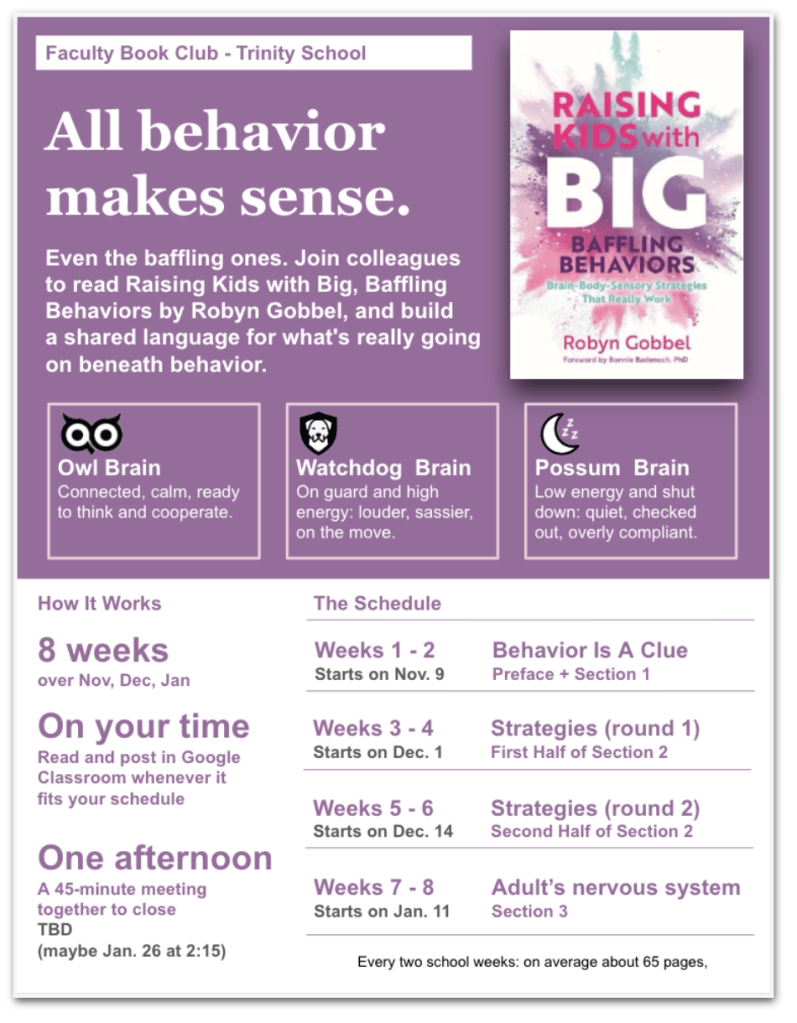
That question is at the heart of our next asynchronous book club. This winter, Joe Marshall and I will co-moderate a book club around Raising Kids with Big, Baffling Behaviors: Brain-Body-Sensory Strategies That Really Work by Robyn Gobbel.
Why this book?
Gobbel starts with a bold claim: all behavior makes sense, even the baffling kind. Her mantra is simple and memorable:
“Regulated, connected kids who feel safe behave well.”
To help us see what’s happening beneath behavior, she introduces three brain states:
- The Owl: calm, connected, and ready to think and cooperate.
- The Watchdog: on guard and high energy.
- The Possum: low energy and shut down.
Once you learn these, you start seeing them everywhere, in children and in yourself.
That last part is what drew me to this book. Gobbel doesn’t stop at the child. She turns the lens on the adults, too. We often know exactly what a child needs and still can’t give it, because our own nervous systems shift into protection mode. Our regulation matters just as much as theirs.
Gobbel writes for parents, but her ideas translate beautifully to classrooms, hallways, offices, and carpool lines. How might our work change if we got even better at reading the clues behavior gives us?
How it works
Like our Smart Teaching, Stronger Learning book club, this one is designed to protect time while deepening our thinking. We’ll read in four parts, with two weeks for each part:
- Behavior Is a Clue (Preface + Section 1)
- Strategies, Round One (Section 2, first half)
- Strategies, Round Two (Section 2, second half)
- The Adult’s Nervous System (Section 3 + Epilogue)
School holidays don’t count toward those two weeks, so the club runs at a gentle pace from November through February. For each part, participants read about 65 pages and share their thinking in Google Classroom, posting one response and replying to two others whenever it fits their schedule. We’ll close in February with one morning conversation together.
Each post follows a simple routine:
- Reframe: One idea that changed how I see a child.
- Rewind: One moment from my week I’d now read differently.
- Wonder: One question I’m still holding.
The ones doing the talking are the ones learning, and asynchronous discussion means everyone gets a chance to talk.
An invitation
This book club is open to all Trinity faculty and staff, because everyone who works with children shapes how safe and connected they feel. [Trinity colleagues, look for the sign-up email in your inbox.]
I’ll be sharing reflections from our conversations here along the way. In the meantime, I’ll leave you with the question I keep coming back to:
What is this behavior telling me, and what does this child need right now?

