What does it mean to know your multiplication facts?
For a long time, many of us would have answered with a timer. Fast meant fluent. Slow meant not yet.
At Trinity, our 4th-, 5th-, and 6th-grade teams have made a commitment: we strive to ensure that all students in 4th, 5th, and 6th grade are fluent in multiplication. Not fast. Fluent. That one word changes what we look for, what we ask students, and what we do next.
What do we mean by fluency?
We use NCTM’s definition of procedural fluency: “the ability to apply procedures efficiently, flexibly, and accurately.” A fluent mathematician also transfers what they know to new problems, builds new procedures from familiar ones, and recognizes when one strategy fits better than another.
In the Figuring Out Fluency series, including Multiplication and Division With Whole Numbers, Jennifer Bay-Williams and John SanGiovanni name three components we now use with teachers and students alike: efficiency, flexibility, and accuracy.
Speed can show up as a side effect of fluency. It is not the definition. NCTM’s 2023 position statement goes further: timed tests do not assess fluency, can negatively affect students, and should be avoided.
Let’s say that again: Speed can be a side effect of fluency. It is not the definition.
Why we ask students what they think
John Hattie’s research places student-reported progress among the most powerful influences on learning. When students predict how they will do, check that prediction against evidence, and set a goal, they become partners in their own growth.
So we do not only score students. We ask them.
- Did you know it right away?
- Are you confident it is correct?
- What’s next for you?
Those questions give students a voice. They also give teachers information a score alone cannot.
Three ways we listen for fluency
- Accuracy, in chunks. Short forms check accuracy with the 1s, 2s, and 3s, then the 4s, 5s, and 6s, then the 7s, 8s, and 9s. Small chunks show exactly which facts are solid and which need attention. One score on a 100-fact test hides that.
- A fluency assessment. An auto-graded form checks accuracy, flexibility, and students’ confidence.
- Leveled retrieval practice. A four-level assessment lets us see whether students are growing in their understanding over time.
Each level of the retrieval practice is an “I can” statement students can read, own, and reach for.
Level 4:
I can solve a multiplication problem in more than one way and build an argument with enough detail so that a reader understands my answer and my strategy is correct. (Example: Solve 24 × 6 using two different strategies.)
Level 3:
I can find factor pairs of a number. (Example: Find two numbers whose product is 48 and whose sum is 16.)
Level 2:
I can find the missing factor in a multiplication problem when given the product. (Example: 9 × ___ = 63)
Level 1:
I can multiply two one-digit numbers automatically and with confidence. (Example: 6 × 7 = ___)
Because there are several versions, students meet the same ideas again and again with fresh numbers. That is retrieval practice, spaced over time.
Knew it right away, or figured it out?
Every Level 1 and Level 2 problem asks students two separate questions. Knew it right away? I am confident that it is correct? Students check one, both, or neither.
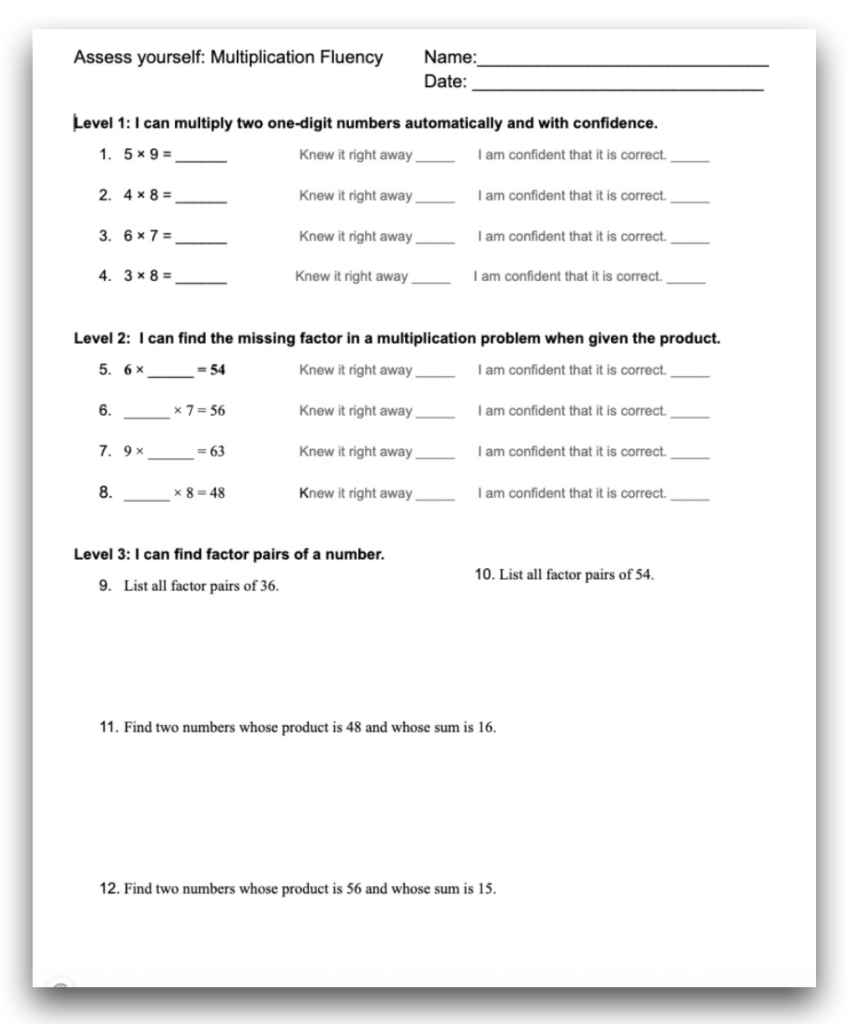
This small design choice has become the most revealing part of the assessment. Together, the two checkmarks tell us four different stories.
| Knew it right away | Confident it’s correct | What it tells us | What we do next |
|---|---|---|---|
| Yes | Yes | The fact is automatic. | Keep it strong with spaced practice. |
| No | Yes | The student reasoned it out with a strategy. That is flexibility. | Name and celebrate the strategy, then practice toward efficiency. |
| Yes | No | Quick recall, but the student isn’t sure. | Verify it together using a related fact. |
| No | No | This is our starting point. | Build from a fact the student already knows, often in a small group. |
The second row matters most to us. A student who doesn’t instantly know 7 × 8 but thinks 7 × 7 is 49 and 7 more is 56 is not behind. That student is reasoning. Our job is to help that reasoning become efficient, not to replace it with a stopwatch.
What would change in your classroom if students could tell you not only what they know, but how they know it?
Check, reflect, choose
After Levels 1, 2, and 3, students pause. They check their work with their teacher, then complete a self-assessment table with a score and a confidence rating for each level.
Then they answer one question: What’s next for you? Level 4, or work on the levels above?
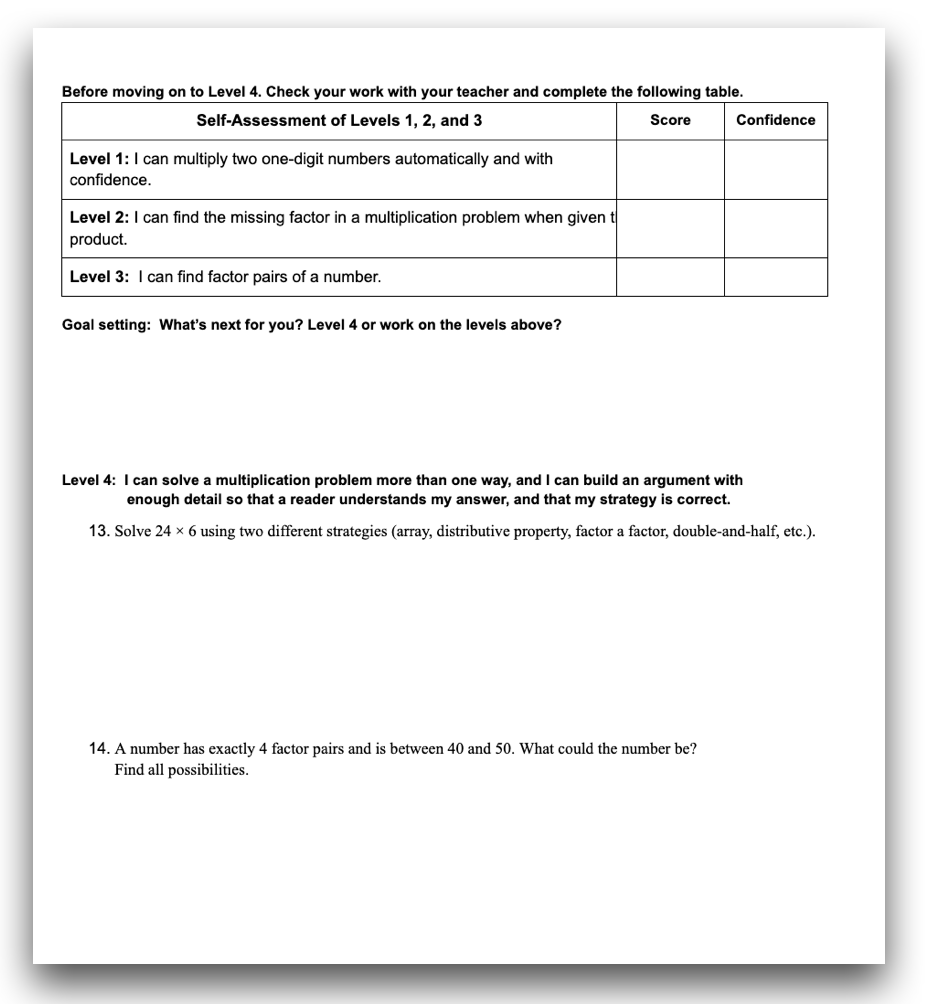
The choice belongs to the student and is informed by evidence. Some students move on to building arguments. Others honestly decide that factor pairs need more work. Both are good mathematical decisions.
Seeing the data, planning what’s next
We track our data visually, by grade, by class, and over time. The patterns help us decide what to do next. Here are two different students’ visual summaries. Do you see similarities and differences? The student’s work visualized on the left says “I know my multiplication facts,” while the student’s work on the right indicates “I might know my multiplication facts.” If we look at the results from their leveled multiplication assessment, what do we learn?
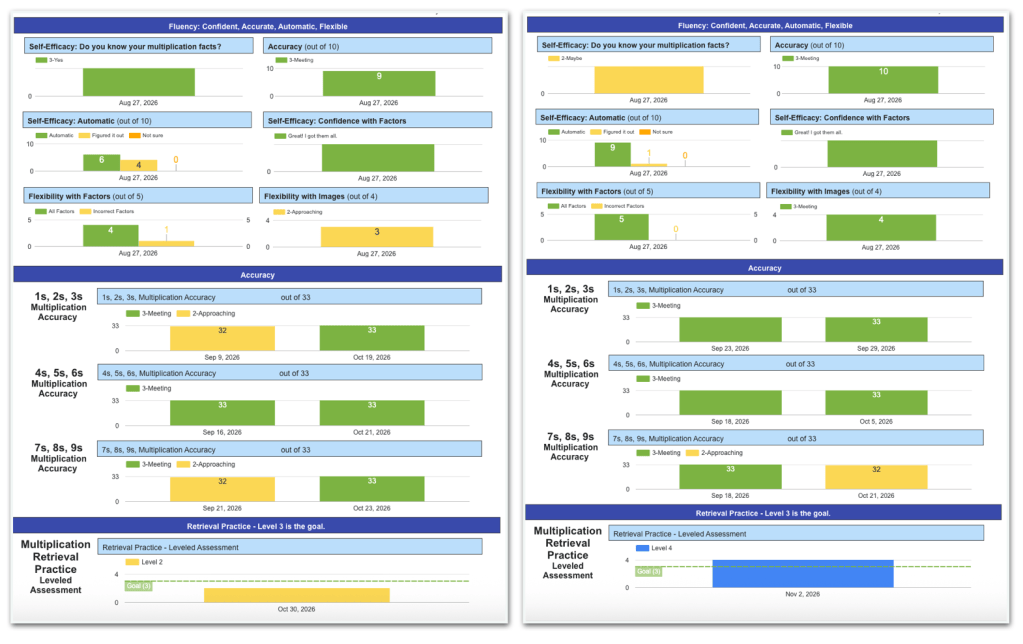
Accuracy alone does not tell them apart. Both students earn 32 or 33 out of 33 on every chunk of facts.
The leveled assessment does. Student A is accurate with facts but is still forming factors and factor pairs. Student B is already building arguments at Level 4, beyond our Level 3 goal.
Why is Level 3 our goal? Finding factor pairs is about fluency. It is about flexibility. It is about long-term memory. Our students need this agile thinking when they enter algebra and begin factoring expressions. We want strong, numeric students who are agile and creative in their thinking and problem-solving.
Their beliefs point in opposite directions. Student A is more confident than the evidence shows. Student B is less confident than the evidence shows, and that “maybe” can become a ceiling.
Accuracy tells us what students can do. Confidence tells us what they believe. The leveled assessment tells us how deeply they understand. We need all three.
Across classes, the same patterns help us:
- Differentiate. Small groups form around the specific facts and levels students need, not a general label.
- Space the practice. Facts students know come back over time so they stay strong. Facts still forming come back more often.
- Plan teacher learning. This round of data shaped our next faculty learning, built around Part 3 of Figuring Out Fluency. More about that in my next post.
Questions I’m sitting with
- How do your students tell you what they know?
- What do you do when a student is accurate but not yet efficient?
- How might separating “I knew it” from “I’m confident” change the conversations in your classroom?
I’d love to learn from you. What are you noticing about fluency with your mathematicians?
Resources
- National Council of Teachers of Mathematics. 2023. Procedural Fluency in Mathematics (position statement).
- SanGiovanni, John J., Jennifer M. Bay-Williams, and Rosalba Serrano. 2021. Figuring Out Fluency: Multiplication and Division With Whole Numbers. Corwin. Routines, games, and game boards are on the companion website.

