What happens when we slow down long enough to notice what learners already know? That question kept showing up for me over the first two days of NCTM 2026. It showed up in a session on math anxiety, in my own session on language-rich classrooms, at a dinner full of people who have spent their careers on this work, and in a session on learning trajectories for our youngest mathematicians. Here is my attempt to make sense of it all.
Day 1: Calm and Confident with Veronica Meeks
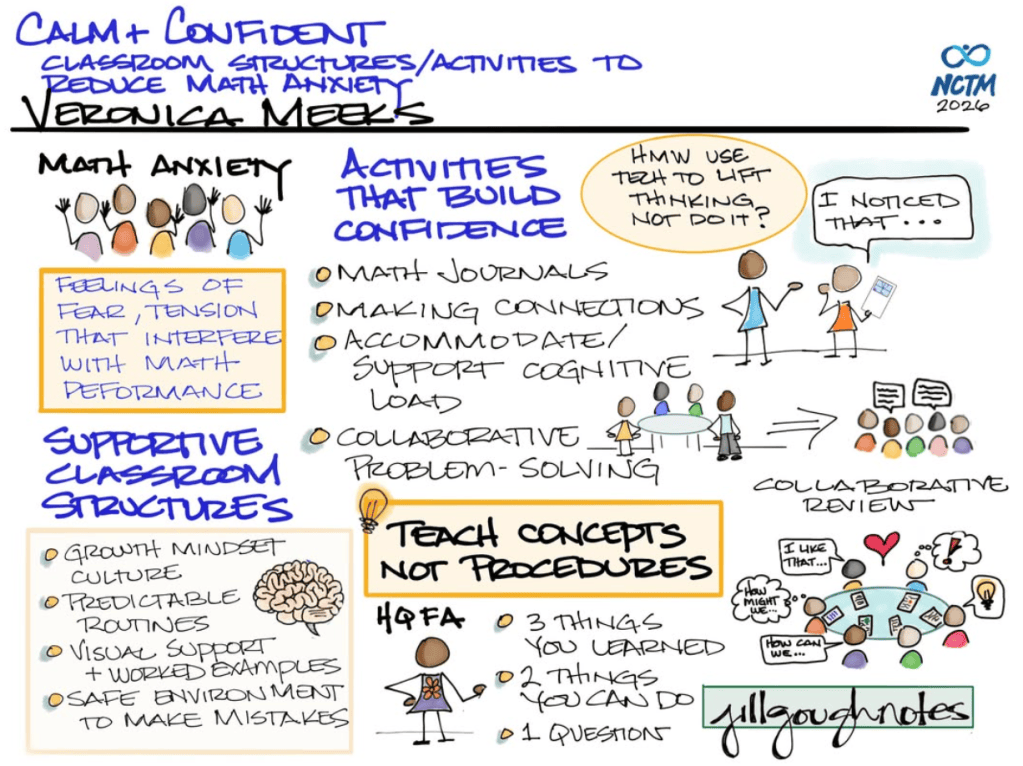
Veronica Meeks opened with Calm and Confident: Classroom Structures and Activities to Reduce Math Anxiety. She framed math anxiety as feelings of fear and tension that interfere with math performance. Interfere. That word matters. Anxiety is not a measure of what a student knows; it is something standing between the student and what they know.
So what do we do about it? Veronica offered two lenses.
Supportive classroom structures:
- A growth mindset culture
- Predictable routines
- Visual supports and worked examples
- A safe environment to make mistakes
Activities that build confidence:
- Math journals
- Making connections
- Accommodating and supporting cognitive load
- Collaborative problem-solving and collaborative review, where we hear “I like that…,” “How might we…,” and “How can we…”
Two ideas are still rattling around in my head. The first was her call to teach concepts rather than procedures. When students understand why, there is less to hold in memory and less to fear. The second was a question I wrote in a big thought bubble: How might we use tech to lift thinking, not do it?
She closed with a 3-2-1 reflection: 3 things you learned, 2 things you can do, 1 question. I am borrowing that for the end of this post.
Day 1: Language-Rich Mathematics Classroom
In the afternoon, I had the joy of facilitating Language-Rich Mathematics Classroom: Precision, Perseverance, and Sense-Making.
We started where I love to start: anticipate before you teach. We looked at 432 ÷ 36 and four different ways of thinking about it.
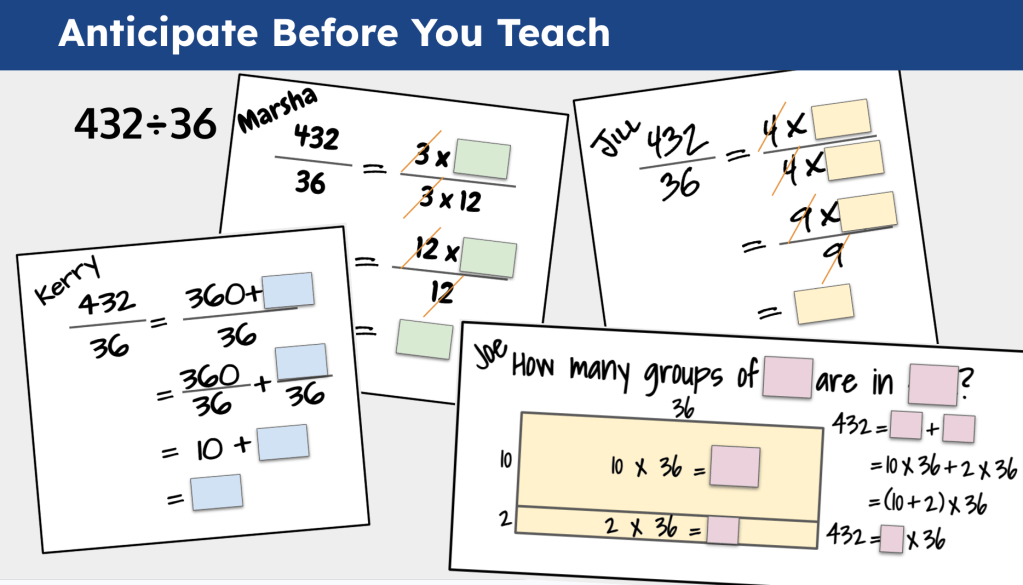
- Joe asked, “How many groups of 36 are in 432?” and broke it down into 10 groups and 2 groups: (10 + 2) × 36.
- Kerry decomposed the dividend: (360 + 72) ÷ 36 = 10 + 2.
- Marsha factored a factor: 3 × 144 over 3 × 12 becomes 144 ÷ 12.
- I factored differently: 4 × 10⁸ over 4 × 9, then 9 × 12 over 9.
All land on 12. All tell a different story about what each of us noticed.
Then we wrote. Writing makes thinking visible, and sentence frames give every learner a way in:
- I like her/his method. Who? What? Why?
- I want to learn more about this method. What? Why?
The strategy names (Round and Adjust, Double and Half, Factor a Factor, Decompose into 2 or More Addends) served as a word bank to help participants be precise.
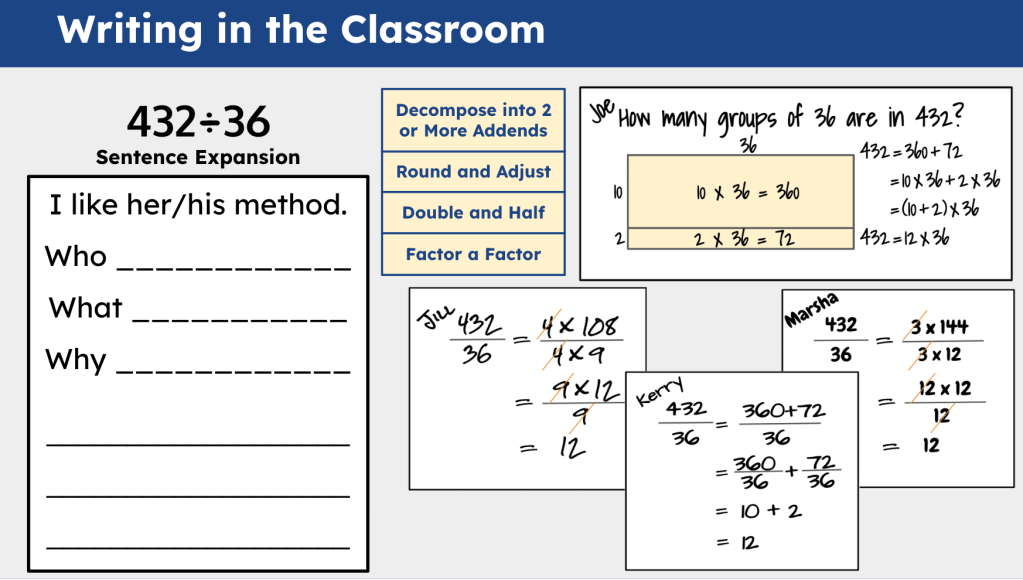
We also practiced sentence expansion using a “Which One Doesn’t Belong” activity. Starting from the kernel, it is not like the others; participants expanded on what and why, using a word bank of width, length, area, rectangle, units, square units, quadrilateral, and irregular. From there, we moved into an Open Middle task using note-making for consolidation.
Math language routines support sense-making, optimize output, and give students a reason to talk and write with precision. As I say often, the ones doing the talking are the ones learning. I am so grateful to everyone who came, talked, wrote, and pushed my thinking.
Day 1: Celebrating with CPAM
The evening ended at the CPAM dinner celebrating our newest Presidential Awardees from 2023 and 2024. (The 2025 awardees have not been announced yet, and we are eager to welcome them.) What a gift to sit at a table with teachers who have been recognized for their excellence and who are still, every single day, asking how to make math class better for kids. Congratulations, awardees. Welcome to the family.
Day 2: Math Trajectories for Young Learners
Day 2 started with a session by DeAnn Huinker, Melissa Hodges, and Beth Schefelker, Math Trajectories for Young Learners: Counting, Subitizing, Composing in Action.
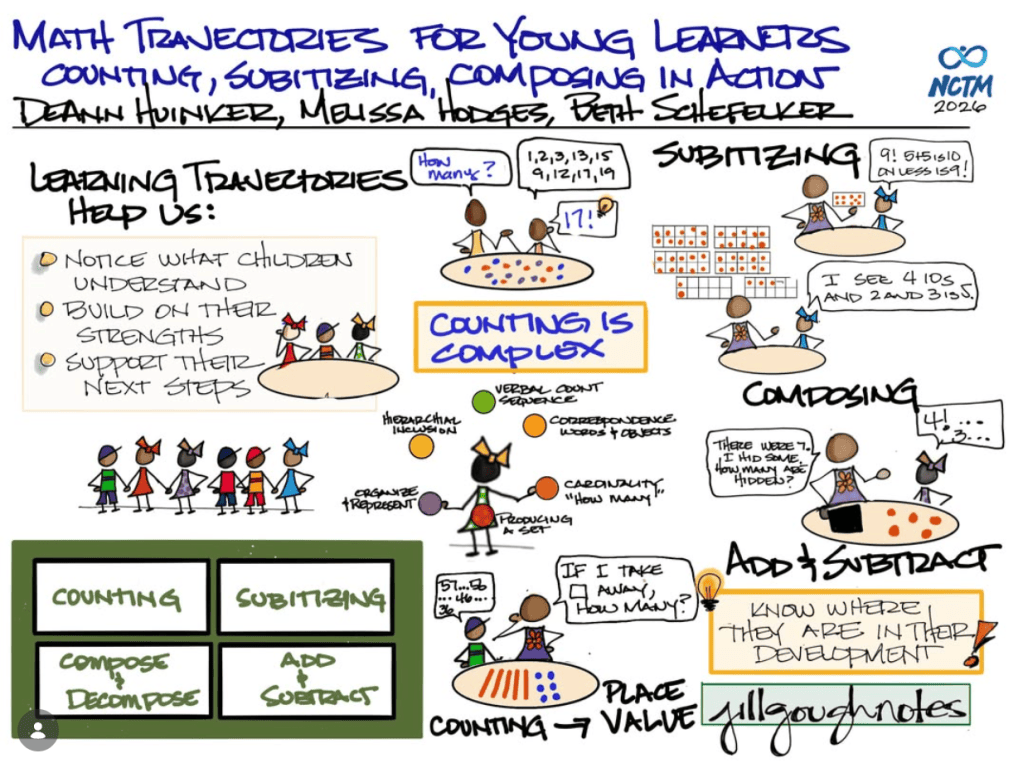
Learning trajectories help us:
- Notice what children understand
- Build on their strengths
- Support their next steps
The big headline for me: counting is complex. Think about everything a child must coordinate to answer “How many?”: the verbal count sequence, one-to-one correspondence between words and objects, cardinality, producing a set, organizing and representing, and hierarchical inclusion. When a child counts “1, 2, 3, 13, 15, 9, 12, 17, 19” and then confidently says “17!”, what do they know? What is next for them?
We watched children subitize (“9: 5 and 5 is 10, one less is 9.” and “I see 4 tens and 2 and 3 ones”), compose and decompose (“There were 7. I hid some. How many are hidden?”), and add and subtract (“If I take some away, how many?”). Each of these grows toward place value. Counting leads to place value.
The message I underlined twice: know where they are in their development.
Day 2: Research in the Exhibit Hall
I spent the rest of Day 2 doing research in the exhibits, talking with publishers and organizations and looking with our Trinity lens: How does this resource help teachers notice what students understand? Does it build on strengths? Does it ask students to talk, write, and make sense?
Connecting the Two Days
Looking back, I see a common thread. Veronica’s structures reduce anxiety by making the path predictable and safe. Learning trajectories make the path visible so we can meet children exactly where they are. Language routines give students the words to show us where they are. Calm, confidence, and sense-making all start with noticing.
My 3-2-1 Reflection
3 things I learned:
- Math anxiety interferes with performance; it is not a measure of understanding.
- Counting is far more complex than it looks, and trajectories help us see the essentials to learn.
- Predictable routines and visual supports lower the barrier to entry for every learner.
2 things I can do:
- Use the 3-2-1 reflection with our faculty after our Workshop next Wednesday.
- Share the counting trajectory with our early elementary teams as a lens for noticing.
1 question:
How might we use tech to lift thinking, not do it?
What would be on your 3-2-1?

